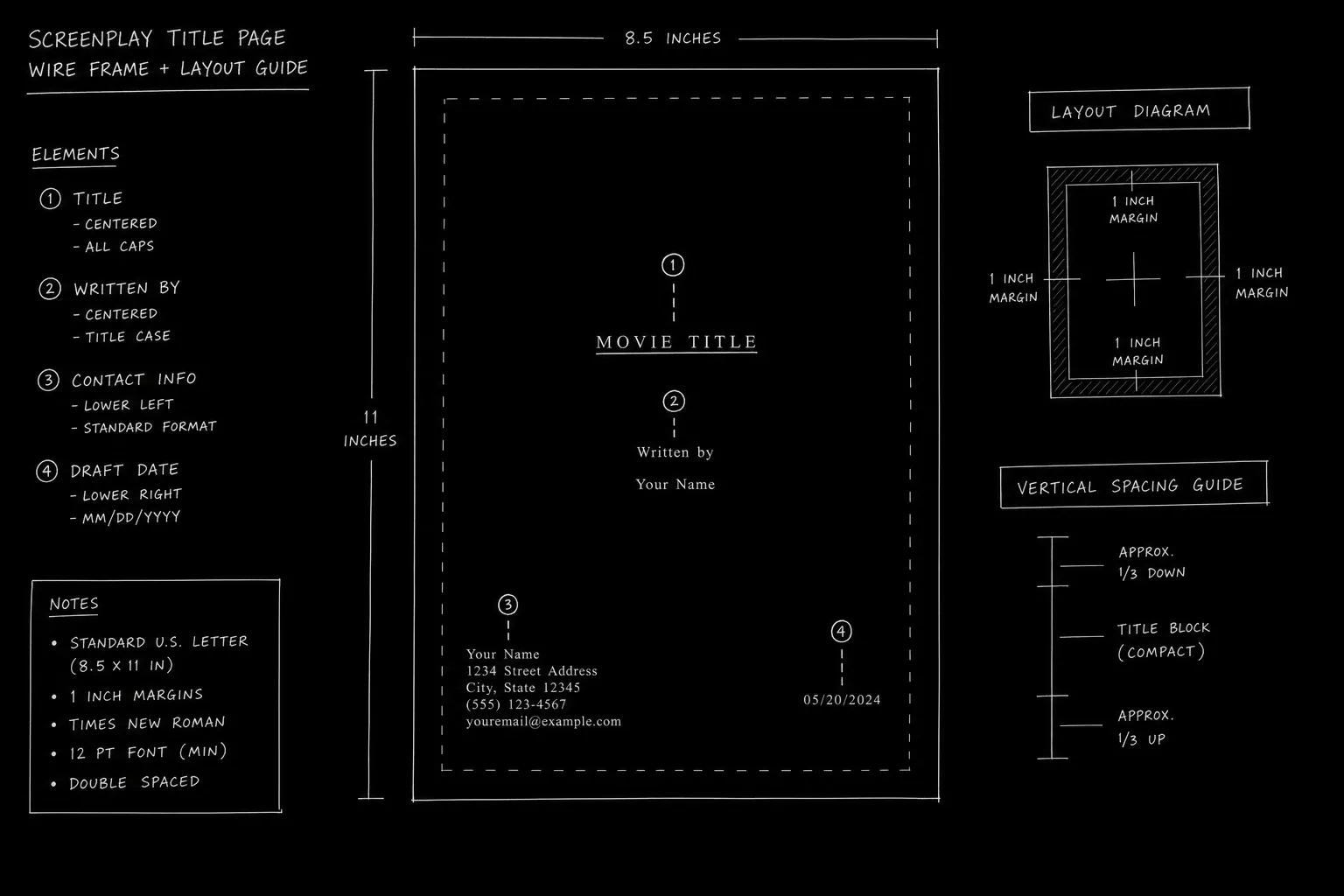

Short answer: most major screenplay fellowships and competitions, including the Nicholl Fellowship, Austin Film Festival, and the PAGE Awards, require an anonymous title page for at least the first reading round: title only, centered, with no writer name, no contact information, and no identifying details anywhere in the document. Rules and exact rounds vary by program and change year to year, so verify the current submission guidelines before you upload anything.
Why anonymity exists in the first place
Blind reading exists to keep early rounds judged on the pages, not on a name, a prior credit, or a recognizable representative. Programs that anonymize the first round are explicitly trying to prevent a known writer's script from getting a warmer read than an unknown writer's script of equal quality. That is the entire point, and it is why the rule gets enforced strictly rather than treated as a formatting suggestion.
Common ways writers accidentally break anonymity
A beautiful, perfectly formatted title page can still disqualify an entry if identity leaks somewhere else in the document.
PDF file properties. Word processors and screenwriting software often embed the author's name in a document's metadata by default, visible in file properties even when the visible title page is clean. Check and clear this before exporting.
Headers or footers with your name. Standard practice puts the writer's name in a running header on every page. For an anonymous submission, that header needs to come out entirely, not just off the title page.
Self-identifying dedication or "based on" lines. A script "based on a true story from my time working at..." or a dedication naming a real person connected to the writer can identify the author to a reader who recognizes the reference, even without a name printed anywhere.
Contact information buried in the script body. Some writers leave contact details on a final page or in a footer meant for a different draft. Anonymity applies to the entire document, not just page one.
Build a clean anonymous export
Do not edit your standard title page under deadline pressure and hope you caught everything. Use the free screenplay title page maker to generate a dedicated anonymous export with only the title field filled in, separate from your standard and represented versions. The opposite case, a named copy going to a producer, is where a watermark tool for screenplays earns its keep by tagging each PDF with its recipient.
Free tool: the screenplay title page maker builds a clean anonymous title page in seconds, no signup. For every other title page layout, standard, represented, adaptation, and more, see Screenplay Title Page Examples.
Try it free
Try Screenweaver for free on your script
It is free. Import your existing project, get a clearer view of your outline, and regain control of your story structure in minutes.
Start FreeFAQ
Does the Nicholl Fellowship require an anonymous title page?
Yes, entries are read anonymously for the earlier rounds of judging, which is why the Academy's submission guidelines specify a title-only cover page with no writer-identifying information. Always confirm the current year's exact requirements on the official Nicholl page before submitting, since procedures can be updated.
What happens if I forget to remove my name from a contest submission?
Policies vary by program, but many fellowships and competitions treat a de-anonymized entry as disqualified rather than simply penalized, since the entire judging structure depends on blind reading. Some programs allow a corrected resubmission before a deadline; many do not.
Can I include my name in a header or footer if it's not on the title page?
No. Anonymity requirements apply to the entire document, not just the cover page. A name in a running header defeats the purpose of the blind read just as much as a name on page one.
Do all screenwriting contests require anonymous submissions?
No. Many smaller contests and most agency or producer submissions expect a standard title page with full contact information. Anonymity requirements are specific to programs built around blind judging, check each program's current rules rather than assuming one standard applies everywhere.
Final Step
Build your next script with Screenweaver
Move from ideas to production-ready pages faster with timeline-native writing and AI-assisted story flow.
Try Screenweaver