
Most job interview scenes in scripts are dead weight.
They look useful. They sound realistic. They often feel like narrative paperwork.
A character enters a room, answers predictable questions, leaves, and the plot continues. Nothing breaks, nothing shifts, nothing gets exposed that could not have been shown somewhere else.
That is the core problem.
A great interview scene is not about employment logistics. It is a pressure chamber for identity. Under formal politeness, people leak hierarchy instincts, insecurity, ego, shame, ambition, class performance, moral compromise, and strategic intelligence.
Here is why that matters: interviews are one of the few socially acceptable arenas where people are asked to perform a curated version of themselves while being actively evaluated. That contradiction is cinematic by default.
If you write only the literal conversation, it feels procedural.
If you write the subtext battle, it reveals character fast.
Why Interview Scenes Become Cliche
Weak interview scenes usually fail because they are written as Q&A transcripts.
Interviewer asks: "Tell me about yourself."
Candidate answers in polished paragraph.
Interviewer asks: "Where do you see yourself in five years?"
Candidate delivers another polished paragraph.
This may resemble a real interview template, but it does not create drama unless each answer changes relational leverage.
Another common failure is using interview scenes only for backstory delivery. Characters summarize resume details and past events the audience already knows. Scene becomes exposition packaging.
Think about it this way: if you can replace the entire scene with a one-line update ("she interviews for the job") and lose nothing emotionally, the scene has no dramatic payload.
Interview scenes work when they test values under power imbalance, not when they recap biography.
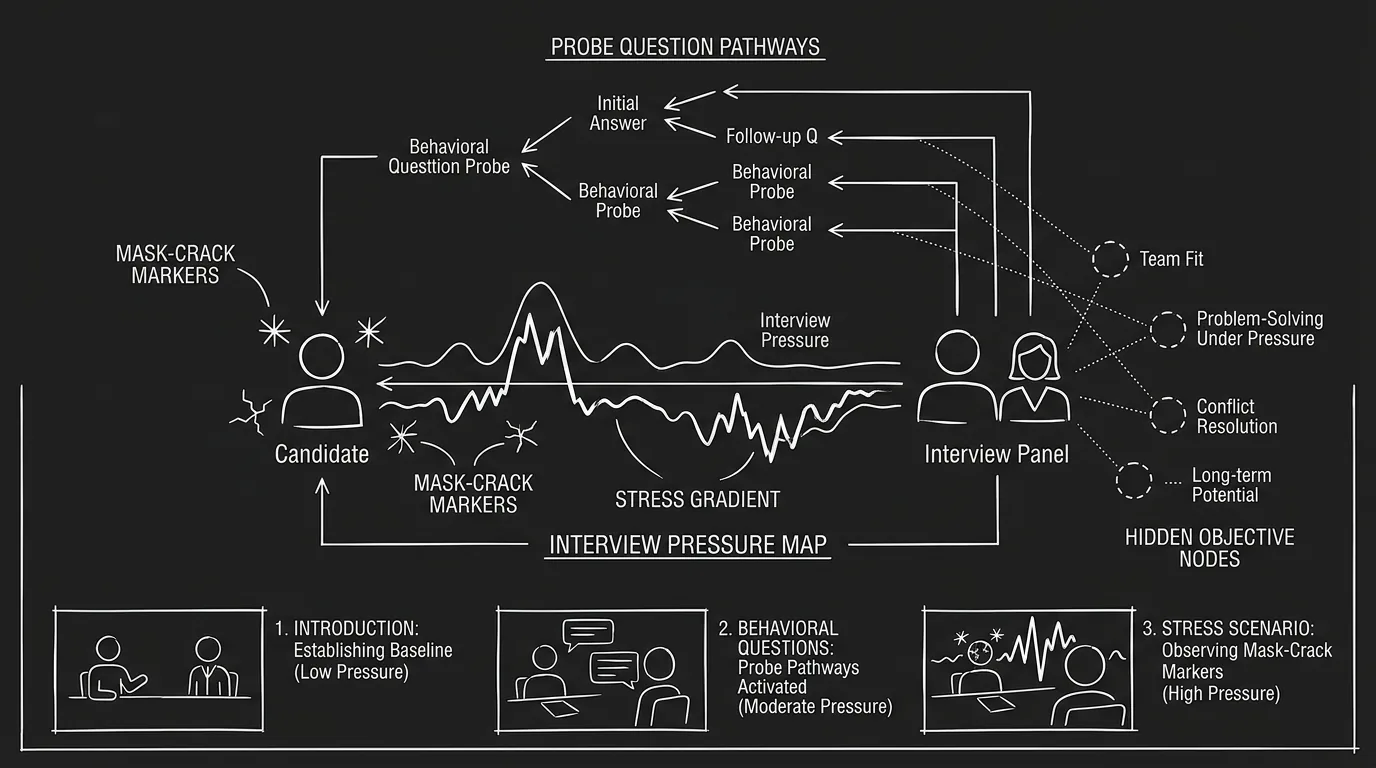
The Core Model: Objective, Mask, Probe, Crack, Choice
Strong interview scenes follow a psychological progression.
Objective: what does each side actually want, beyond surface employment goal?
Mask: what persona is each side performing?
Probe: what question or behavior tests the mask?
Crack: where does the performed persona fail, shift, or reveal contradiction?
Choice: what decision is made in response to that crack?
If your scene has no crack and no choice, it is usually informational, not dramatic.
Scenario One: The Beginner's "Perfect Candidate" Trap
A common beginner pattern is writing the protagonist as flawlessly competent in interview mode. Every answer is sharp. Every challenge is handled elegantly. Interviewers are impressed. Done.
This can make a protagonist look capable, but it rarely reveals depth.
A stronger version gives the protagonist one pressure vulnerability. Maybe they are excellent at strategy but bristle at hierarchy. Maybe they are brilliant technically and terrible at self-marketing. Maybe they are trying to hide a recent failure and overcompensate with arrogance.
Now answers become decisions, not speeches.
Character emerges through trade-offs.
Scenario Two: The "Evil Interviewer" Cliche
Another frequent issue is caricatured interviewers who exist only to be rude, elitist, or cruel. This can work in satire, but in drama/thriller it often flattens conflict.
More interesting: give interviewers conflicting incentives.
One interviewer wants risk and innovation.
One wants predictability and compliance.
One has political reasons to block this candidate.
Now the candidate is not facing one antagonist. They are navigating a fractured institution.
That is far richer than generic hostility.
Scenario Three: The Interview That Secretly Auditions Morality
Great interview scenes often reveal not "can this person do the job?" but "what will this person compromise to get this job?"
You can design this through ethically loaded hypotheticals, confidentiality tests, references to prior controversial decisions, or subtle pressure to denounce someone.
When candidate responds, they are not just answering a question. They are declaring a moral operating system.
That declaration can reshape plot.
Step-by-Step Workflow to Build an Interview Scene with Real Character Revelation
Step 1: Define Hidden Objective for Both Sides
Write one hidden objective per key participant.
Candidate objective might be income stability, status recovery, visa survival, revenge proximity, or access to internal secrets.
Interviewer objective might be finding compliant talent, protecting team culture, preventing political threat, testing loyalty.
Hidden objectives create subtext friction.
Step 2: Choose the Candidate's Performance Mask
What version of self is candidate presenting?
Disciplined professional?
Charismatic disruptor?
Humble learner?
Hyper-competent closer?
Then define where mask is weakest. That weak point is where scene gets alive.
Step 3: Design Probe Questions That Force Value Exposure
Avoid generic HR prompts as primary beats.
Use probes that force prioritization:
deadline vs ethics,
team loyalty vs truth,
profit vs safety,
speed vs quality,
authority vs autonomy.
Answers reveal value hierarchy, which is character.
Step 4: Add Environmental Power Signals
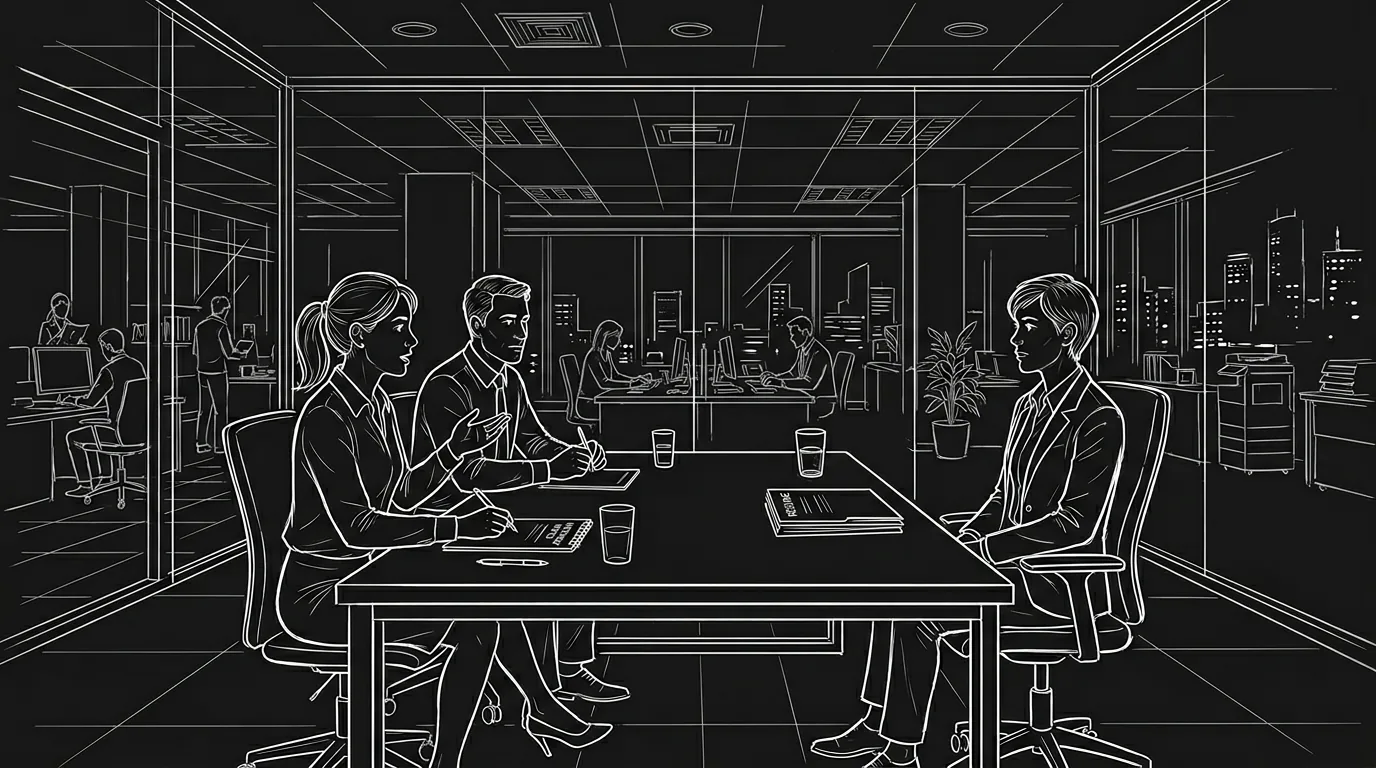
Interview rooms communicate status through layout.
Seating asymmetry.
Clock placement.
Window glare.
Nameplate hierarchy.
Who controls water, files, and pause timing.
Use two or three of these details to reinforce pressure.
Step 5: Write Tactical Interruptions
Real interviews are rarely clean.
Phone buzz from executive.
Unexpected panel member joins.
Reference check contradiction arrives live.
Candidate portfolio file missing.
These interruptions test adaptability and expose core traits under stress.
Step 6: Force a Crack Beat
At some point, performance mask should strain.
Candidate avoids eye contact after one question.
Interviewer loses neutrality at mention of prior company.
Silence extends too long.
A joke lands wrong and reveals contempt.
This crack is the scene's hinge.
Step 7: End with Decision, Not Polite Closure
Do not end on "we will be in touch."
End on consequential decision:
candidate withdraws,
interviewer fast-tracks or sabotages,
conditional offer with ethical cost,
candidate lies to secure next round,
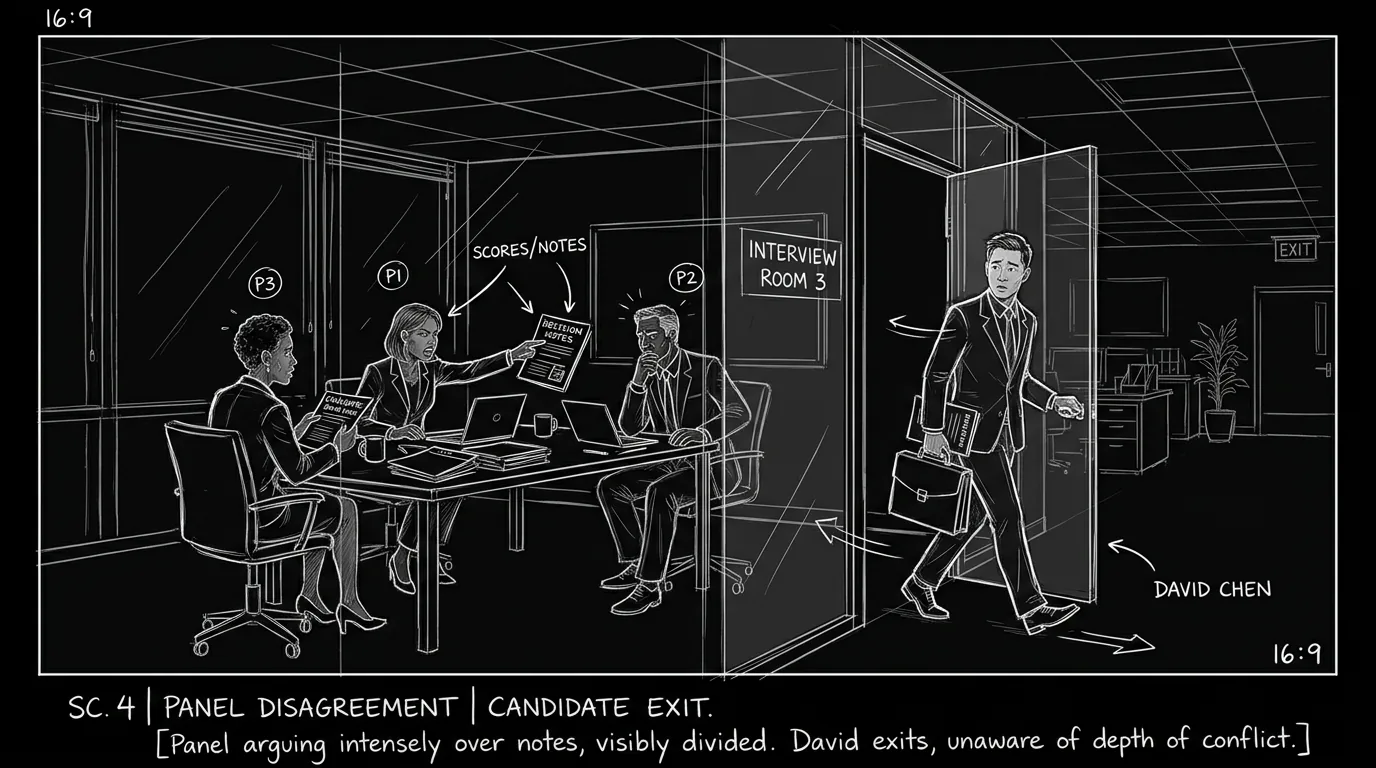
panel splits publicly.
An interview scene should launch narrative movement.
Table: Flat Interview Scene vs Character-Revealing Interview Scene
| Dimension | Flat Version | Character-Revealing Version |
|---|---|---|
| Question design | Generic HR prompts | Value-conflict probes |
| Candidate behavior | Polished consistency | Strategic mask with crack |
| Interviewer role | One-note gatekeeper | Conflicting institutional agendas |
| Stakes | "Get job or not" | Identity, ethics, access, power |
| Rhythm | Linear Q&A | Probe, interruption, recalibration |
| Ending | Neutral politeness | Consequential decision shift |
The Trench Warfare Section: What Beginners Get Wrong (and How to Fix It)
This section is blunt because these errors are common and fixable.
Error one: writing interview as exposition container.
You use questions to dump backstory. Fix by moving resume facts elsewhere and keeping interview answers focused on values under pressure.
Error two: no asymmetry of power.
Everyone speaks as equals. Fix by scripting structural imbalance through who asks, who waits, who interrupts, who summarizes.
Error three: candidate too competent, too clean.
No vulnerability, no contradiction. Fix by giving candidate one pressure fault line that appears under specific probe.
Error four: interviewer as cartoon villain.
Rudeness replaces complexity. Fix with mixed motives and institutional constraints.
Error five: no real stakes beyond employment.
Scene feels small. Fix by tying interview outcome to housing, legal status, family care, mission access, or moral compromise.
Error six: generic dialogue voice.
Every character sounds corporate. Fix by preserving idiolect under formal setting.
Error seven: no subtext.
Characters say exactly what they mean. Fix by writing divergence between literal answer and strategic intent.
Error eight: no interruptions.
Scene runs too smoothly. Fix with one or two plausible disruptions that test control.
Error nine: no environmental writing.
Room is blank abstraction. Fix with selective status cues in space and objects.
Error ten: question-answer length monotony.
Every exchange same size. Fix with rhythm variation: clipped answers, long defense, strategic silence.
Error eleven: no crack beat.
Mask never slips. Fix by designing specific trigger question where composure strains.
Error twelve: crack has no consequence.
Slip happens, ignored. Fix by making crack alter panel behavior or candidate strategy immediately.
Error thirteen: interview ignores genre.
Thriller, comedy, drama all written same. Fix by aligning probes and stakes with genre engine.
Error fourteen: no institutional politics.
Scene treated as isolated event. Fix by hinting at hiring power struggles and internal alliances.
Error fifteen: ending with dead line.
"Thank you for your time" and cut. Fix by ending on a decision, offer, refusal, or strategic lie.
Error sixteen: overuse of jargon.
Corporate buzzwords drown character. Fix with plain language plus a few domain-specific terms only when meaningful.
Error seventeen: candidate confesses too much too soon.
Radical honesty can feel implausible unless motivated. Fix with controlled disclosure tied to tactical objective.
Error eighteen: no listener strategy.
Interviewers only prompt. Fix by giving each interviewer an evolving tactic.
Error nineteen: no post-interview residue.
Scene ends, characters reset. Fix by showing immediate behavioral aftershock.
Error twenty: no thematic connection.
Interview does not echo story's core question. Fix by embedding thematic conflict in at least one probe.
The best interview scenes do not answer "who gets hired?" first. They answer "who is this person when approval and self-respect collide?"
Try it free
Try Screenweaver for free on your script
It is free. Import your existing project, get a clearer view of your outline, and regain control of your story structure in minutes.
Start FreeBody Image: Interview Pressure Map
Practical 50-Minute Rewrite Drill
Take your existing interview scene and run this process.
First ten minutes: mark lines that only provide background facts and cut them.
Next ten minutes: rewrite three interviewer questions so each forces value prioritization.
Next ten minutes: insert one interruption that changes conversational control.
Next ten minutes: add one crack beat and immediate tactical adjustment.
Final ten minutes: rewrite ending so someone makes a consequential choice on-page.
This drill usually converts interview scenes from static realism to dynamic character revelation.
Advanced Calibration: Class Performance and Social Code Switching
Interview scenes are often secretly about class and code.
Characters manage accent, vocabulary, posture, clothing signals, and confidence display to fit perceived institutional norms. Writing this carefully can add huge nuance without heavy exposition.
A candidate may switch diction depending on which panelist speaks. An interviewer may reward familiarity cues and penalize perceived cultural mismatch while claiming objectivity. A protagonist may over-formalize language to avoid stereotype risk, then lose spontaneity.
These dynamics are dramatically rich when handled with precision and respect.
For external script-study reference, the Writers Guild Foundation Library is useful and should be treated as nofollow in publication setup.
As discussed in our guide on [how to write a public humiliation scene in a screenplay], social visibility pressure can transform routine exchanges into status battles.
If your interview reveals hidden guilt or misconduct, our framework in [how to write a confession scene in a thriller] helps structure disclosure timing and verification.
And when interview conflict escalates into strategic confrontation, the approach in [how to write a final confrontation scene that feels earned] helps carry scene momentum into endgame stakes.
Body Image: Post-Interview Consequence Beat
YouTube Placeholder
[YOUTUBE VIDEO: A scene-doctor workshop rewriting a generic interview scene into a high-tension character reveal with hidden objectives, probe design, and a consequential ending.]
Extra Deep Dive: Writing Interview Answers as Tactical Moves
One of the most useful upgrades you can make is to stop thinking of answers as content and start thinking of answers as maneuvers.
In weak scenes, answers are informational:
"I led a team of six."
"I handled a difficult client."
"I am passionate about growth."
These lines may be realistic, but they rarely reveal strategy.
In stronger scenes, each answer attempts to move power.
A candidate can answer narrowly to avoid opening a vulnerability.
They can answer with a story that reframes a known weakness as judgment under pressure.
They can answer with a counter-question that tests interviewer assumptions.
They can intentionally over-answer to consume time and avoid a dangerous follow-up.
They can under-answer to force interviewer to show their true evaluative criteria.
This does not mean every answer should be manipulative. It means every answer should be purposeful.
Another high-value technique is answer layering.
Layer one: literal response.
Layer two: social signal (confidence, deference, challenge, alignment).
Layer three: strategic disclosure (what is revealed, withheld, or reframed).
When all three layers are active, interview dialogue feels alive.
Example pattern:
Interviewer asks about a failed launch.
Literal response gives timeline.
Social signal accepts responsibility without self-erasure.
Strategic disclosure reveals candidate protected junior staff despite executive pressure.
Now one answer reveals competence, ethics, and leadership style simultaneously.
That is efficient character writing.
You can also sharpen scenes with deliberate non-answers.
A non-answer is not evasion for its own sake. It is a reveal of boundary.
When a candidate says, "I can discuss process, but not client-identifying detail," that line can communicate professionalism, legal awareness, and stress tolerance in one beat. If interviewer pushes, you get escalation without melodrama.
Silence is another tactical answer.
A two-second pause before replying to a values question can feel like honesty, calculation, fear, or contempt depending on context and body language. Write those pauses with intent. Not every pause needs annotation, but key pauses should change interpretation.
Finally, calibrate answer strategy by character arc stage.
Early in story, protagonist may overperform and hide uncertainty.
Mid-story, pressure may force defensive overtalking or brittle honesty.
Late-story, they may answer with integrated clarity that costs them the role but preserves identity.
When answer strategy evolves across scenes, interviews become arc instruments, not isolated events.
Scenario Layering in Practice
Imagine a candidate interviewing for a crisis-communications role after being scapegoated in their previous company.
Beginner version: they explain what happened and ask for a second chance.
Advanced version: they decline to vilify former colleagues, disclose one verifiable mistake they own, and refuse to accept a framing that requires blaming a junior employee. The panel realizes they are either high-integrity or politically unmanageable depending on viewpoint.
That ambiguity is dramatic fuel.
Now the hiring decision exposes the organization's character too.
Ending Perspective: Interviews Are Character Cross-Examinations
If your interview scene feels cliche, do not start by polishing dialogue.
Start by sharpening the test.
What is being evaluated beyond skill?
What value conflict is embedded in the questions?
Where does the candidate's mask fail?
Who exploits that failure?
What choice closes the scene?
Write those with precision, and interview scenes stop feeling like administrative pauses.
They become mini-trials of identity under institutional power.
That is where character is exposed.
That is where story moves.
And that is why a well-written interview scene can do in two pages what ten pages of backstory cannot: show exactly who someone is when acceptance has a price.
Final Step
Build your next script with Screenweaver
Move from ideas to production-ready pages faster with timeline-native writing and AI-assisted story flow.
Try Screenweaver