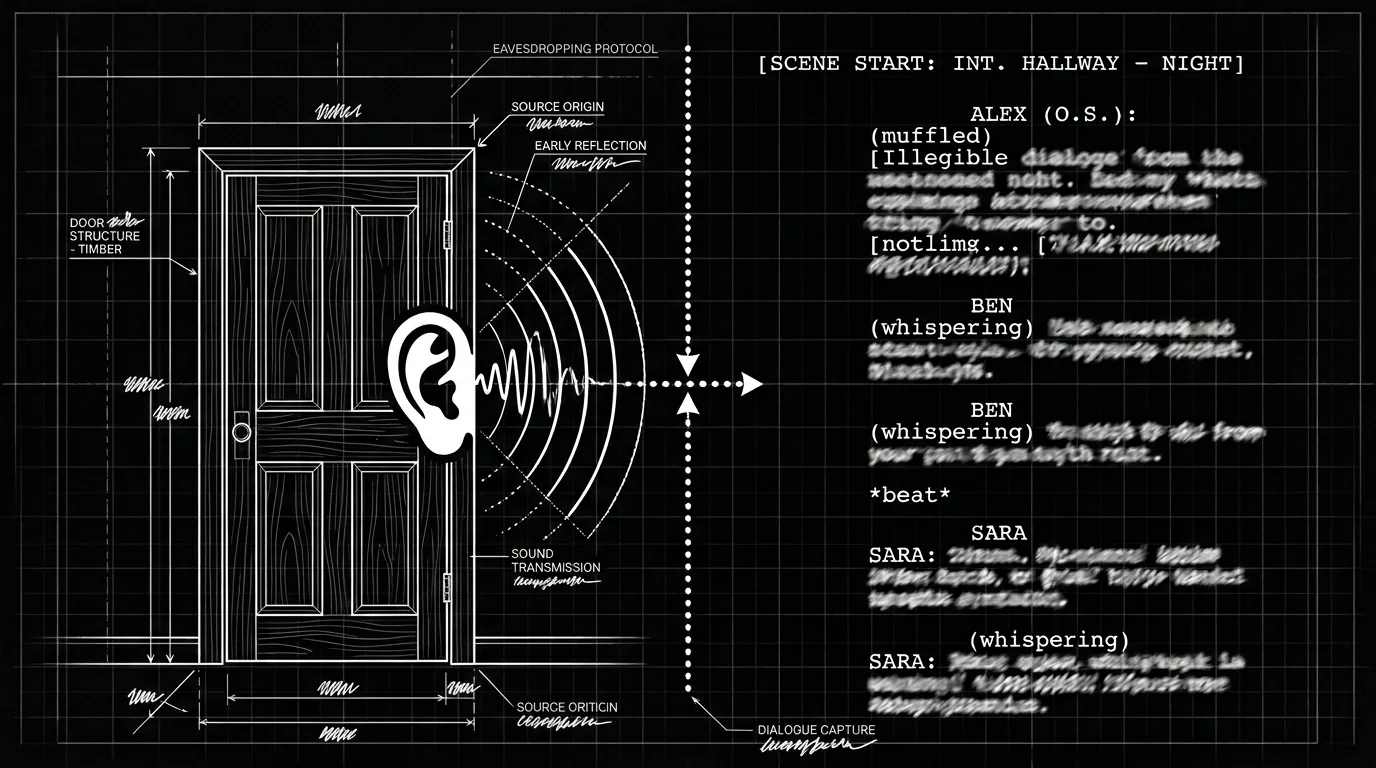

Sarah presses her ear to the door. Through the wood, she hears her parents arguing, her name, again and again. She can't make out every word, but what she hears changes everything.
The eavesdropping scene is a staple: a character overhears something they shouldn't, gaining information that shifts the story. But formatting this scene raises questions traditional action-dialogue structure doesn't easily answer. How do you show two spaces at once, the listener and the speakers? How do you convey partial hearing, muffled sound, selective comprehension? How do you create tension from the act of listening?
This is a technical challenge as much as a craft one. Done well, the eavesdropping scene delivers powerful dramatic irony: the audience knows what the character just learned, and they know the speakers don't know they were heard.
Free tool: use the Slugline Formatter to clean up and standardize your scene headings.
Cinematic workflow frames
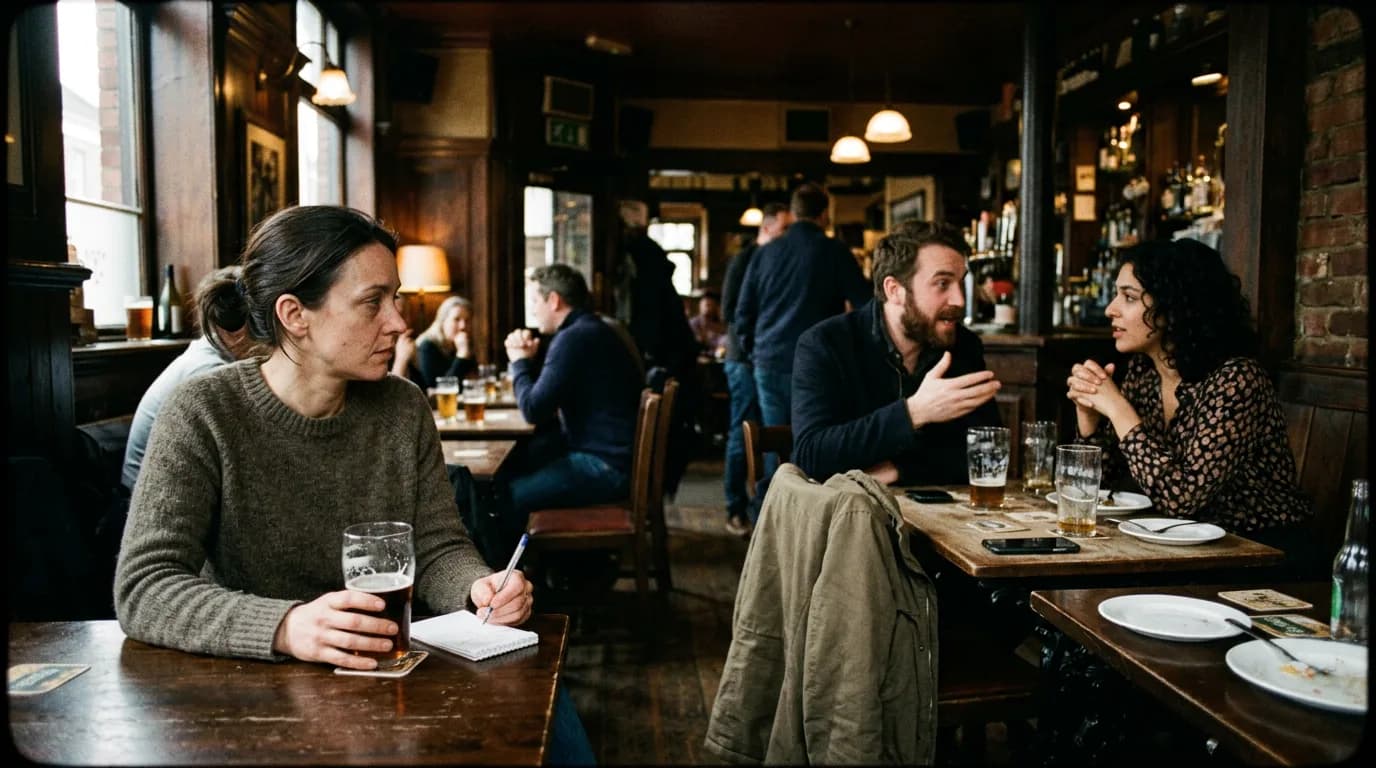
These two visuals work as a pair: the first shows Cinematic workflow still, first angle, 35mm film grain, and the second shifts to Cinematic workflow still, second angle, 35mm film grain - compare them briefly, then move on.
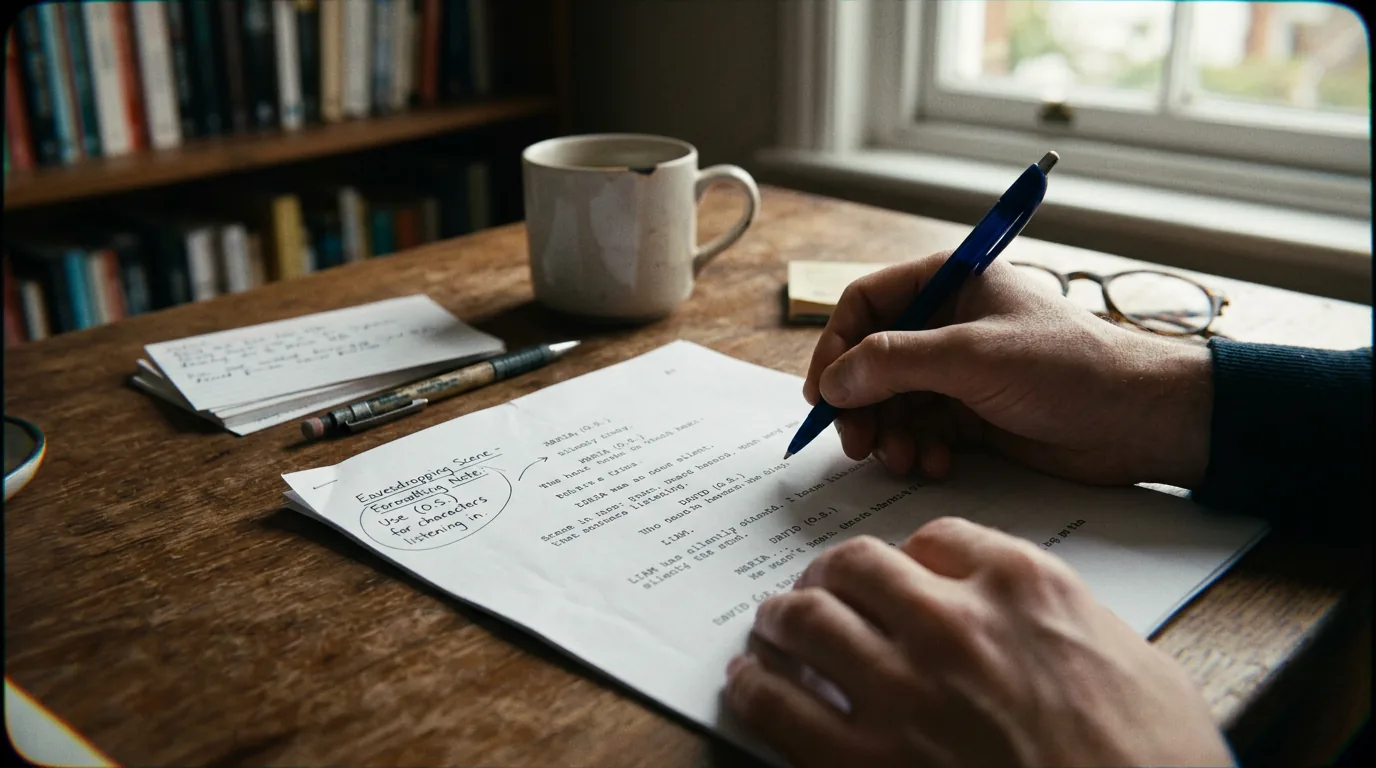
The Core Tension: Two Scenes in One
An eavesdropping scene is really two simultaneous scenes:
Scene A: The conversation being overheard. This has its own dynamics, its own character objectives.
Scene B: The listener. Their reactions, their risks of being discovered, what they choose to do with what they hear.
Your formatting must convey both without confusing the reader. The challenge is clarity: we need to know who's speaking, who's hearing, and where everyone is spatially.
Formatting Option 1: Single Location with Distance
The simplest approach: everyone is technically in one location, but the listener is separated by distance or obstruction.
Example:
INT. LIVING ROOM – NIGHT
Sarah crouches behind the couch, hidden from view.
Across the room, her parents, ELLEN and MARK, stand by the window, voices low but audible.
ELLEN We can't keep protecting her.
MARK She's our daughter.
ELLEN She's not a child anymore. She needs to know the truth.
Sarah's breath catches. She presses herself against the couch.
Here, the single scene heading works because everyone is in the same room. Sarah's action (crouching, pressing) is interleaved with the dialogue she hears.
Formatting Option 2: Separate Locations with INTERCUT
When the listener is in a different space (behind a door, in an adjacent room, on a phone tap), use INTERCUT to move between locations.
Example:
INT. HALLWAY – NIGHT
Sarah stands at the closed door, ear pressed to the wood.
INT. BEDROOM – CONTINUOUS
Ellen and Mark stand beside the bed. Their voices are urgent.
ELLEN She's never going to forgive us.
INTERCUT: HALLWAY/BEDROOM
Sarah listens, face unreadable.
MARK That's a risk we have to take.
In the hallway, Sarah's hand finds the doorknob. She hesitates.
ELLEN I won't be the one to tell her.
The INTERCUT header allows you to move fluidly between spaces. The reader understands we're cutting between Sarah listening and the conversation happening behind the door.
A Table: Formatting Options Comparison
| Scenario | Formatting | When to Use |
|---|---|---|
| Same room, distance | Single scene, action interleaving | Listener is in the same physical space |
| Different rooms, door/wall | INTERCUT or separate scenes | Listener is physically separated |
| Phone tap / bug | V.O. from speakers, listener's location primary | Audio-only eavesdropping |
| Flashback eavesdropping | Listener in present, speakers in past | Remembering what was heard |
Conveying Partial Hearing
Real eavesdropping is imperfect. Words are muffled. Sentences are incomplete. This can be dramatically powerful: the listener hears just enough to misunderstand, or just enough to learn the worst.
Technique: Ellipses and fragments.
ELLEN (O.S.) ...can't let her... dangerous...
Sarah strains to hear.
MARK (O.S.) ...what choice do we...
ELLEN (O.S.) ...the accident wasn't...
Sarah freezes. The accident?
The ellipses indicate incomplete hearing. O.S. (off-screen) reinforces that Sarah can't see the speakers.
Technique: Action description clarifying audibility.
Through the door, VOICES. Muffled. Ellen's tone is angry, Sarah recognizes the cadence. But the words are lost.
Then, clear:
ELLEN (O.S.) She's not our real daughter!
The door might as well be paper. Sarah hears every syllable.
Here, you describe what Sarah can and can't hear, then mark the moment when clarity arrives.
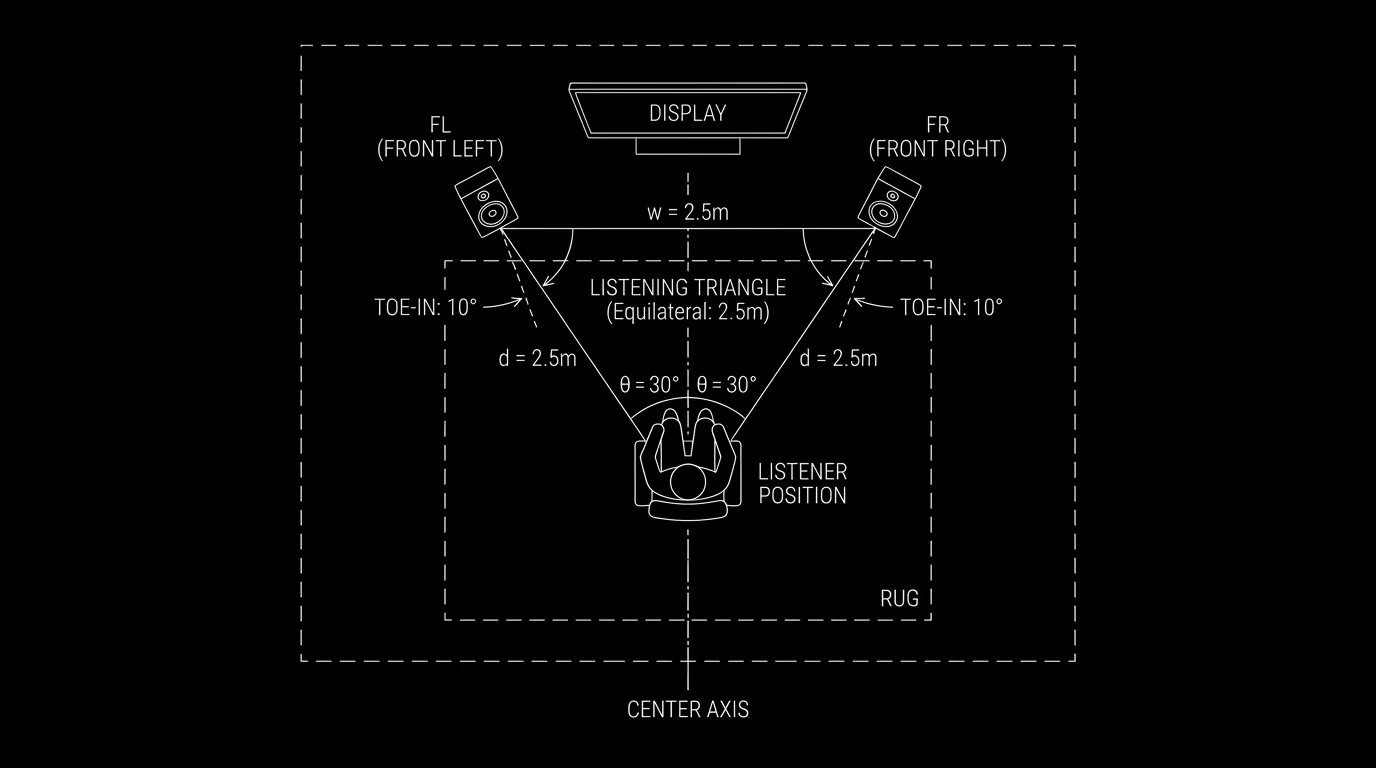
Listener Reactions: The Heart of the Scene
The power of the eavesdropping scene lies not in what's said, but in how the listener reacts. Their face, their body, their choices.
Weave reactions into dialogue:
MARK (O.S.) The money's gone. All of it.
Sarah's knees go weak. She grabs the doorframe.
ELLEN (O.S.) When were you going to tell me?
MARK (O.S.) I was hoping I wouldn't have to.
Sarah looks at her hands, they're shaking.
Each dialogue exchange is followed by the listener's physical response. This keeps the scene dynamic and centered on the emotional impact.
Try it free
Try Screenweaver for free on your script
It is free. Import your existing project, get a clearer view of your outline, and regain control of your story structure in minutes.
Start FreeRisk of Discovery: Adding Tension
The best eavesdropping scenes include the risk of getting caught. The listener might make a sound. Someone might approach. The speakers might suddenly open the door.
Build in close calls:
ELLEN (O.S.) Did you hear something?
Sarah stops breathing.
MARK (O.S.) It's nothing. The house settling.
Sarah exhales silently. She presses closer to the door.
The moment of danger heightens stakes. Even if the listener isn't caught, the possibility keeps readers tense.
The "Trench Warfare" Section: What Goes Wrong
Failure Mode #1: Confusion About Location
The reader can't tell where the listener is versus where the speakers are. Who's hearing what? Spatial confusion kills tension.
How to Fix It: Use clear scene headings and action description. "Sarah is in the hallway. Her parents are in the bedroom, behind the closed door."
Failure Mode #2: The Listener Is Passive
Sarah eavesdrops, but she has no reactions. She's a recording device, not a character.
How to Fix It: Interleave reactions. What does she feel? What does she do? Her emotional journey is the scene.
Failure Mode #3: Too Much Dialogue
The conversation being overheard runs for two pages. The listener fades from focus.
How to Fix It: Keep cutting back to the listener. Every few lines of dialogue, show their reaction. The scene is about them as much as the speakers.
Failure Mode #4: Perfect Hearing
The listener hears every word perfectly, through a thick door, at the right moment. Too convenient.
How to Fix It: Add realistic limitations. Muffled words, strain, movement closer. Let them miss some things.
Failure Mode #5: No Payoff
The listener hears damning information, and then nothing happens. The scene has no consequences.
How to Fix It: The eavesdropping should change something. The listener's behavior shifts. A confrontation follows. The plot advances because of what was heard.
Phone Taps and Bugs: Audio-Only Eavesdropping
When the listener is eavesdropping via technology (wiretap, baby monitor, bug), the formatting adjusts:
Example:
INT. SURVEILLANCE VAN – NIGHT
Detective HAYES sits with headphones, recorder running.
Through static, VOICES emerge:
CRIMINAL #1 (V.O.) The shipment lands at midnight.
CRIMINAL #2 (V.O.) And the cops?
CRIMINAL #1 (V.O.) Taken care of.
Hayes writes quickly, face grim.
V.O. (voice-over) indicates the speakers are heard but not seen. The primary location is Hayes's van; the voices are filtered through technology.
Flashback Eavesdropping: Memory of What Was Heard
Sometimes a character remembers overhearing something in the past. The scene structure shifts:
Example:
INT. THERAPIST'S OFFICE – DAY
Sarah sits across from DR. WELLS.
DR. WELLS When did you first suspect?
SARAH I was twelve.
FLASHBACK – INT. HALLWAY – NIGHT (TWELVE YEARS EARLIER)
Young SARAH (12) crouches by her parents' door.
ELLEN (O.S.) She can never know the truth.
Young Sarah's face: confusion, fear.
BACK TO PRESENT
Adult Sarah's face mirrors the same fear.
The flashback structure allows you to present the eavesdropping scene while maintaining a present-day frame.
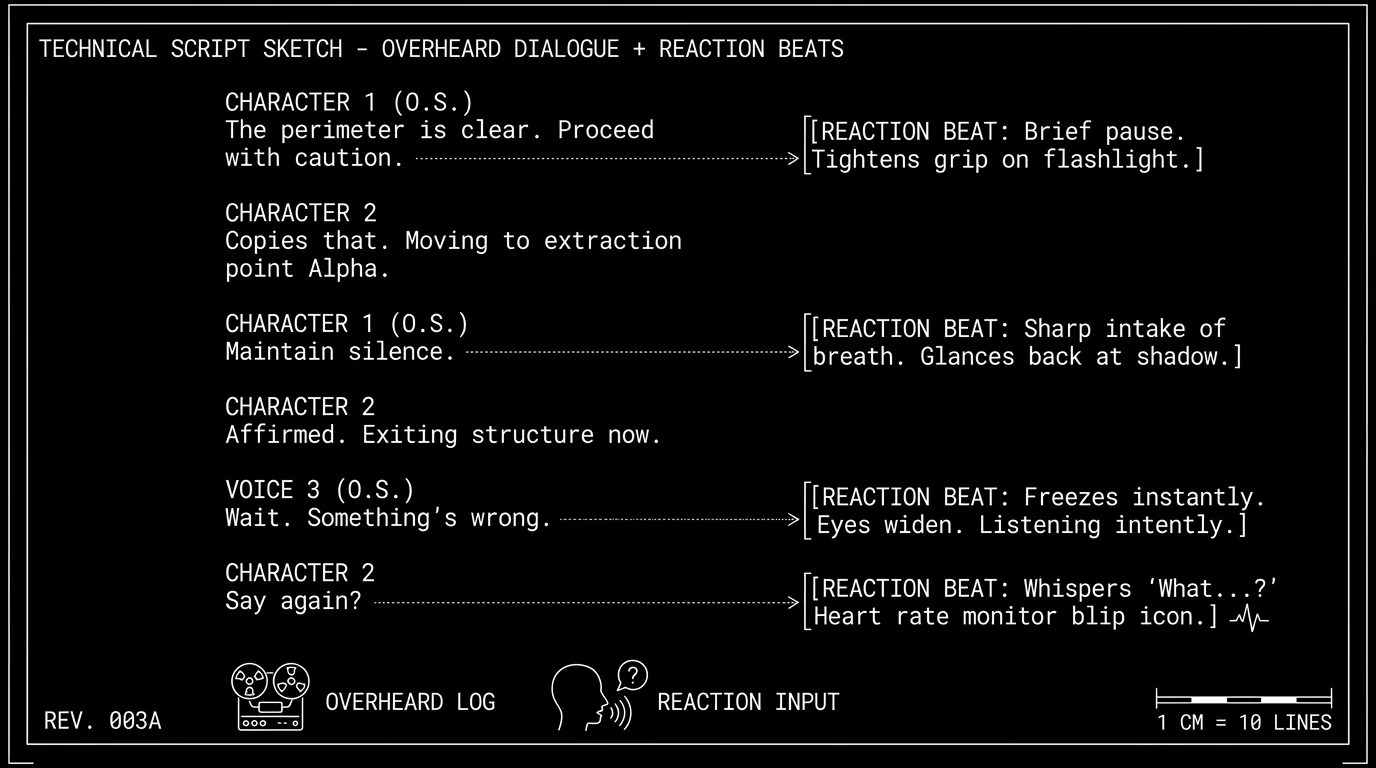
Dramatic Irony: What the Audience Knows
Eavesdropping creates dramatic irony: the audience (and the listener) know something the speakers don't, that they've been heard.
This irony can fuel subsequent scenes:
- The listener confronts the speakers, revealing they know.
- The listener pretends they don't know, and the audience watches them act.
- The listener uses the information against the speakers.
When writing the eavesdropping scene, consider its ripple effects. The scene is setup; the payoff comes later.
The Perspective: The Power of Listening
Writing teaches you that silence can be louder than speech. The eavesdropping scene is a study in this truth: the most powerful character in the scene is the one who says nothing.
They are active in their stillness. Every creak of the floorboard is danger. Every breath is risk. They hear words that change their understanding of everything, and they must decide, in real time, what to do with that knowledge.
This is drama distilled. Not action, not spectacle, just information, and the weight of knowing.
When you write an eavesdropping scene, you're writing about knowledge and power. Who knows what? Who doesn't? What does knowing cost?
These questions are at the heart of storytelling. The eavesdropping scene makes them visceral.
[YOUTUBE VIDEO: A scene breakdown of a classic eavesdropping moment, showing how the director balanced the listener's reactions with the overheard conversation to maximize tension.]
Further reading:
- For dinner scenes with hidden dynamics, see the dinner scene: how to write a single-room scene around a table.
- If you're working with phone conversations, see formatting the phone call: intercut, one-side, and the unknown caller.
- The Script Lab has resources on building dramatic irony at thescriptlab.com{:rel="nofollow"}.
Final Step
Build your next script with Screenweaver
Move from ideas to production-ready pages faster with timeline-native writing and AI-assisted story flow.
Try Screenweaver