
Party scenes fail in one very specific way.
They look alive.
They read dead.
Music, lights, drinks, bodies, dancing, fast cuts, crowded rooms. On screen this can be thrilling. On the page, many party scenes become generic motion with no narrative vector. Characters drift through noise, exchange fragments, then leave. The plot is exactly where it started.
That is not a scene. That is atmosphere.
A high-value party scene should function like a collision engine. Different agendas occupy the same unstable ecosystem under sensory pressure. Alliances form and fracture faster than usual. Information leaks. Secrets get tested. Desire and status compete in public.
Here is why that matters: parties are social compression devices. People who avoid each other get forced into proximity. People who control their image in daylight lose precision after midnight. Boundaries blur. Witnesses multiply. Small choices become visible and expensive.
If your party scene only looks fun, it is usually expendable.
If it changes power, trust, and trajectory, it becomes unforgettable.
Why Party Scenes Turn Into Empty Montage
Most weak party scenes have one core flaw: no governing objective.
Writers often treat the party as a break between "real scenes." They add banter, dancing, and visual flavor, hoping energy alone will carry value. But narrative energy without objective direction becomes noise.
Another issue is perspective drift. Camera can cut anywhere, but script still needs point-of-view gravity. If the reader cannot tell whose stakes organize the scene, the party becomes incoherent.
Third issue: random escalation. Something shocking happens for spice, yet nothing structural changes afterward. That erodes trust fast.
Think about it this way: a strong party scene is not "many things happening." It is one central pressure field producing multiple meaningful consequences.
Great party scenes are not interludes. They are accelerators.
The Core Model: Entry Objective, Social Terrain, Trigger Chain, Fallout Selection
A robust party scene runs through four functional phases.
Entry Objective: what your focal character needs from this party right now.
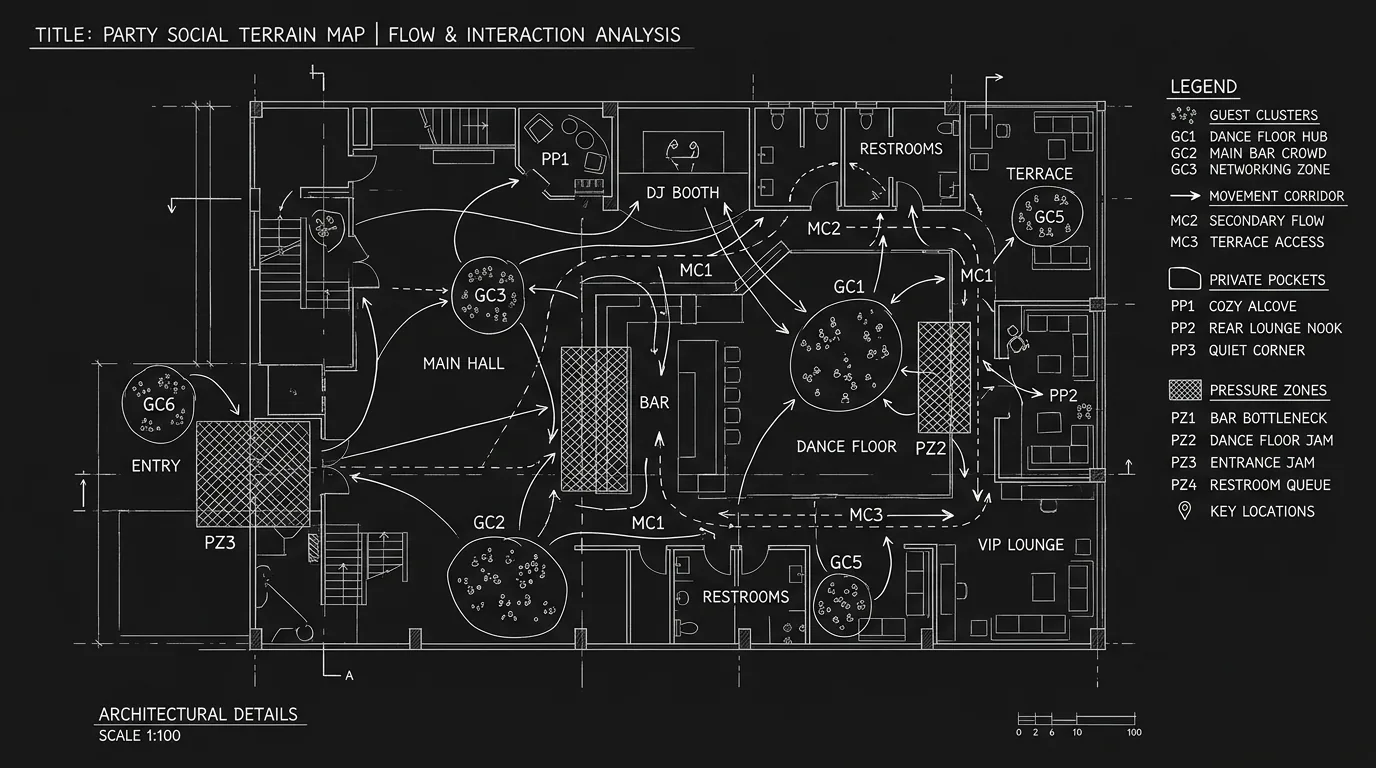
Social Terrain: who is present, who has status, who watches whom, where pressure zones are.
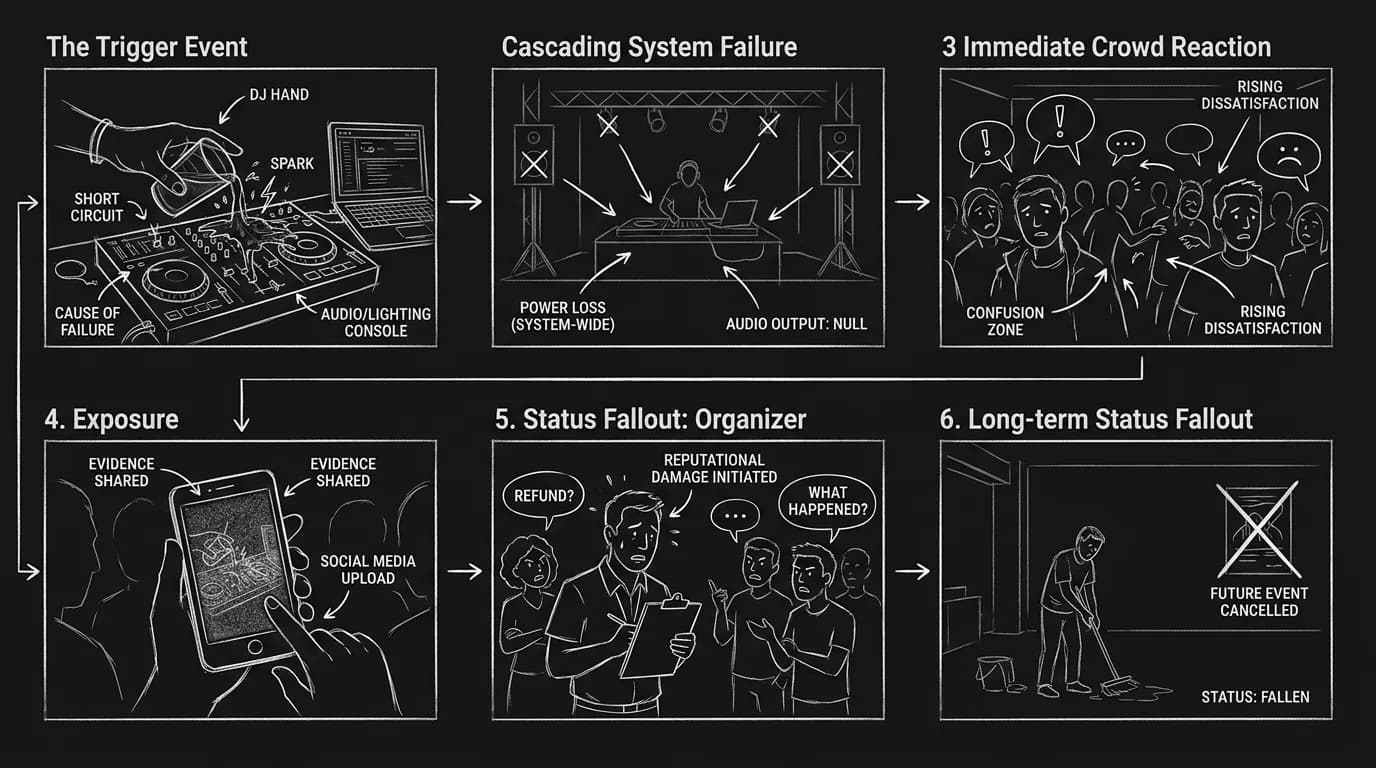
Trigger Chain: one event leads to another through believable social causality.
Fallout Selection: which consequences carry forward and for whom.
If you skip Entry Objective, scene feels aimless.
If you skip Terrain, scene feels generic.
If you skip Trigger Chain, scene feels random.
If you skip Fallout, scene feels disposable.
Scenario One: The High School Party That Never Moves Character Arc
Beginner version: protagonist arrives nervous, gets offered drink, sees crush, awkward dance, minor argument, leaves.
It can be relatable.
It often does not matter.
A stronger version sets a mission before arrival: recover a compromised photo, confront a rumor source, secure witness to an incident, or prevent friend from revealing secret. Now each movement through rooms has purpose. Party geography becomes tactical.
Kitchen talk is no longer filler. It is intel exchange.
Balcony is no longer aesthetic. It is privacy zone with risk of being seen.
Bathroom mirror beat is not cliché if it marks identity fracture before decision.
Now the scene has spine.
Scenario Two: The Elite Gala Scene with Predictable Decadence
Writers often default to visual luxury and social satire at galas, but forget conflict architecture.
A stronger gala party scene encodes gatekeeping and reputational warfare.
Who controls invitations?
Who controls introductions?
Who controls donor access?
One denied handshake can carry more dramatic force than a long argument if status stakes are clear.
You can create tremendous pressure through etiquette constraints: everyone must smile while strategically excluding someone from a deal-conversation circle.
That is conflict with teeth.
Scenario Three: The Celebration Party After a Win
Victory parties are dangerous writing territory because they tempt sentimental release with no friction.
But post-win parties are often where future collapse begins.
Success exposes jealousy, entitlement, debt, and fear of decline. If one character's rise threatens another's identity, celebration becomes battleground.
Write that contradiction.
When joy and insecurity coexist, scenes feel real.
Step-by-Step Workflow for Party Scenes That Drive Plot
Step 1: Define the Party Function in Story Structure
Write one sentence: "This party scene exists to cause ______."
Examples:
public reputation reversal,
secret exposure,
alliance formation,
moral compromise,
failed intervention.
No function, no scene.
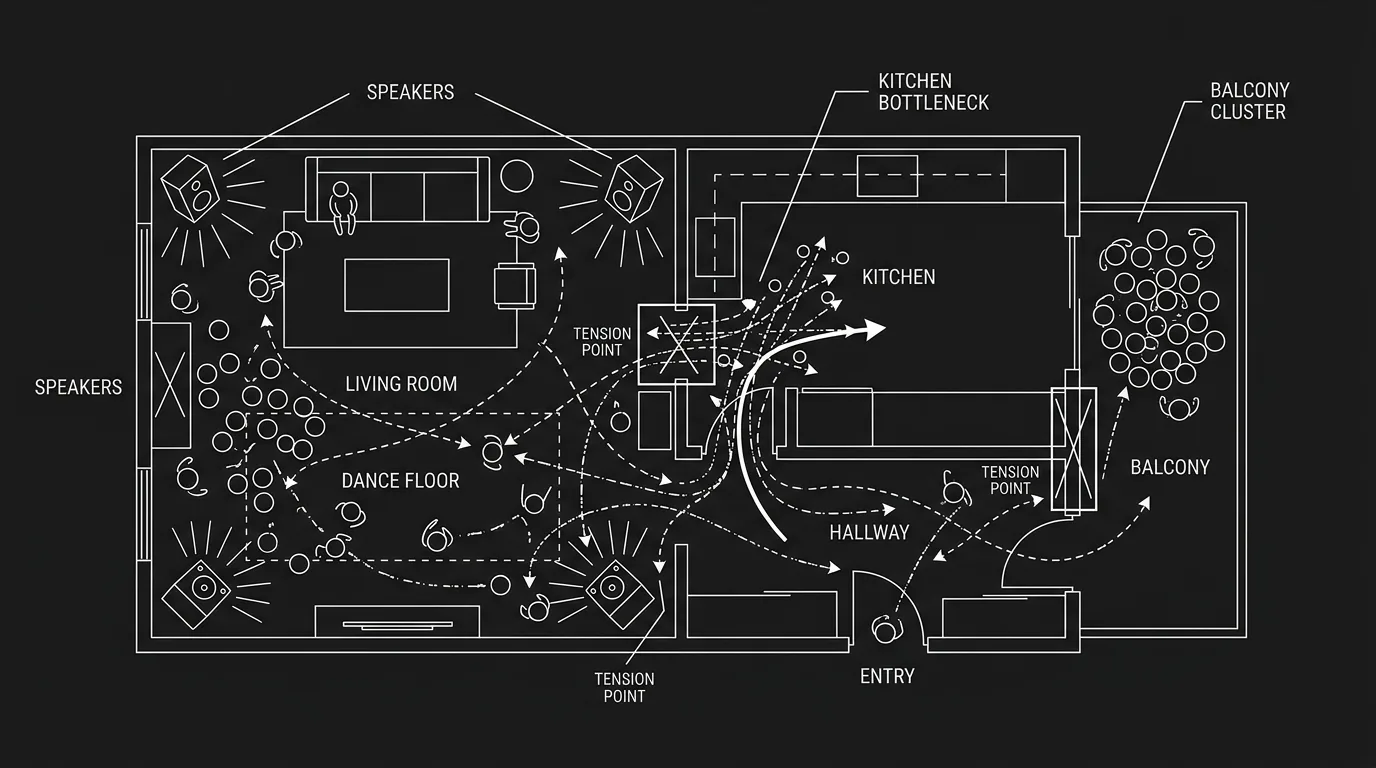
Step 2: Build a Social Map Before Dialogue
Map locations and social clusters:
entry zone,
music core,
kitchen corridor,
private room,
outdoor escape point.
Assign who occupies each cluster and why it matters.
This prevents spatial vagueness and helps tension sequencing.
Step 3: Assign Agenda to Every Major Character
No one should be "just partying."
Each major player wants something:
attention,
information,
cover,
forgiveness,
access,
proof.
Agendas create collision logic.
Step 4: Plan Trigger Chain, Not Single Twist
Instead of one random shock moment, design chain reactions.
Message seen.
Wrong person overhears.
Video goes live.
Friend intervenes badly.
Authority figure appears.
Chain logic makes chaos readable.
Step 5: Write Sensory Pressure with Selective Precision
Party scenes need sensory cues, but not sensory spam.
Pick high-signal details:
bass vibration cutting dialogue,
strobe masking eye contact,
crowd surge separating allies,
drink spill marking public embarrassment.
Sensory detail should alter decision-making, not just decorate.
Step 6: Rotate Focus Without Losing POV Gravity
You can show multiple micro-scenes, but anchor them to one or two central stakes. Without that anchor, readers feel montage blur.
A practical method: each micro-beat must either increase, complicate, or endanger the focal objective.
Step 7: End on Consequence, Not Vibe
Party scene should close with changed reality:
relationship status altered,
evidence leaked,
social status shifted,
plan compromised,
new alliance forged.
If ending is just "night ends," rewrite.
Table: Atmosphere Party Scene vs Plot-Driving Party Scene
| Dimension | Atmosphere Version | Plot-Driving Version |
|---|---|---|
| Scene purpose | Mood and energy only | Clear structural function |
| Character movement | Random wandering | Objective-driven navigation |
| Conflict | Isolated flare-ups | Trigger chain with causality |
| Ensemble behavior | Generic crowd texture | Agenda-based social tactics |
| Sensory detail | Decorative overload | Decision-relevant pressure cues |
| Ending | Vibe fade-out | Concrete consequence |
The Trench Warfare Section: What Beginners Get Wrong (and How to Fix It)
This is where party scenes are usually saved.
Mistake one: no objective on entry.
Fix by defining focal mission before character arrives.
Mistake two: crowd as wallpaper.
Fix by giving crowd behavior narrative influence: witness pressure, obstruction, rumor spread.
Mistake three: random montage cuts.
Fix by linking each beat through cause-effect chain.
Mistake four: one-note tone.
Fix by layering fun, threat, desire, shame, and urgency in waves.
Mistake five: dialogue drowned by style writing.
Fix by reducing ornamental descriptors and prioritizing tactical exchanges.
Mistake six: no geography.
Fix by anchoring transitions through repeatable zones.
Mistake seven: generic party dialogue.
Fix by writing agenda-specific lines rather than ambient chatter.
Mistake eight: public/private boundary ignored.
Fix by using semi-private pockets for strategic lines and public zones for consequence.
Mistake nine: instant escalation with no setup.
Fix by planting trigger seeds early in scene.
Mistake ten: too many simultaneous reveals.
Fix by sequencing revelations for readability and impact.
Mistake eleven: no witness economy.
Fix by tracking who sees which event and how that changes leverage.
Mistake twelve: no aftermath bridge.
Fix by writing next-scene consequence immediately.
Mistake thirteen: over-reliance on intoxication trope.
Fix by making character decisions legible beyond "they were drunk."
Mistake fourteen: no status mechanics.
Fix by showing who hosts, who is invited, who is tolerated, who is excluded.
Mistake fifteen: aesthetic overstory.
Fix by letting set dressing serve conflict axis.
Mistake sixteen: unearned reconciliation beats.
Fix by requiring action proof before emotional resolution.
Mistake seventeen: all characters equally loud.
Fix by assigning vocal dominance patterns and silence tactics.
Mistake eighteen: no timing clock.
Fix with event schedule pressure: toast, performance, announcement, curfew, ride departure.
Mistake nineteen: scene steals spotlight from main arc.
Fix by tying every key beat to central story question.
Mistake twenty: no changed plan.
Fix by ending with explicit strategy adjustment.
A party scene becomes memorable when celebration and threat occupy the same frame and both are true.
Try it free
Try Screenweaver for free on your script
It is free. Import your existing project, get a clearer view of your outline, and regain control of your story structure in minutes.
Start FreeBody Image: Party Social Terrain Map
Practical 45-Minute Rewrite Drill
Take your current party scene and run this pass.
First ten minutes: define focal objective and cut beats unrelated to it.
Next ten minutes: map social zones and assign where each key character starts.
Next ten minutes: insert a three-step trigger chain that escalates stakes.
Next ten minutes: rewrite one public beat and one private beat to contrast social pressure.
Final five minutes: end on explicit consequence that changes next-scene strategy.
This pass turns party scenes from visual filler into narrative pivots.
Advanced Calibration: Managing Multi-Thread Scenes Without Chaos
Party scenes often carry multiple subplots. The trick is thread prioritization.
Use one primary thread, one secondary thread, and keep tertiary signals short. If all threads peak equally, scene becomes unreadable.
Another technique is sonic gating in writing. Let music volume and crowd density control what can be said where. Loud zones favor gesture and misread. Quiet zones favor confession and manipulation. This creates believable communication constraints.
For external script-study references, the Writers Guild Foundation Library is useful and should be treated as nofollow in publishing workflows.
As discussed in our guide on [how to write a dinner party scene with hidden conflict], social etiquette and status choreography can carry conflict as effectively as direct confrontation.
If party dynamics trigger confession or exposure, our framework in [how to write a confession scene in a thriller] helps structure reveal timing under pressure.
And if party fallout drives endgame rupture, the principles in [how to write a final confrontation scene that feels earned] can help design payoff momentum.
Body Image: Trigger Chain to Fallout
YouTube Placeholder
[YOUTUBE VIDEO: A practical rewrite session showing how to convert a generic party montage into a cause-and-effect scene that changes character power and plot direction.]
Extra Deep Dive: Writing Party Scenes as Information Markets
One advanced way to sharpen party scenes is to treat them as information markets.
At a party, information behaves like currency.
Some facts are public and cheap.
Some are private and expensive.
Some are rumors with volatile value.
Characters trade this currency through jokes, introductions, photos, side whispers, social media posts, and strategic silence. If you write these trades intentionally, the scene gains structural precision.
Start by identifying three information assets in the scene:
one everyone thinks is true,
one only a few people know,
one nobody should know but might leak.
Then map who can profit from each asset.
Now every conversational move has economic logic.
Another high-value technique is witness layering.
Not all witnesses matter equally.
A random guest seeing an argument may do little.
A friend with social media reach seeing it may do a lot.
An investor, parent, editor, producer, or authority figure witnessing the same beat can transform consequences entirely.
Write witness hierarchy explicitly in your prep notes.
Scenario Layer: The Viral Micro-Moment
Modern party scenes often involve recording risk.
A two-second clip taken out of context can redefine reputation by morning. This is not just a tech detail. It is a conflict multiplier.
If you use this, avoid cliché "someone films everything" writing. Be specific:
who records,
why they record,
where clip goes,
who sees it first,
what interpretation wins initial narrative.
This specificity makes fallout believable.
Social Energy Wave Design
Parties are not flat emotional spaces. They move in waves:
arrival uncertainty,
early social calibration,
confidence spike,
midpoint volatility,
late-night honesty or collapse.
If your scene spans multiple phases, reflect these energy shifts in dialogue density and conflict style.
Early phase favors coded probing.
Mid phase favors status contests.
Late phase favors confession, error, or irreversible impulse.
This wave model prevents tonal monotony.
Compression Technique for Overcrowded Drafts
Party scenes often bloat with mini-beats.
Use this compression rule:
for each mini-beat, keep only one of these functions:
advance objective,
reveal alliance,
raise risk,
change status.
If a mini-beat does none, cut it.
If it does one weakly, merge it with a stronger beat.
This keeps pace sharp while preserving richness.
Designing the Exit Moment
A party scene ending is not just "people leave."
The exit is a narrative statement.
Who leaves first can signal defeat, control, panic, or strategic retreat.
Who stays can signal dominance, denial, or trap setting.
Who leaves together can establish alliance.
Who leaves alone can establish isolation arc.
Write exit choreography intentionally and your scene ending will carry far more weight.
Micro-Exercise: Convert Noise to Narrative
Take one page of your party scene and label each line as:
noise,
signal,
or consequence.
Noise lines create atmosphere only.
Signal lines reveal intention or pressure.
Consequence lines alter what can happen next.
Aim for a strong ratio of signal and consequence. Atmosphere still matters, but once noise dominates, scenes feel long without impact.
Extended Craft Layer: Multi-Character Blocking Without Reader Confusion
A frequent party-scene problem is reader disorientation. Too many names, too many movements, too many side conversations.
You can fix this with anchor-beat blocking.
Choose one anchor character for every 8-12 lines. Track where they are, who they can see, and what they can hear. Then shift anchors only when a clear trigger justifies it.
Anchor blocking keeps scene kinetic without becoming chaotic.
Another useful method is proximity coding.
Group characters by proximity tiers:
immediate zone (direct interaction),
near zone (partial overhear/interruption risk),
far zone (visual cue only).
When a reveal happens, state which zones register it. This clarifies witness economy and helps consequences feel earned.
Writing Overlapping Dialogue on the Page
Parties naturally create overlapping talk. On the page, too much overlap becomes unreadable.
Use overlap sparingly and intentionally:
one foreground conversation,
one background interruption line,
one reaction beat.
Then return to clarity.
If every line competes for attention, none land.
Tactical Use of Music and Sound Drops
Music level can be a narrative switch, not just ambience.
Sound drop before announcement.
Track change at key lyric line.
Speaker feedback squeal during tense silence.
Playlist handover signaling control shift.
These are powerful when they alter communication conditions and social visibility.
Aligning Party Scene Endings with Episode or Act Breaks
If your story structure includes act breaks, party scenes are excellent break candidates because they can combine emotional peak and social consequence.
To land an act break effectively:
end on irreversible information release,
or end on unexpected alliance,
or end on public/private identity split becoming unsustainable.
This creates strong forward pull.
Ending Perspective: Fun Is Not a Function
If your party scene feels cliche, the issue is rarely style.
It is function.
Parties can be beautiful, chaotic, seductive, reckless, funny, and painful.
But on the page, they earn their place only when they force choices characters cannot easily undo.
Write the party as a pressure architecture.
Track who wants what.
Track who sees what.
Track what breaks.
Then end with a changed map of trust and power.
Do that, and your scene stops being "the fun part."
It becomes the hinge where everything tilts.
Final Step
Build your next script with Screenweaver
Move from ideas to production-ready pages faster with timeline-native writing and AI-assisted story flow.
Try Screenweaver