The network exec leans back. "I love the pilot. But here's my question: what's Season 4?"
You've pitched a limited series. A contained story with a beginning, middle, and end. But the network isn't looking for one-and-done. They want a franchise. They want something that can run for years, generating value, building audience, filling a programming slot indefinitely.
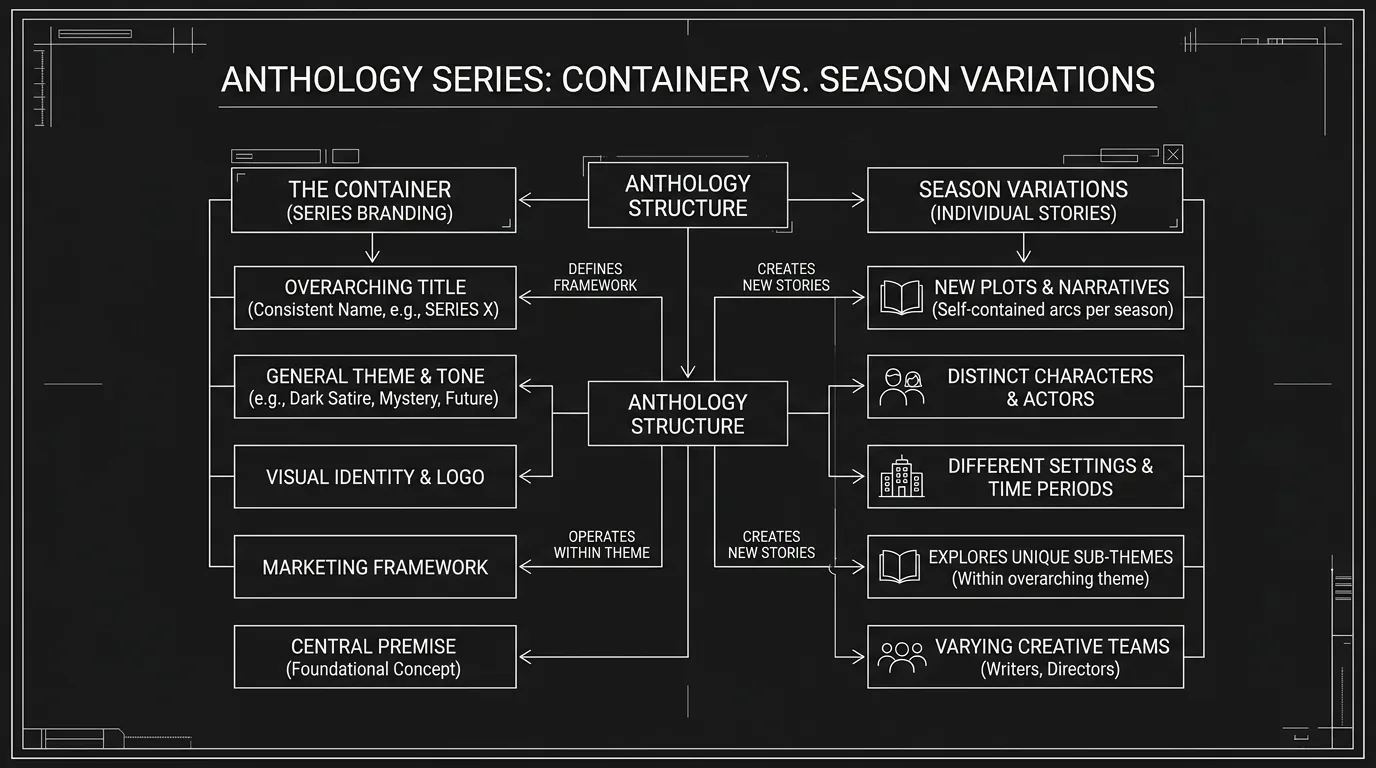
Enter the anthology format. A series where each season (or each episode) tells a complete story with new characters, new settings, new conflicts, but united by a common thread: a genre, a theme, a tone, a premise that makes it all feel like the same show.
American Horror Story. True Detective. Black Mirror. Fargo. These are anthologies. Each season reinvents the show while keeping something constant. And that constant is what makes the concept renewable, a machine that can produce new stories forever, as long as the audience keeps coming.
Pitching an anthology requires a different approach than pitching a traditional series. You're not just pitching a story. You're pitching a story-generating engine.
Free tool: use the Logline Workshop to build and pressure-test your logline.
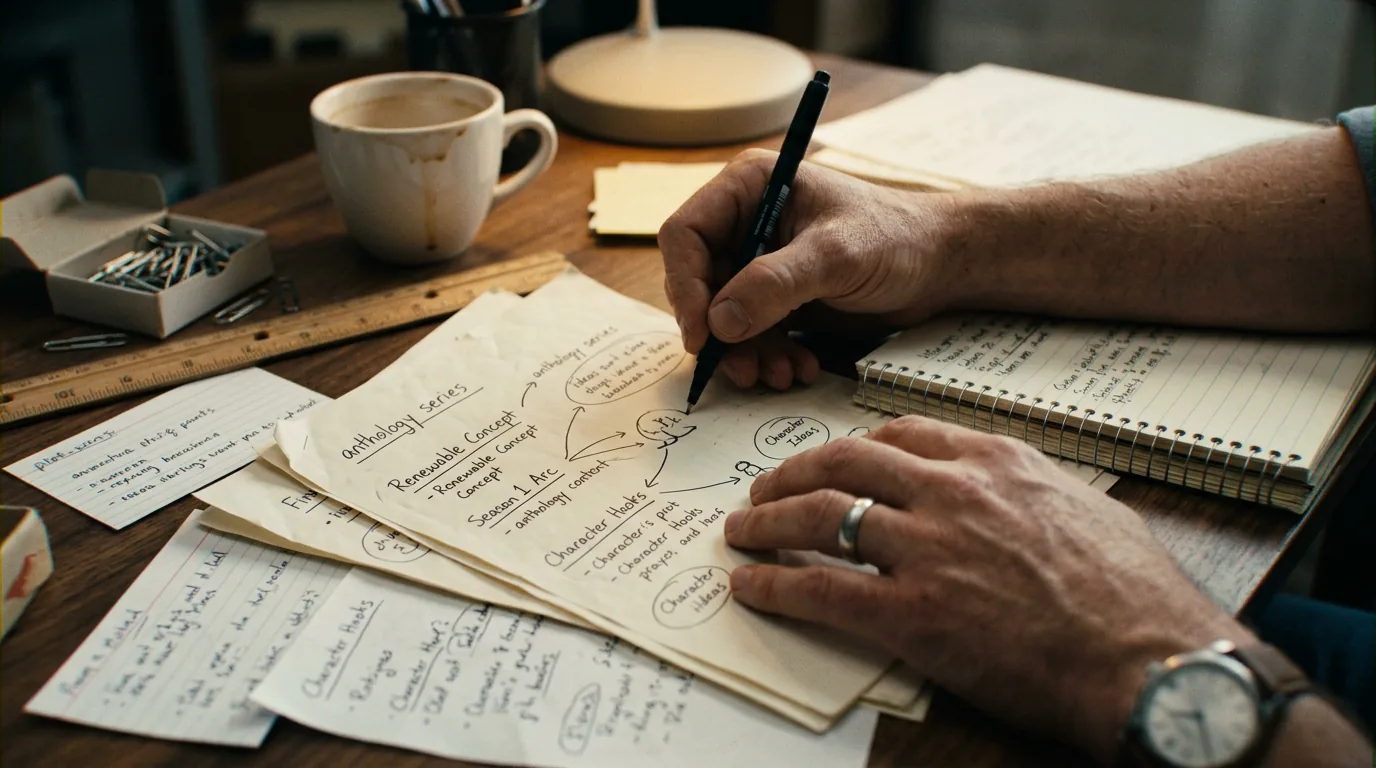
Cinematic workflow frames
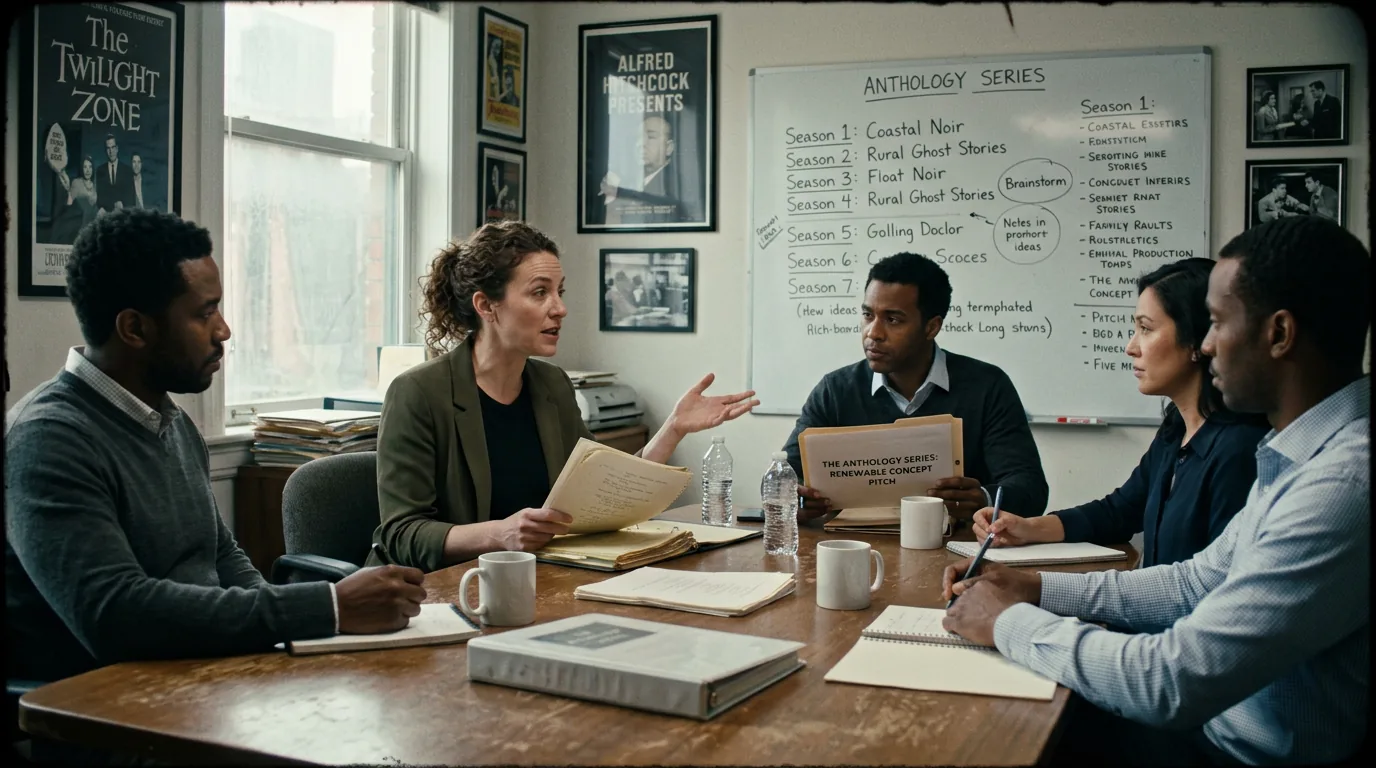
These two visuals work as a pair: the first shows Cinematic workflow still, first angle, 35mm film grain, and the second shifts to Cinematic workflow still, second angle, 35mm film grain - compare them briefly, then move on.
Why Networks Love Anthologies
Anthologies solve problems that plague traditional series:
No actor fatigue. In a traditional series, the show depends on its cast. If a lead wants out, the show might collapse. In an anthology, the cast changes every season. No single actor has leverage.
No narrative dead ends. Traditional series often overstay their welcome. The story is told by Season 3, but the show runs to Season 7, getting weaker each year. Anthologies end each story when it should end, then start fresh.
Infinite renewal potential. A traditional series has a finite premise: these characters in this situation. Eventually, you run out of story. An anthology's premise is broader: horror stories, or American crime sagas, or technology gone wrong. The premise can generate stories indefinitely.
Star casting appeal. Actors often avoid multi-season commitments but will do a single anthology season. True Detective Season 1 got Matthew McConaughey and Woody Harrelson. A traditional series would never have landed them.
Reduced syndication risk. Anthology seasons stand alone. If Season 2 underperforms, Season 3 can reboot entirely. You're not locked into a failing trajectory.
Anthologies are series designed for adaptation, not continuation.
The Anatomy of an Anthology Pitch
When you pitch an anthology, you're pitching three things:
1. The Container
The container is the unifying element, what makes it all the same show. This might be:
- A genre: Horror (American Horror Story), crime (Fargo), sci-fi (Black Mirror)
- A theme: Technology anxiety, American identity, moral ambiguity
- A format: Standalone episodes, season-long arcs, interconnected stories
- A tone: Dark comedy, psychological intensity, elevated pulp
The container defines what's in bounds and what's out. Black Mirror can tell any story about technology, but not a medieval epic with no tech relevance.
2. The First Season
You need to prove the container works by demonstrating one complete season. This is your pilot pitch: specific characters, specific story, specific arc. It's the proof of concept.
The first season should exemplify the container. If you're pitching American Crime Stories, Season 1 better be a crime story that feels like the kind of crime story the show will tell.
3. The Renewal Vision
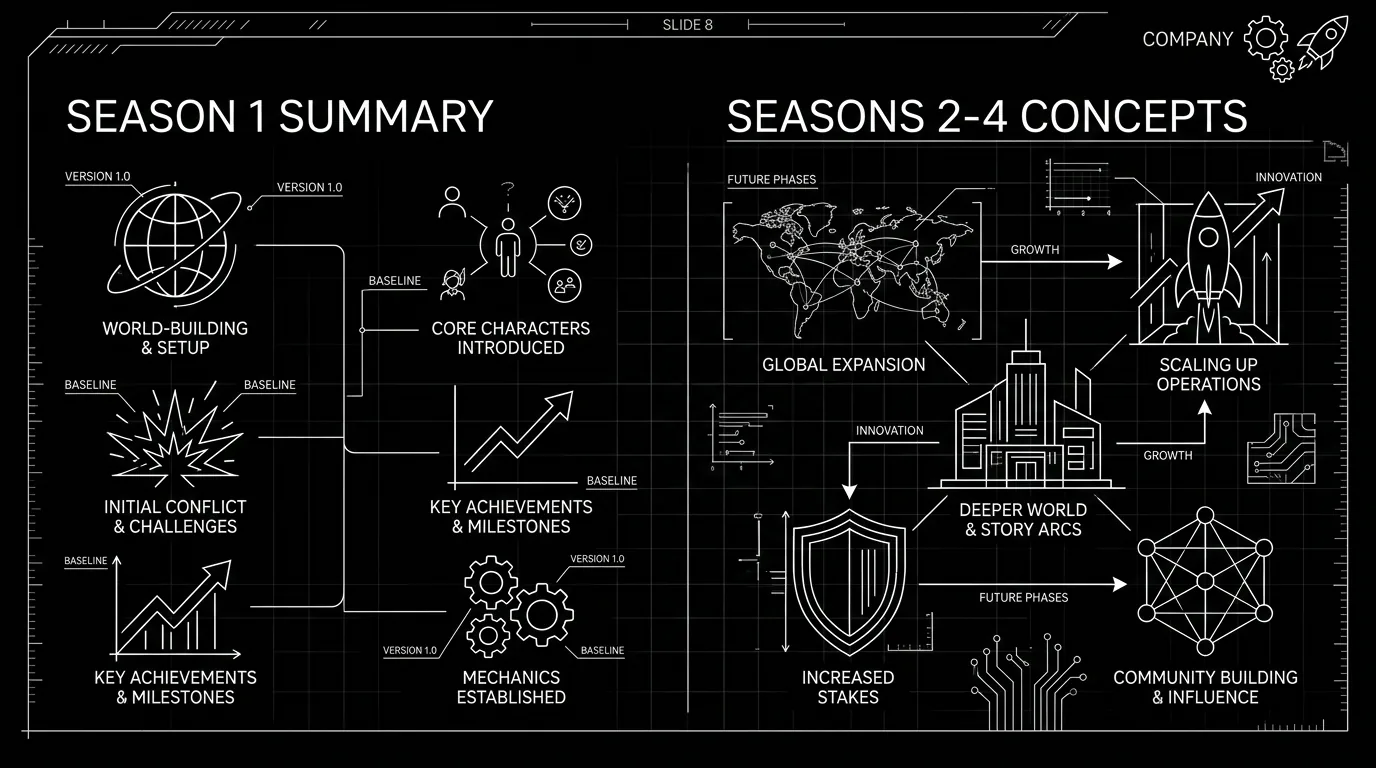
Here's where anthology pitching differs most from traditional pitching. You must convince the network that the well won't run dry. What are Seasons 2, 3, and 4?
You don't need full pitches for future seasons, but you need concepts. "Season 2 could explore a cult in 1970s California. Season 3 could be a true crime adaptation set in present-day Chicago." Show them the possibilities.
A Table: Anthology Pitch Structure
| Component | What to Include | Purpose |
|---|---|---|
| Title and Logline | A franchise title + what unifies the seasons | Establish the brand |
| The Container | Genre, theme, tone, format | Define the boundaries |
| Season 1 Pitch | Characters, plot, arc (like a limited series pitch) | Prove the concept |
| Season 2–4 Concepts | One-paragraph ideas for future seasons | Show renewal potential |
| Why Now | Cultural relevance, market gap | Justify the timing |
| Comparables | Other successful anthologies | Help them visualize |
Three Anthology Models
Model A: Seasonal Reset (American Horror Story)
Each season is a complete story with new characters, new setting, new plot. The only constant is genre (horror) and some recurring actors in new roles.
Advantages: Maximum creative freedom. Every season can reinvent.
Challenges: Each season must build audience anew. No carryover loyalty.
Model B: Thematic Connection (True Detective)
Each season tells a new crime story, but the themes resonate: masculinity, institutional corruption, the cost of violence. The title and tone are constant; the story is new.
Advantages: Strong brand identity. Audience knows what to expect tonally.
Challenges: Pressure to match the best season. True Detective Season 2 suffered from True Detective Season 1 comparisons.
Model C: Shared Universe (American Crime Story)
Each season adapts a real case, O.J. Simpson, Versace, Clinton/Lewinsky. The format is consistent: true crime dramatization. The specifics are new.
Advantages: Built-in interest (famous cases). Pre-existing narrative.
Challenges: Rights acquisition. Sensitivity to living subjects.
Writing the Pilot: Exemplify, Don't Exhaust
The anthology pilot has a specific job: exemplify the container without exhausting it.
Exemplify: Show the network what the show is. If this is a horror anthology, the pilot should be scary. If this is a crime anthology, the pilot should have crime. The pilot is a sample of the product.
Don't exhaust: Don't put everything in the pilot. If your first season uses every trick in the genre, what's left for Season 2? The pilot should feel representative, not definitive.
Think of the pilot as one example from a category. It should make the reader think: "If they can do this, imagine what else they can do."
Try it free
Try Screenweaver for free on your script
It is free. Import your existing project, get a clearer view of your outline, and regain control of your story structure in minutes.
Start FreeThe Renewal Vision: Proving the Well Won't Run Dry
The exec asks: "What's Season 4?"
Your answer proves you've thought beyond the pilot. Here's how to build a strong renewal vision:
Generate ten season concepts. You won't pitch all ten, but having them shows the container is fertile. If you can't generate ten concepts, the container might be too narrow.
Vary the concepts. Show range. If Season 1 is set in the present, pitch a historical season. If Season 1 is urban, pitch a rural season. Demonstrate that the container allows diversity.
Root concepts in research. If you're pitching a true crime anthology, reference real cases that could be future seasons. This shows you've done the work.
Present three explicitly. In the pitch, describe Seasons 2, 3, and 4 in one paragraph each. These aren't full treatments, they're teases that prove the concept has legs.
Example:
"Season 2 could explore the Satanic Panic of the 1980s, a day care witch trial in a small Texas town, where mass hysteria destroys innocent lives. Season 3 might be a ripped-from-headlines story about a charismatic wellness influencer whose followers start dying. Season 4 could go international: an American diplomat implicated in a murder in Eastern Europe, with geopolitics complicating justice."
The network now sees the franchise potential.
The "Trench Warfare" Section: What Goes Wrong
Failure Mode #1: Container Too Narrow
The pitch is for a "haunted house anthology." Every season is... a haunted house story. The network worries: how many haunted house seasons can you really do?
How to Fix It: Broaden the container. "Haunted places anthology", now you can do asylums, hotels, ships, whole towns. Or reframe: "homes gone wrong", now psychological thrillers about domestic space qualify.
Failure Mode #2: Container Too Broad
The pitch is for "stories about people." That's not a container; that's all of fiction.
How to Fix It: Define constraints. What genre? What themes? What makes this different from any other show? The container should exclude more than it includes.
Failure Mode #3: First Season Is the Best Idea
You pitch your strongest concept as Season 1. The network asks about Season 2, and the ideas get weaker. They worry the franchise will decline.
How to Fix It: Bank strong concepts for future seasons. Season 1 should be strong, but not obviously the best thing you'll ever do. Show that you're holding aces.
Failure Mode #4: No Connecting Thread
Each season concept sounds like a different show entirely. The network doesn't understand what makes it one franchise.
How to Fix It: Identify the thread. What's consistent? Maybe it's a tone (dark comedy), or a structure (parallel timelines), or a question (who's really the monster?). Make the thread explicit.
Failure Mode #5: Ignoring the Casting Advantage
Anthologies attract stars because commitments are short. But your pitch features only unknowns, losing a key selling point.
How to Fix It: When pitching Season 1, suggest the type of actor who might be interested. "This is a role for someone like Oscar Isaac, a charismatic antihero carrying moral weight." You're not promising casting; you're signaling potential.
Case Study: How Black Mirror Works
Black Mirror is the gold standard for anthology pitches. Let's analyze:
Container: Near-future technology stories that explore the dark side of innovation. The tone is unsettling, satirical, occasionally hopeful. The format is standalone episodes (no seasonal arcs).
Why it works:
- Technology anxiety is evergreen. New platforms, new threats, new stories.
- The standalone format means wildly varying lengths, genres, and tones.
- Each episode is a complete narrative; no serialization dependency.
- Guest stars can commit to a single episode. Bryce Dallas Howard, Daniel Kaluuya, Jodie Foster, all did Black Mirror.
Renewal potential: As long as technology evolves, Black Mirror has material. Every new app, every new controversy, every new ethical dilemma is potential fuel.
The lesson: a good container is generative. It produces new ideas automatically because it's linked to an inexhaustible source (technology, crime, human fear).
The Pitch Meeting: What to Emphasize
When pitching an anthology to a network, emphasize:
Franchise thinking. "This isn't a limited series. It's a franchise that can run for a decade."
Flexibility. "Every season is a fresh start. If Season 2 doesn't work, Season 3 can course-correct."
Casting potential. "Each season is a chance to attract A-list talent for a single commitment."
Cultural relevance. "This container is tied to [crime, technology, horror, etc.], which is always relevant."
Market gap. "There's no anthology doing exactly this. Here's the white space."
The network is buying a machine, not just a story. Sell the machine.
The Perspective: Stories Without End
The anthology format represents a particular philosophy of television: that what matters isn't continuity but quality. That every story should end when it ends. That reinvention is preferable to repetition.
Not every idea fits the anthology mold. Some stories demand serialization, deep character development over many seasons, evolving relationships, a single arc that spans years. Those are valid and valuable.
But if your idea is a container, a genre, a theme, a question, then the anthology might be your format. You're not writing one story. You're writing the conditions under which many stories can be told.
That's a different kind of creativity. Less about the perfect ending, more about the fertile premise. Less about these characters, more about the kind of characters this world produces.
When you find the right container, the ideas come easier. You're not squeezing a story from nothing; you're selecting from abundance. And that abundance is what you're selling when you walk into the network's office.
"What's Season 4?"
"I've got twelve possibilities. Let me tell you my favorites."
[YOUTUBE VIDEO: A showrunner discussing how they developed an anthology series concept, including the process of defining the container and generating season ideas.]
Further reading:
- For guidance on pitching with visual materials, see our pitch deck template guide.
- If you're developing your first season as a limited series, see our guide on 5-act structure for limited series.
- The WGA has contract information specific to anthology series at wga.org{:rel="nofollow"}.
Final Step
Build your next script with Screenweaver
Move from ideas to production-ready pages faster with timeline-native writing and AI-assisted story flow.
Try Screenweaver