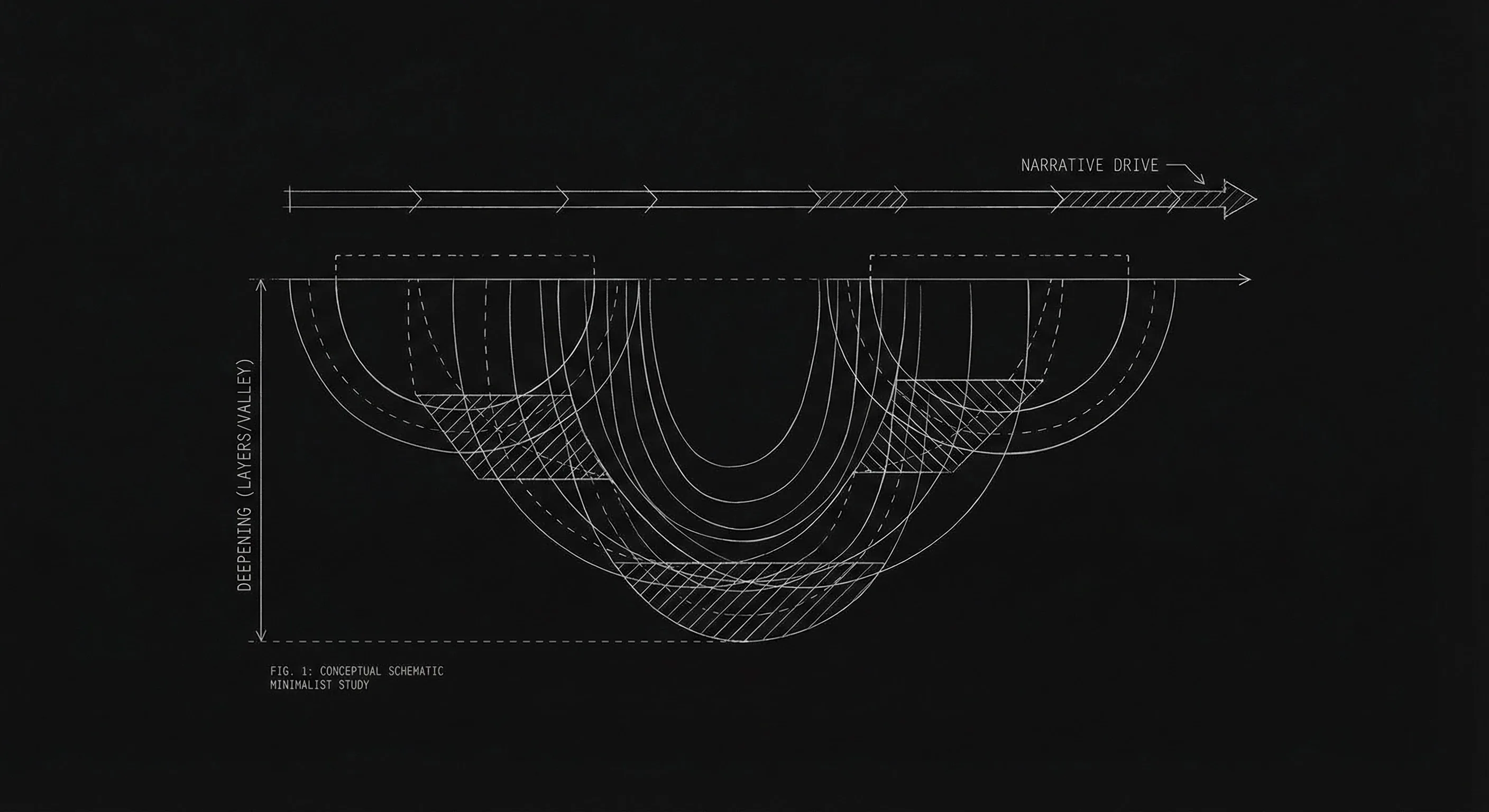

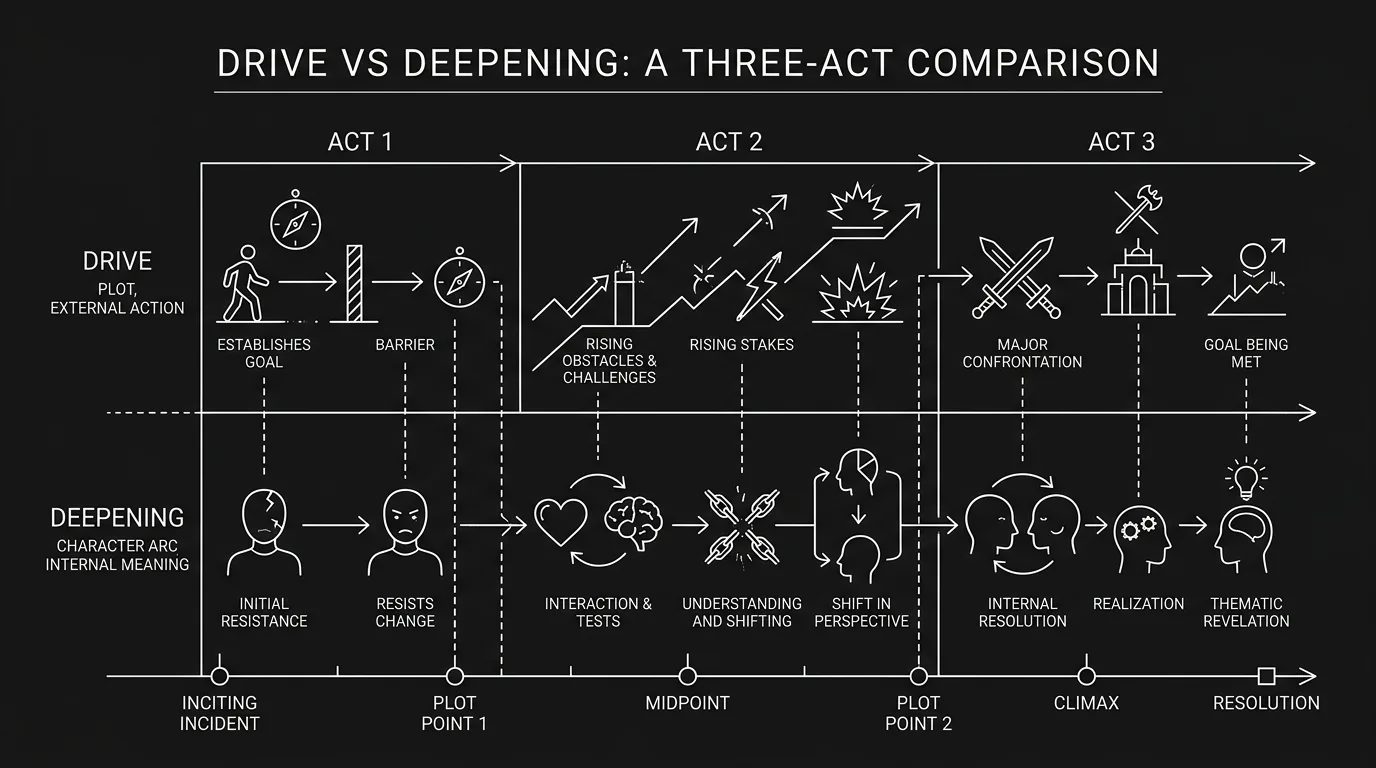
The plot moves. The detective gets a clue. The couple has a fight. The mission advances. That’s narrative drive,the engine that pulls the audience forward. But if the story only moves and never deepens, it feels thin. We need moments where we sit with the character, where the theme lands, where the relationship or the cost gets real. That’s narrative deepening,the moments that make the audience care about what’s moving. The trick is balance. Too much drive and the story feels like a checklist. Too much deepening and the story stalls. The best scripts alternate. They push forward, then they pause. They advance the plot, then they advance the meaning.
Drive answers “what happens next?” Deepening answers “why do we care?”
Think about it. A thriller that never stops moving can be exhausting,or empty. We need a beat where the protagonist feels the cost. A drama that only deepens can feel static. We need something to happen,a decision, a revelation, a turn. So the writer is always making a choice: is this beat about drive (moving the story) or deepening (making the story matter)? And is the proportion right for this section of the script? The first act often needs more drive,we’re setting up the world and the problem. The middle often needs both,drive to avoid the sag, deepening to avoid the hollow. The end needs drive to land the climax and deepening to land the emotional payoff. When you feel the script dragging, you might need more drive. When you feel the audience doesn’t care, you might need more deepening.
What Drive and Deepening Look Like on the Page
Narrative drive is any beat that advances the plot. New information. A decision. A confrontation. A twist. The audience asks “what happens next?” and the story answers. Scenes that are mostly drive are lean. Something happens. We move. Dialogue and action serve the forward motion. There’s little time for reflection. That’s not bad. Drive is what keeps the script from feeling slow. But drive alone doesn’t make us care. It just makes us curious.
Narrative deepening is any beat that advances our relationship to the story. We understand the character more. We feel the theme. We see the cost of what’s happening. These beats might be quieter. A conversation that doesn’t change the plot but changes how we see the character. A moment alone. A look. A line that lands. Deepening doesn’t always slow the plot,sometimes a plot turn is the deepening (e.g., the revelation that changes how we see everything). But often deepening is the pause. The breath. The moment we sit with what just happened. Without it, the plot can feel like a series of events that don’t land. With too much of it, the plot can feel like it’s going nowhere.
| Drive | Deepening |
|---|---|
| “What happens next?” | “Why does it matter?” |
| Plot advancement | Emotional or thematic weight |
| Forward motion | Pause, reflection, cost |
| Scenes that move | Scenes that land |
The balance is the craft. As with the midpoint, the middle of the script is where the balance is hardest. Too much drive and the middle feels like a checklist. Too much deepening and the middle sags. You want both,scenes that move and scenes that make the movement matter.
Relatable Scenario: The Thriller That Feels Empty
The script has chase after chase. Clue after clue. The plot never stops. But when the hero wins, we don’t feel much. Why? Because we never had a deepening beat. We never sat with the cost. We never saw the character doubt or hurt or care. Fix: Add one or two beats where the plot pauses. The character reflects. We see what they’re risking or what they’ve lost. Then when the climax comes, we have something to root for. The drive got us there. The deepening makes it land.
Try it free
Try Screenweaver for free on your script
It is free. Import your existing project, get a clearer view of your outline, and regain control of your story structure in minutes.
Start FreeRelatable Scenario: The Drama That Drags
The script has beautiful scenes. Long conversations. Lots of subtext. But the audience is bored. Nothing seems to happen. Why? Because there’s not enough drive. The story isn’t moving. We’re deepening into a pool that doesn’t go anywhere. Fix: Add beats that advance the plot. A decision. A confrontation. A piece of information that changes the situation. The deepening will land harder when there’s something concrete at stake. Drive creates the stakes. Deepening makes us feel them.
The Trench Warfare Section: What Beginners Get Wrong
Equating “deepening” with “slow.” Deepening doesn’t have to be a long, quiet scene. A single line can deepen,if it changes how we see the character or the situation. Fix: Deepening is about weight, not length. You can deepen in one line. You can deepen in the middle of a chase (the character has a flash of doubt). Don’t assume deepening means “add a five-page conversation.”
Equating “drive” with “action.” Drive is forward motion. That can be a car chase. It can also be a piece of dialogue that changes everything. A confession. A lie. A decision. Fix: Drive is any beat that answers “what happens next?” Dialogue can be drive. So can a look, if it triggers the next event. Action is one kind of drive. Not the only kind.
Putting all deepening in Act 1. We get to know the character, then the plot takes over and we never return to their interior life. Fix: Spread deepening across the script. The middle and the end need moments of weight too. The climax will land harder if we’ve had deepening beats along the way.
Putting all drive in the climax. The script is slow for 90 pages, then everything happens at the end. Fix: Distribute drive. The audience needs to feel forward motion throughout. The climax is the peak of drive,but there should be smaller peaks before it. Each act should have beats that move the story.
Ignoring the ratio. You don’t think about whether a scene is drive or deepening. You just write. Then the script feels off,too thin or too slow,and you don’t know why. Fix: In revision, label scenes. Drive or deepening? Look at the distribution. Is there a long stretch with no drive? No deepening? Adjust. The balance is something you can fix in draft two.
Step-by-Step: Checking the Balance
List your scenes (or sequences). For each, ask: is this primarily drive or primarily deepening? Mark them. Look at the pattern. Do you have 20 pages of drive with no deepening? Do you have 20 pages of deepening with no drive? If the middle is all drive, add a beat where we sit with the character or the cost. If the middle is all deepening, add a beat that advances the plot. Read the script again. Does it move? Do you care? The balance doesn’t have to be 50/50. Thrillers lean drive. Character pieces lean deepening. But both need some of the other. Our guide on keeping the middle moving is about preventing the second act from sagging; narrative deepening is what makes that movement matter. Use both.
The Perspective
Narrative drive pulls the audience forward. Narrative deepening makes them care. You need both. When the script feels thin, add deepening. When it feels slow, add drive. When you’re not sure what’s wrong, label the beats and look at the balance. The fix is often there: too much of one, not enough of the other. Get the ratio right and the script will move and land.
Final Step
Build your next script with Screenweaver
Move from ideas to production-ready pages faster with timeline-native writing and AI-assisted story flow.
Try Screenweaver