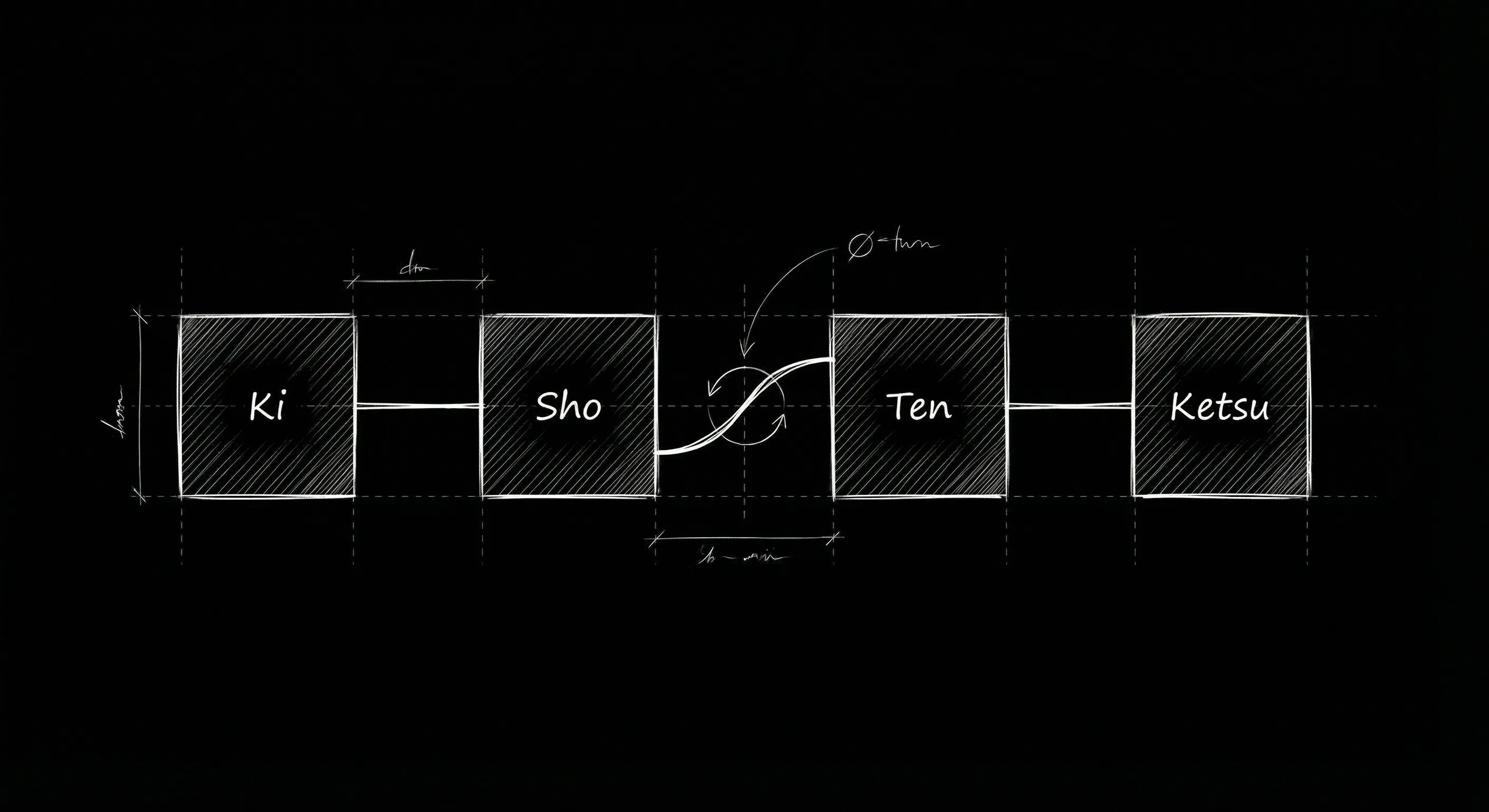

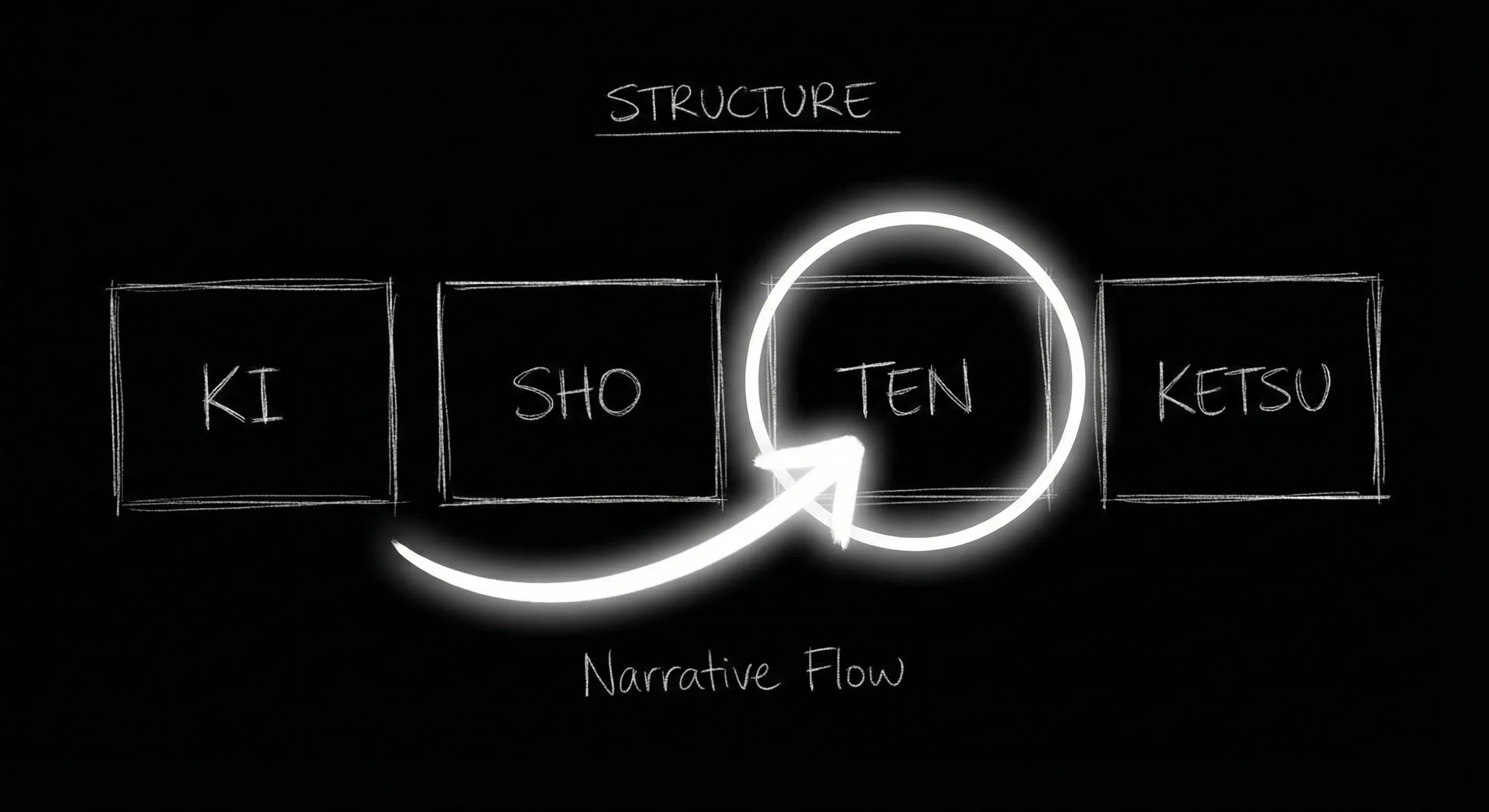
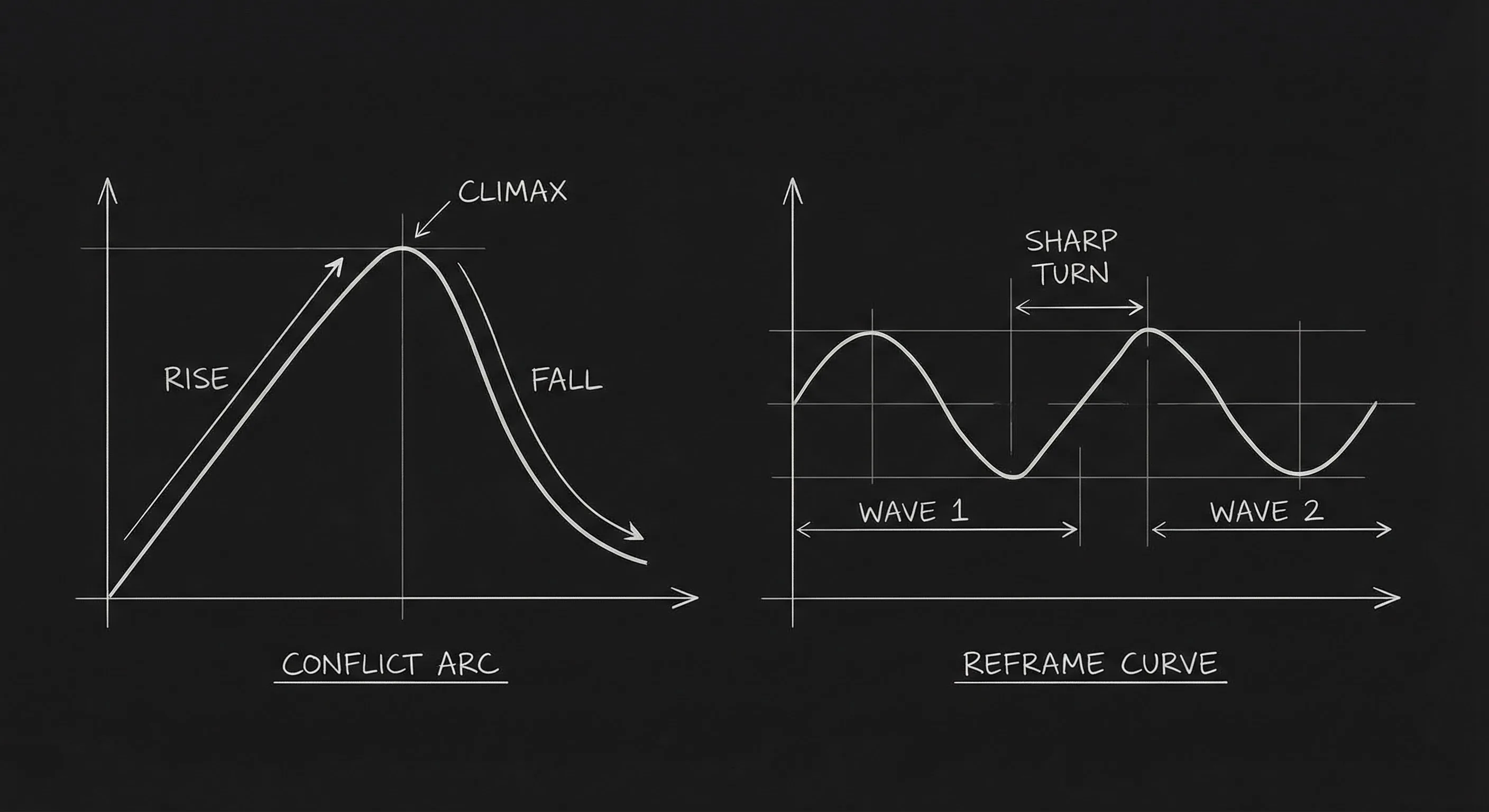
Most Western narrative theory starts with conflict. Setup, confrontation, climax, resolution. Something wants something; something else gets in the way. Kishōtenketsu doesn't. It's a four-part structure that comes from classical Chinese and Japanese narrative: Ki (introduction), Shō (development), Ten (twist/turn), Ketsu (conclusion). There's no requirement for a hero and a villain. No requirement for a central obstacle that gets defeated. The Ten is the pivot,a twist, a new perspective, or a contrast that reframes what came before. The story doesn't "resolve" a conflict. It recontextualizes the first two acts through the third. That can feel strange to writers raised on three-act structure. But for certain stories,slice of life, mood pieces, character studies, or films where the "point" is revelation rather than victory,Kishōtenketsu offers a different and often fresher shape.
Why should a Western screenwriter care? Because audiences are used to more than one kind of story. Films like A Quiet Place (in parts), many Studio Ghibli works, and a growing number of indies use structures that don't rely on a single central conflict. When you're writing something that's more about atmosphere, contrast, or revelation than about "winning," forcing it into three acts can flatten it. Kishōtenketsu gives you a vocabulary and a template. You don't have to adopt it wholesale. You can borrow the Ten,the twist that reframes,and drop it into a more familiar spine. Or you can build the whole script on four parts and see how it feels.
The Four Parts in Practice
Ki (起): Introduction. We meet the world and the characters. No "inciting incident" in the Western sense,just presence. A place, a mood, a situation. The audience is oriented. There's no stated "goal" that must be blocked. There might be a small tension or a question, but it's not the engine of the plot.
Shō (承): Development. The situation deepens. We follow the characters. Things happen,but they're not necessarily "obstacles." They're developments. In a Western script we'd be building conflict. Here we might be building familiarity or pattern. The audience gets more of the world. Maybe a second thread or a second character is introduced. The story continues. It doesn't "rise" toward a clash; it extends.
Ten (転): Twist / Turn. This is the heart of Kishōtenketsu. Something new enters. A new perspective. A contrast. A revelation. A parallel story that connects. The first two parts are reframed by the third. We didn't know we were building to this. Now we see the earlier material in a new light. In Western terms, it's a bit like a midpoint,but it's not "the protagonist gets new information to defeat the villain." It's "the story reveals what it was always about." The Ten can be gentle (a shift in tone, a new character who reframes the theme) or sharp (a revelation that changes the meaning of everything we've seen).
Ketsu (結): Conclusion. We land. The reframing is absorbed. The story doesn't "resolve" a conflict so much as settle into a new understanding. The mood might be bittersweet, peaceful, or ambiguous. There's no requirement for a winner. Just a sense that the story has completed its shape.
In Kishōtenketsu, the "point" of the story often isn't "who wins." It's "what we understand by the end that we didn't at the start." The Ten is the moment understanding becomes possible.
Relatable Scenario: The Indie Mood Piece
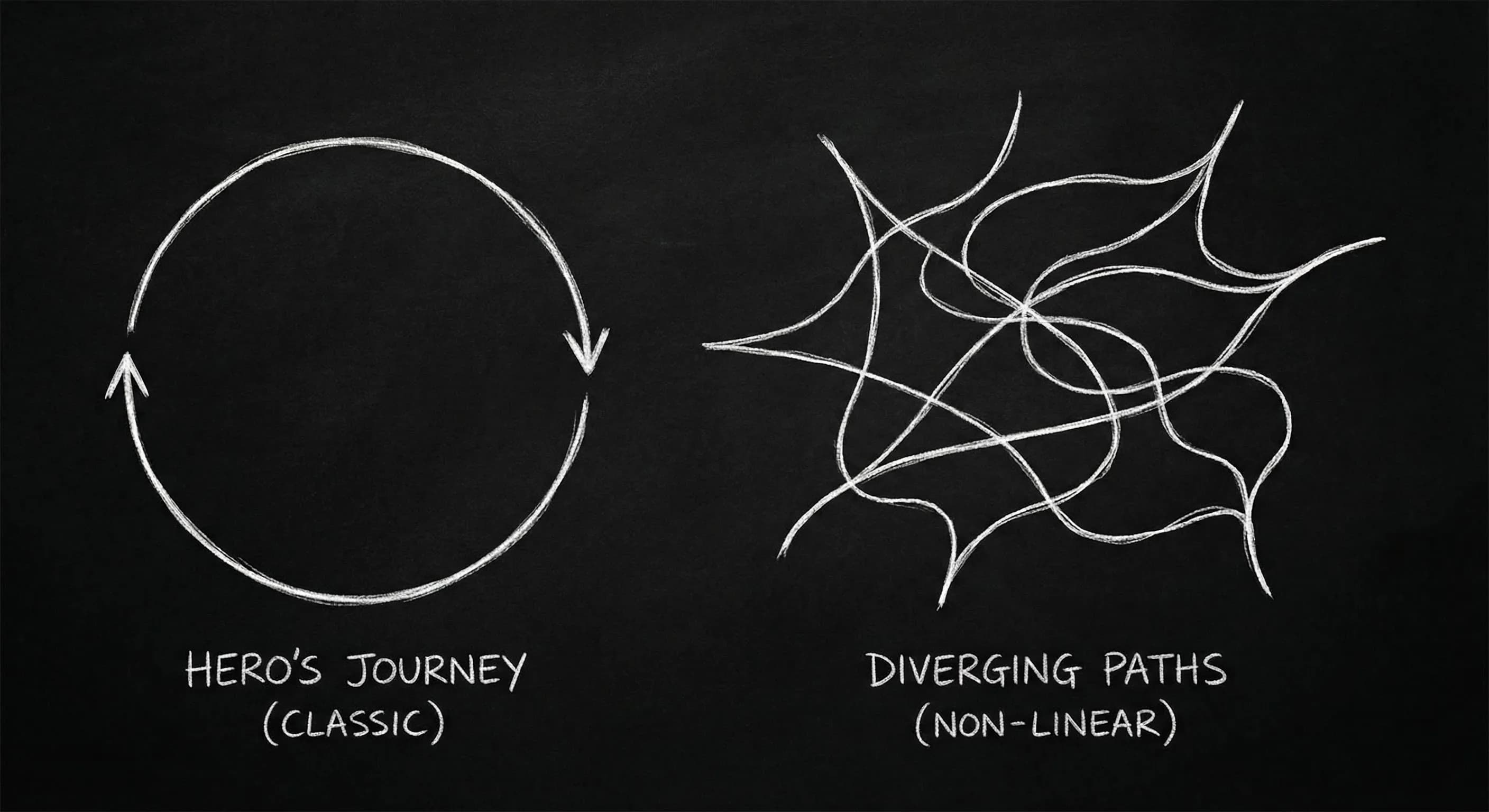
You're writing a small film. Two people in a coastal town. One is leaving; one is staying. There's no villain. No heist. No race. If you force three-act structure, you'll invent a "conflict",maybe they fight over a decision,and the third act will be "they resolve it." But the story you want is quieter. They spend time together. We feel the weight of the leaving. Then,Ten,we learn something that reframes their relationship (a past they shared, a secret, or we see the same day from the other's perspective). The Ketsu isn't "they stay together" or "they part as enemies." It's a moment of clarity. Silence. Acceptance. Kishōtenketsu gives you permission to build that script without a fake antagonist. The structure is: establish, develop, reframe, settle. For more on structures that don't rely on a single hero's journey, see our piece on beyond the Hero's Journey: Kishōtenketsu is one of the alternatives.
Relatable Scenario: The Anthology Segment
You're writing one segment of an anthology. Two stories that seem separate. In the first two parts we follow Story A. In the third part we cut to Story B,or we see Story A from a new angle. The Ten is the connection. We realize Story B is the past of Story A's character, or the two stories are the same event from different sides. The Ketsu is the resonance between them. No one "wins." We're left with a feeling, a theme, a contrast. That's Kishōtenketsu thinking. The non-linear formatting of something like Pulp Fiction is different,there we're playing with time and order. Here we're playing with meaning: the Ten is the moment the two threads (or the two views) lock.
Comparison: Western Three-Act vs. Kishōtenketsu
| Aspect | Western 3-Act | Kishōtenketsu |
|---|---|---|
| Engine | Conflict; obstacle to overcome | Development; then reframing |
| Pivot | Midpoint (new info, shift); climax (confrontation) | Ten (twist that reframes Ki and Shō) |
| End | Resolution of conflict; winner/loser or compromise | Settlement; new understanding; mood |
| Best for | Genre, thriller, drama, clear protagonist goal | Mood, theme, character, revelation |
You can blend. A Western script can have a "Ten-like" beat,a revelation that reframes the first half,and still have a classic climax. Or you can go full Kishōtenketsu and drop the central conflict entirely. The table is a guide, not a rule.
Try it free
Try Screenweaver for free on your script
It is free. Import your existing project, get a clearer view of your outline, and regain control of your story structure in minutes.
Start FreeThe Trench Warfare Section: What Beginners Get Wrong
Using Kishōtenketsu but still centering a "villain." If you have a clear antagonist and a clear victory condition, you're in Western structure. Kishōtenketsu works when the story isn't about defeating someone. It's about seeing differently by the end. If you keep a villain, the Ten and Ketsu will fight with the audience's expectation of a showdown. Either commit to no central conflict or use Kishōtenketsu as a flavor (e.g. a strong Ten that reframes the hero's journey) inside a more familiar spine.
Ten too small. The twist or turn has to reframe the introduction and development. A tiny reveal won't do it. The audience should feel: "Oh. So that's what that was about." If the Ten is a small plot beat, the structure won't land. Think theme, perspective, or meaning,not just "then we find out X."
No clear Ketsu. The conclusion doesn't have to tie every thread. It has to settle the reframing. The audience should feel that the story has completed. If the ending is vague or arbitrary, they'll feel cheated. The Ketsu can be quiet. It can be ambiguous. It can't be "and then we stopped."
Forcing conflict into Ki and Shō. The temptation is to add a "problem" so the script "has stakes." In pure Kishōtenketsu, the first two parts don't need a single obstacle. They need presence and development. If you load Ki and Shō with conflict, the Ten will feel like just another beat instead of a reframing. Trust the form. Let the first two parts build mood and situation; let the Ten do the heavy lifting of meaning.
Ignoring Western expectations in a Western market. If you're writing for a mainstream Western audience, they may still expect some form of conflict and resolution. You can use Kishōtenketsu as the skeleton and add a light throughline (a small goal, a relationship question) so the audience has something to hold. The Ten can still reframe; the Ketsu can still prioritize mood over victory. But don't assume every reader or viewer will be comfortable with zero conflict. Test the script. Get feedback. Adjust.
Step-by-Step: Drafting a Kishōtenketsu Outline
Write one paragraph for Ki: who, where, what's the situation, what's the mood. No "goal" required. Write one paragraph for Shō: how does the situation develop? What do we learn? What patterns or threads appear? Write one sentence for Ten: what enters that reframes Ki and Shō? (A revelation, a new character, a parallel story, a shift in perspective.) Write one paragraph for Ketsu: how does the story settle? What do we feel? What do we understand? Now read Ki and Shō again. Does the Ten actually reframe them? If not, sharpen the Ten or adjust Ki and Shō so that the reframing lands. Then write the script in four blocks. You can use the 3-act structure as a secondary check,Ki and Shō might map to Act 1 and part of Act 2, Ten to the midpoint area, Ketsu to the end,but the logic of the story is four-part: introduce, develop, reframe, settle.
When to Choose Kishōtenketsu
Choose it when the story is about mood, theme, or revelation,not about a character defeating an obstacle. Choose it when you want an ending that settles rather than resolves. Choose it when you're writing for an audience (or a buyer) open to non-Western shapes. And consider borrowing just the Ten when you have a Western plot but want a moment that reframes everything,the twist that makes the first half make new sense. Structure is a tool. Kishōtenketsu is one more in the drawer.
The Perspective
Kishōtenketsu isn't a replacement for Western structure. It's an alternative. When your story doesn't have a clear hero, villain, or conflict,when it's about feeling, meaning, or the moment everything clicks into place,this four-part form can carry it. Use it whole, or steal the Ten and drop it into a more familiar spine. Either way, you're giving yourself permission to write stories that don't have to "win" to matter.
Final Step
Build your next script with Screenweaver
Move from ideas to production-ready pages faster with timeline-native writing and AI-assisted story flow.
Try Screenweaver