
The cameras captured 600 hours of footage. Somewhere in those 600 hours is a story, a narrative arc with characters, conflict, and resolution. But the footage doesn't know it's a story. The footage is raw, unstructured, chaotic. Three cameras running simultaneously for eight weeks, following twelve people whose behavior ranged from compelling to unwatchable.
Someone has to find the story. Someone has to read through transcripts, flag usable moments, build scenes from fragments, and assemble a narrative from material that was never scripted in the first place. That someone is the story producer, and their primary tool is the paper edit.
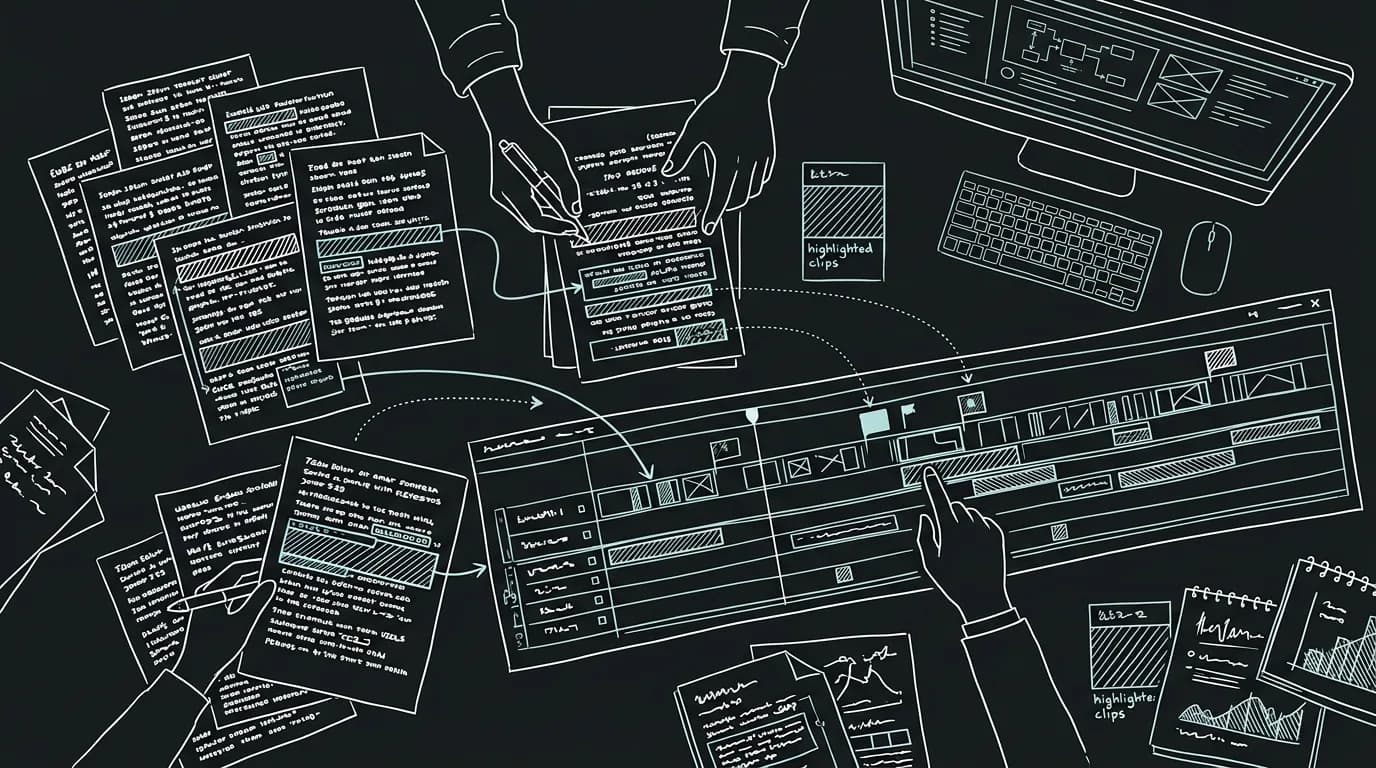
The paper edit is reality television's invisible screenplay. It's a document that sequences moments, describing what happens, what's said, where each clip comes from, before any actual editing occurs. The paper edit is where the show is written, even though the footage already exists.
This is screenwriting without scripts. You don't write dialogue; you find it. You don't invent scenes; you construct them from raw material. It requires the same skills as traditional screenwriting, structure, pacing, character development, applied to material you didn't create but must shape.
Free tool: use the Scene Extractor to pull and organize every scene from your script.
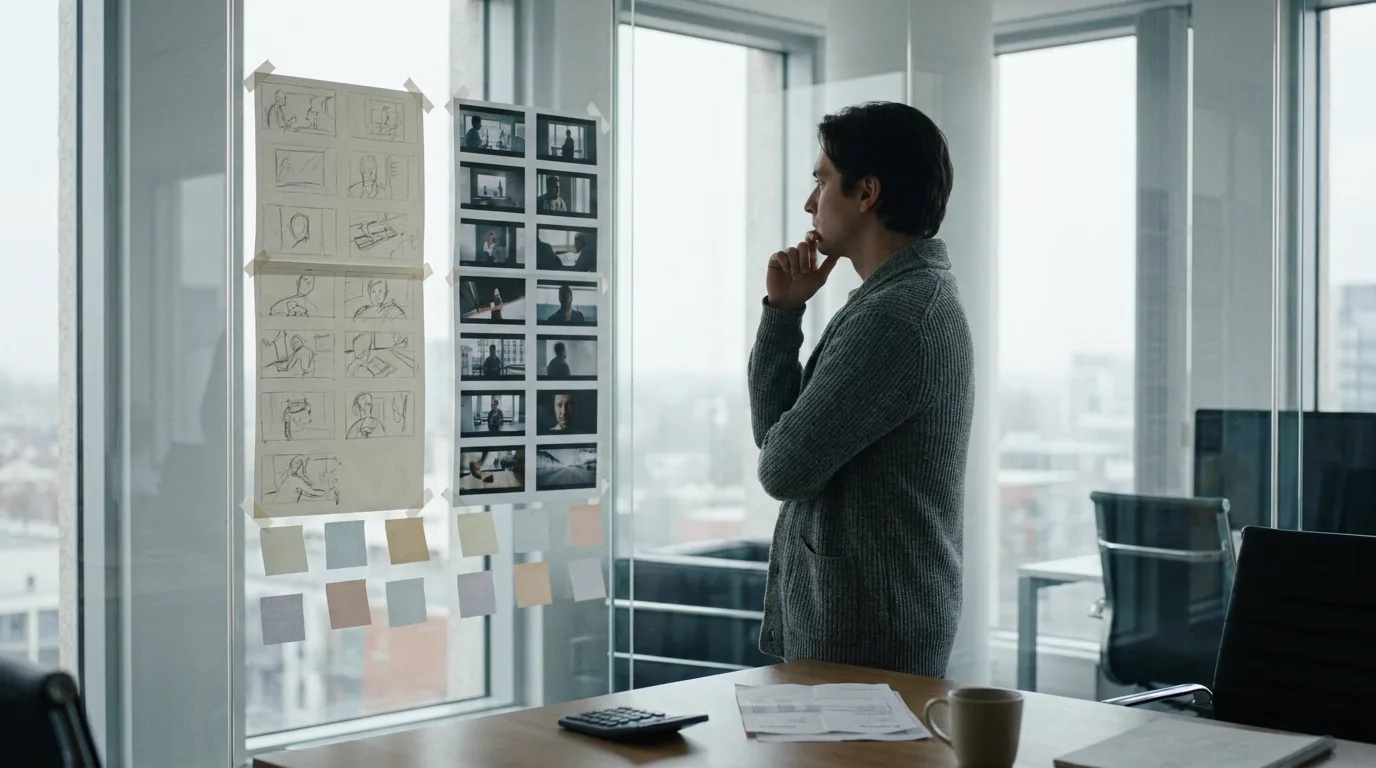
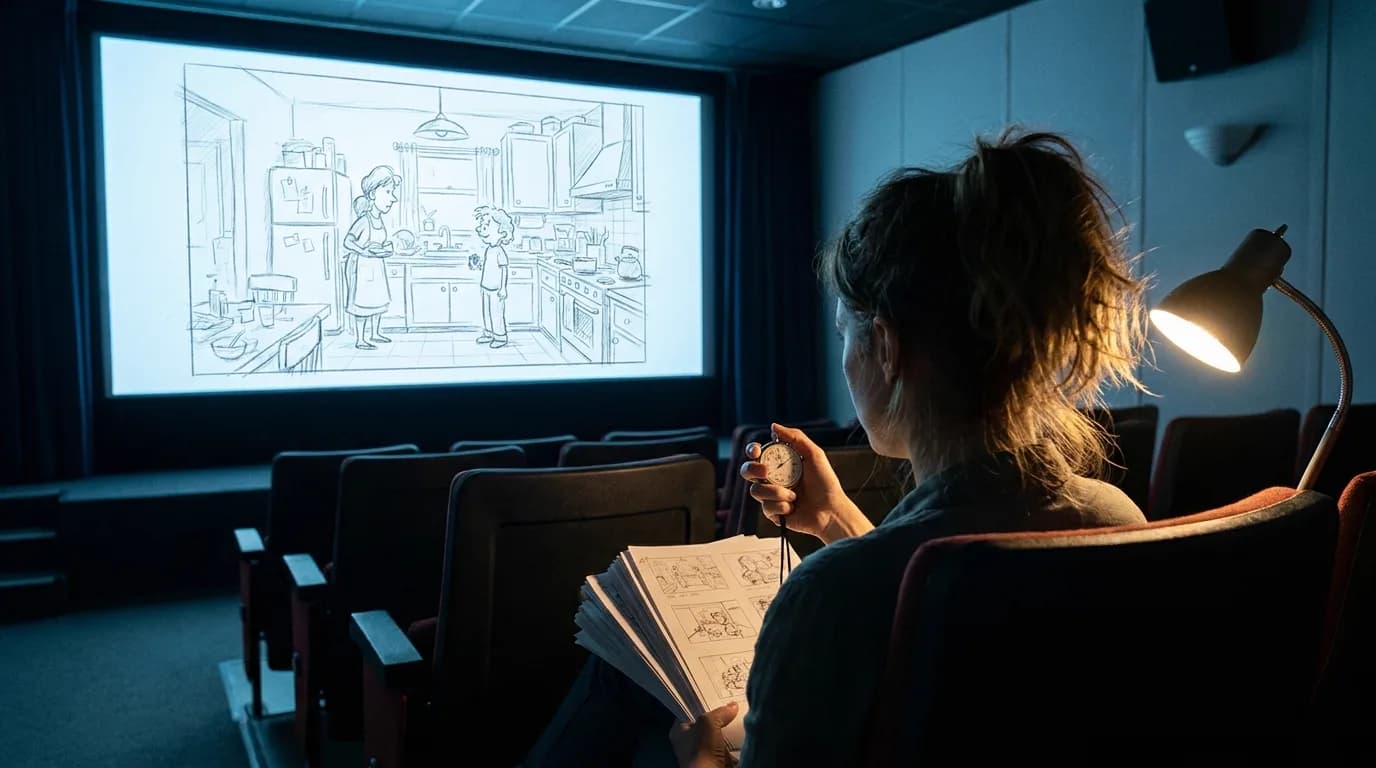
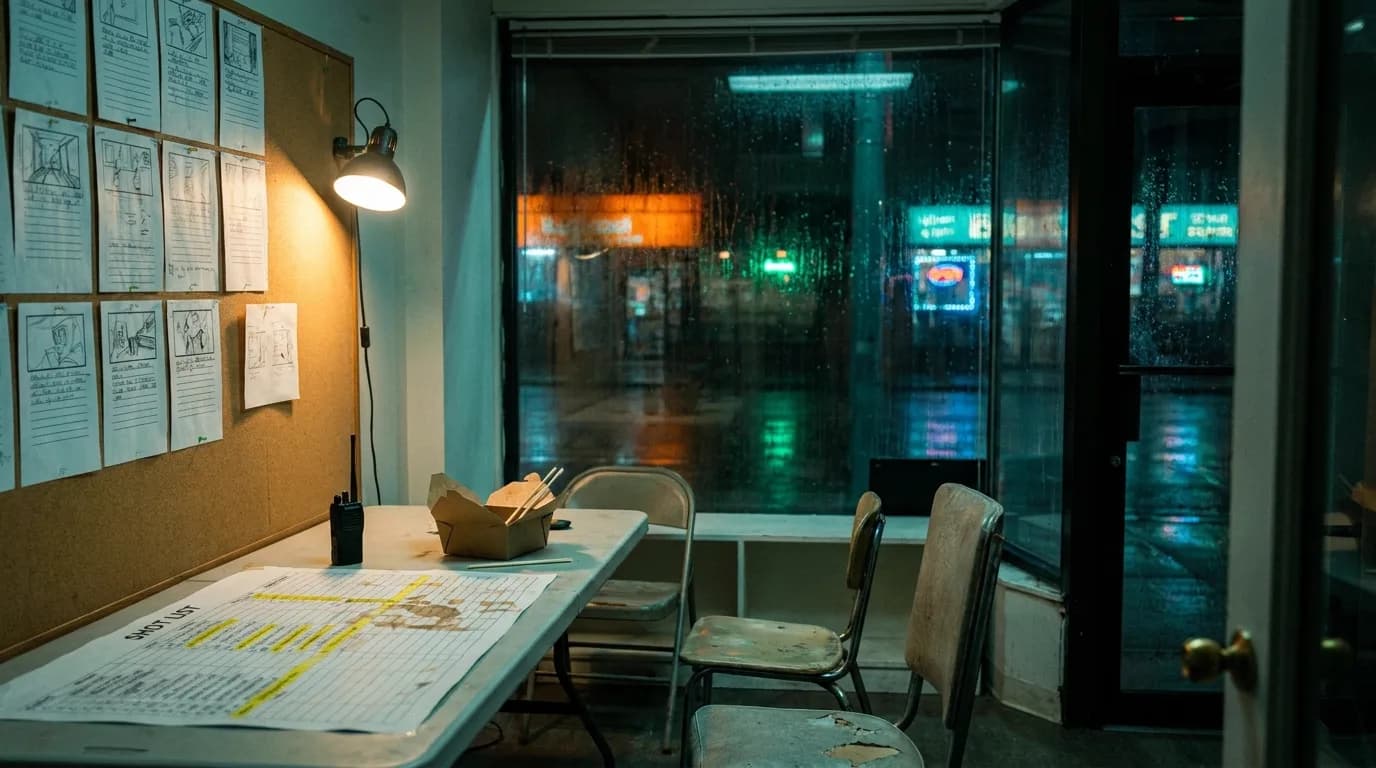
Cinematic workflow frames
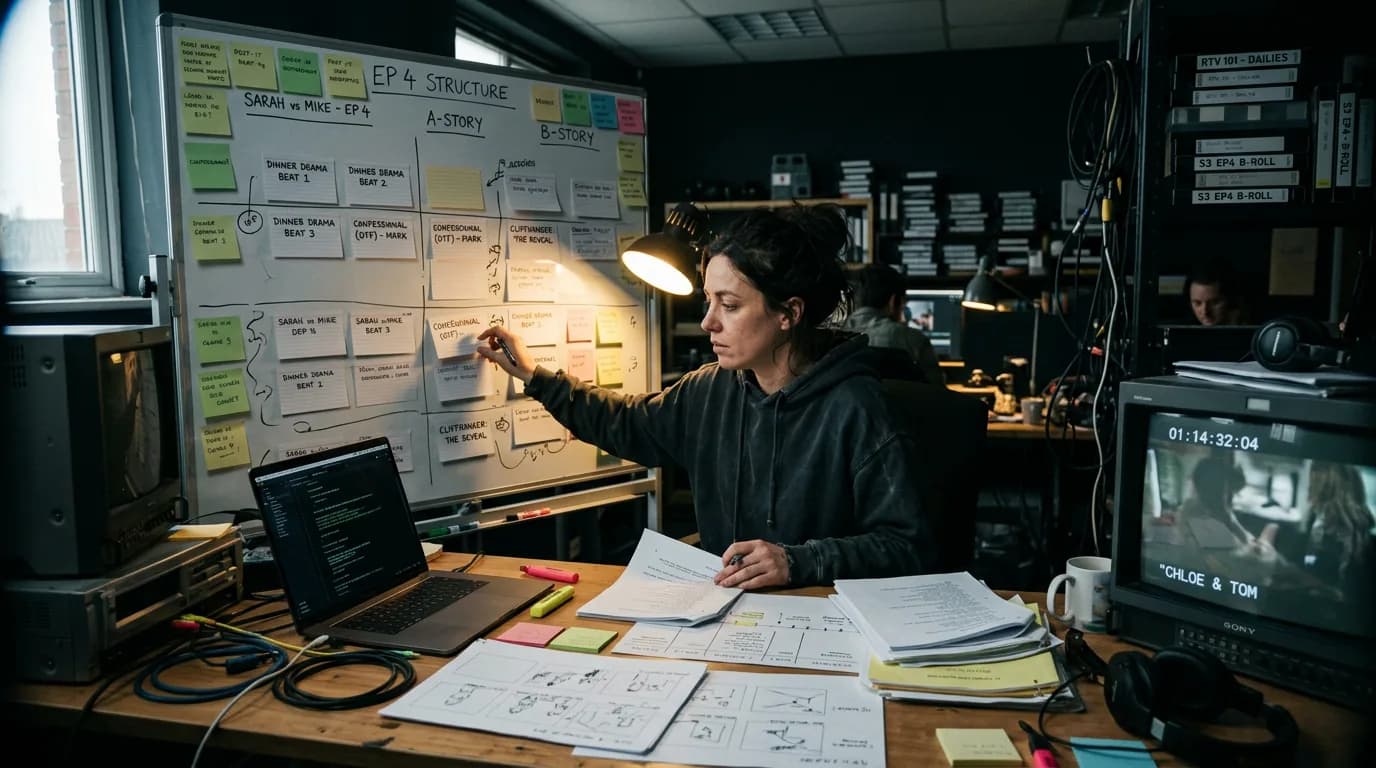
These two visuals work as a pair: the first shows Cinematic workflow still, first angle, 35mm film grain, and the second shifts to Cinematic workflow still, second angle, 35mm film grain - compare them briefly, then move on.
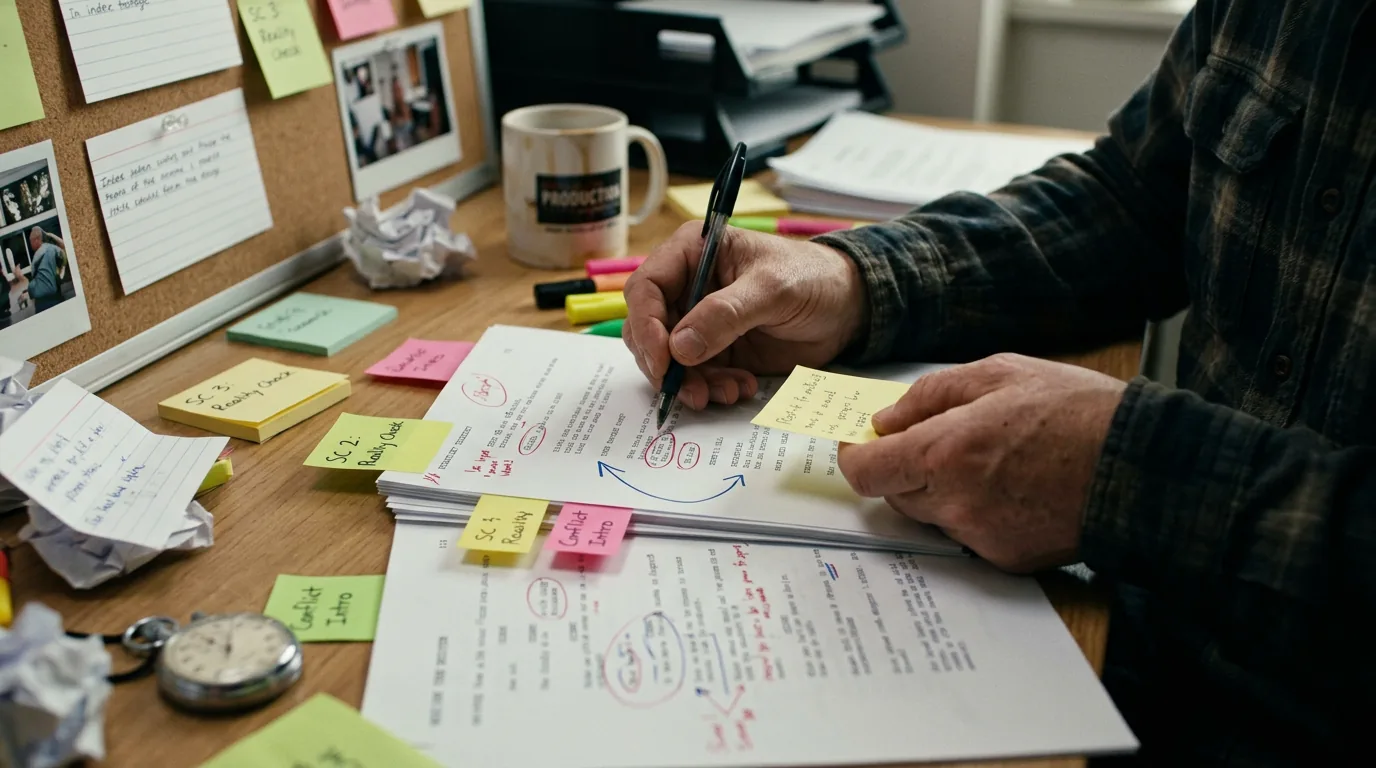
What a Paper Edit Actually Is
A paper edit is a detailed written document that describes the content of an episode before it's assembled in editing software. It includes:
Scene breakdowns. What happens in each scene, in what order.
Transcript references. Specific quotes from footage, with timecodes and tape/file identifiers.
B-roll selections. What visual material (establishing shots, reactions, activities) will cover the scene.
Interview bites. Which on-camera interviews ("OTFs" or "confessionals") will be used to explain or comment on action.
Music and sound cues. General guidance on tone and transitions.
Documentary uses the same device for archive sequences, one row per clip with the source and the clearance beside it. The paper edit is called "paper" because it was historically printed, a physical document that producers and editors could mark up together. Today, it might live in a Google Doc or specialized software, but the concept is the same: write the show before you cut it.
The paper edit serves several purposes:
Alignment. It ensures the showrunner, story producers, and editors share a vision before expensive editing time begins.
Efficiency. Editors don't have to hunt through 600 hours of footage; they follow the paper edit to find specific moments.
Story control. The showrunner can review and approve narrative choices at the paper stage, before they're locked in the timeline.
The Story Producer's Role: Writing Without a Script
In reality TV, the story producer is the de facto screenwriter. They don't write dialogue, they find it in footage. They don't invent plots, they identify and shape narratives from what actually happened.
The story producer's workflow typically includes:
Logging. Reviewing footage and creating logs, summaries of what happens in each clip, with timecodes. This is tedious but essential; you can't write from footage you haven't seen.
Identifying story threads. What conflicts emerged? What relationships changed? What moments are emotionally compelling? The story producer flags potential narratives.
Building scenes. Taking discrete moments from different days, different cameras, and different contexts and constructing scenes that feel continuous. A "conversation" on screen might be assembled from three separate recordings.
Writing the paper edit. Sequencing scenes, selecting bites, and describing each moment in written form.
Revising. The showrunner reviews the paper edit and gives notes. The story producer revises until the episode is approved for editing.
Reality TV is written backward. The dialogue exists; you choose which dialogue to use.
This is why "unscripted" television is a misleading term. The material is unscripted. The show is heavily written, just written in post-production rather than pre-production.
The Anatomy of a Paper Edit Document
A paper edit varies by production, but a common format includes:
Header:
- Episode number and title
- Story producer name
- Date and version
Scene-by-scene breakdown:
Each scene includes:
| Element | Content |
|---|---|
| Scene number | Scene 4: "The Confrontation" |
| Footage source | Day 12, Camera A, Timecode 02:14:33–02:19:07 |
| Description | After the elimination, Marcus corners Jade in the kitchen. Tension. |
| Key dialogue (transcribed) | MARCUS: "You knew the whole time." JADE: "I did what I had to do." |
| Interview bite | Jade OTF: "I wasn't going to apologize. Not to him." (Day 12 OTF, TC 00:04:22) |
| B-roll suggestions | CU on clenched fists. Kitchen establishing. Reactions from patio. |
| Music/tone | Tense underscore. Build to button. |
This level of detail allows the editor to find and assemble the scene efficiently.
A Table: Paper Edit Elements and Their Functions
| Element | Function | Example |
|---|---|---|
| Scene header | Identifies the scene and its purpose | "Scene 7: The Alliance Forms" |
| Timecodes | Directs editor to specific footage | Day 5, Cam B, 01:22:14 |
| Transcribed dialogue | Shows what will be heard | ALEX: "We need to stick together." |
| Description | Explains visual and emotional content | They shake hands. Tentative trust. |
| Interview bites | Provides commentary/context | Alex OTF: "I didn't trust her, but I needed her." |
| B-roll | Covers edits and transitions | Sunset. House exterior. Reaction shots. |
| Music notes | Sets emotional tone | Hopeful but uncertain. Soft strings. |
Three Scenarios: Different Reality TV Structures
Scenario A: Competition Reality (Survivor, Big Brother)
The show has built-in structure: challenges, eliminations, tribal councils. The paper edit fits events into a narrative that emphasizes drama and character.
Paper edit focus: Who's in conflict? Who's at risk? What alliances are forming or breaking? The paper edit weaves these threads into a coherent episode arc.
Challenge: Balancing screen time across a large cast while maintaining story focus.
Scenario B: Docu-Soap (The Real Housewives, Love Island)
The show follows relationships and social dynamics without formal competition. Structure must be imposed on open-ended footage.
Paper edit focus: Finding "scenes", discrete moments of conflict, bonding, or revelation. Creating act breaks where none naturally exist.
Challenge: Without challenges or eliminations, the story producer must manufacture momentum. What's at stake? What are characters pursuing?
Scenario C: Observational Documentary (Below Deck, 90 Day Fiancé)
The show follows real situations (a yacht charter, an international relationship) with inherent structure but unpredictable outcomes.
Paper edit focus: Identifying the episode's throughline. What's the central conflict this week? How do subplots intersect with the main story?
Challenge: Real events may not fit clean story arcs. The paper edit must shape messy reality into satisfying narrative.
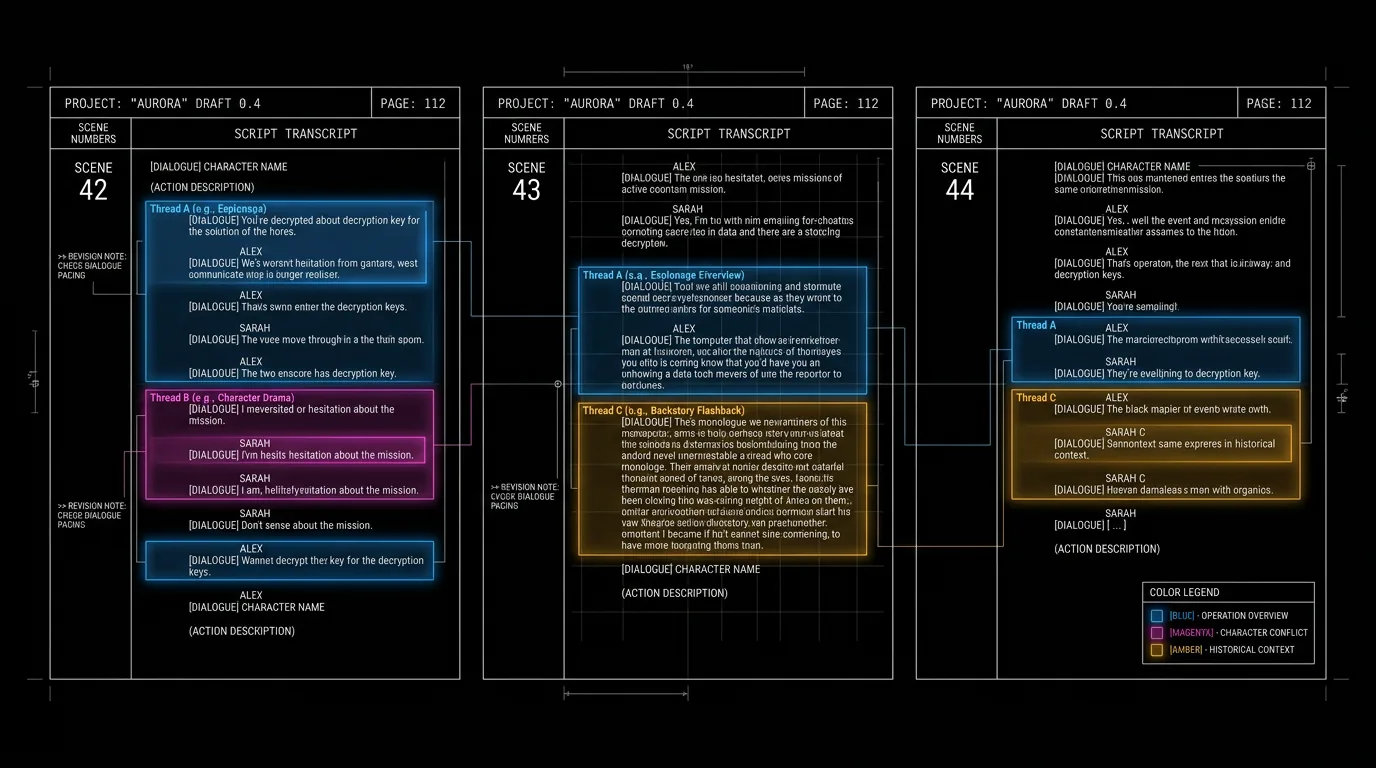
Try it free
Try Screenweaver for free on your script
It is free. Import your existing project, get a clearer view of your outline, and regain control of your story structure in minutes.
Start FreeThe "Trench Warfare" Section: What Goes Wrong
Failure Mode #1: No Story, Just Events
The paper edit sequences events chronologically, Day 5, then Day 6, then Day 7, without shaping them into a narrative. The episode recounts what happened but doesn't tell a story.
How to Fix It: Ask: What's the question this episode answers? What's the arc? Sequence scenes for narrative effect, not just chronology. Start with tension; end with resolution or cliffhanger.
Failure Mode #2: Over-Reliance on OTFs
Every scene is followed by an interview bite explaining what just happened. The show becomes talking heads narrating events rather than events speaking for themselves.
How to Fix It: Trust the footage. Use OTFs for internal perspective ("I was scared"), not for explanation ("That's when things got tense", we can see that). Let scenes breathe.
Failure Mode #3: Frankenbiting
Dialogue is assembled from fragments to create statements that were never actually said. "I... hate... Marcus" might be assembled from "I don't hate Marcus" + "I hate doing dishes" + "Marcus is fine, I guess." Ethically questionable. Legally risky.
How to Fix It: Use complete sentences where possible. If you must edit within a quote, preserve the speaker's intent. Never manufacture a position the person doesn't hold.
Failure Mode #4: Invisible Geography
The paper edit assumes the audience knows where scenes are taking place. Characters jump from kitchen to patio to bedroom without establishing shots, confusing the spatial logic.
How to Fix It: Include B-roll suggestions that establish location. Ground each scene before diving into dialogue.
Failure Mode #5: Character Imbalance
The episode focuses entirely on two characters while ignoring the rest of the cast. Six people live in the house, but four are invisible.
How to Fix It: Track screen time in the paper edit. Even minor moments keep supporting characters present. Balance isn't always equal, but it shouldn't be neglected.
Ethical Considerations
Reality TV editing raises ethical questions that don't exist in scripted work:
Authenticity vs. narrative. Editing shapes perception. A person's complex behavior can be flattened into a "villain edit" through selective use of footage. Is this fair?
Consent and context. Participants sign releases, but do they understand how their words might be recontextualized? A joke made sarcastically might be edited to seem sincere.
Frankenbiting concerns. Assembling dialogue from fragments can distort meaning. The line between editing for clarity and editing for manipulation is blurry.
Story producers operate within the showrunner's vision and network standards, but individual ethical judgment matters. The paper edit is where these decisions are made, long before the audience sees anything.
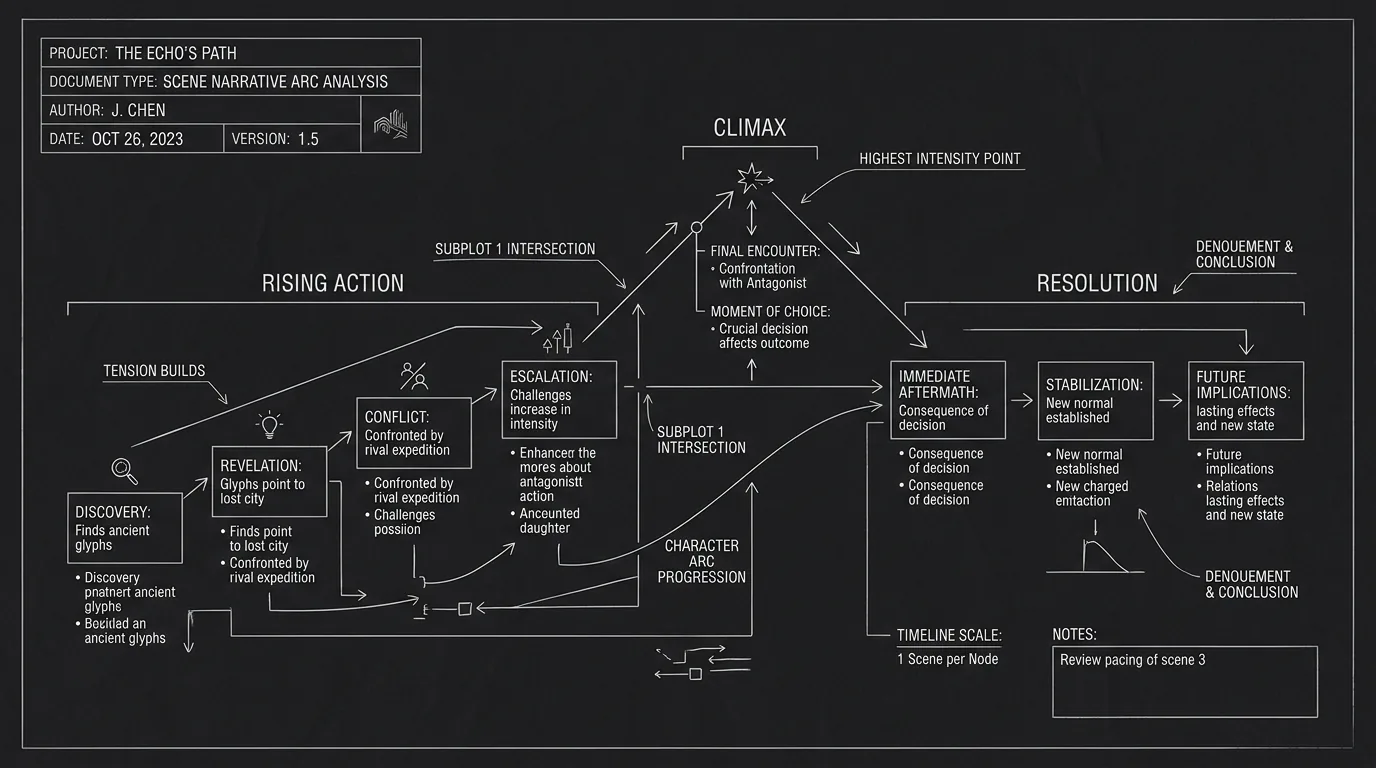
From Paper Edit to Final Cut
The paper edit isn't the final product, it's a map for the editor. Here's how the process continues:
Editor's rough cut. The editor follows the paper edit to assemble footage. The rough cut is usually long, including options and alternatives.
Story producer review. The story producer watches the rough cut and notes what's working and what isn't. Some scenes from the paper edit may be dropped; others may need different footage.
Showrunner review. The showrunner gives notes on story, pacing, and character. The paper edit may be revised based on how footage actually cut together.
Fine cut. The editor refines based on notes. Music and sound design are layered in.
Picture lock. The episode is approved. No more story changes.
Throughout this process, the paper edit serves as the guiding document. It's revised repeatedly, but it remains the story's spine.
The Perspective: Writing the Unseen
Story producers don't get "Written by" credits. Their work is invisible to the audience, and often to awards committees. But the craft is real screenwriting: structure, character, pacing, emotional arc. The difference is that the raw material already exists; the skill is in selection and assembly.
This is a humbling discipline. You can't write a perfect line, you can only find the best line that was actually said. You can't invent a climax, you can only recognize one when you see it.
But within those constraints, story producers create television. They shape hundreds of hours into forty-two minutes that feel inevitable. They find the story in the chaos.
That's writing. Even if no one calls it that.
[YOUTUBE VIDEO: A reality TV story producer walking through a paper edit for a single episode, showing how they identify story threads and construct scenes from raw footage.]
Further reading:
- For guidance on finding narrative arcs in real events, see scripting true crime: finding the narrative arc in real events.
- If you're working on documentary, see our documentary series treatment guide.
- The Editors Guild has resources on reality TV editing practices at editorsguild.com{:rel="nofollow"}.
Final Step
Build your next script with Screenweaver
Move from ideas to production-ready pages faster with timeline-native writing and AI-assisted story flow.
Try Screenweaver