The script reaches the actor's team. A manager, an agent, maybe the actor themselves. They flip to page four, where the protagonist first appears. They read:
"SARAH MILLER, 35, enters."
They keep flipping.
Or:
"SARAH MILLER (35) steps into the room like she owns it and apologizes to no one. Her clothes are expensive but rumpled, slept-in, last night was either very good or very bad. When she smiles at the receptionist, it's the smile of someone who knows exactly what she wants and has stopped caring who knows."
They stop flipping.
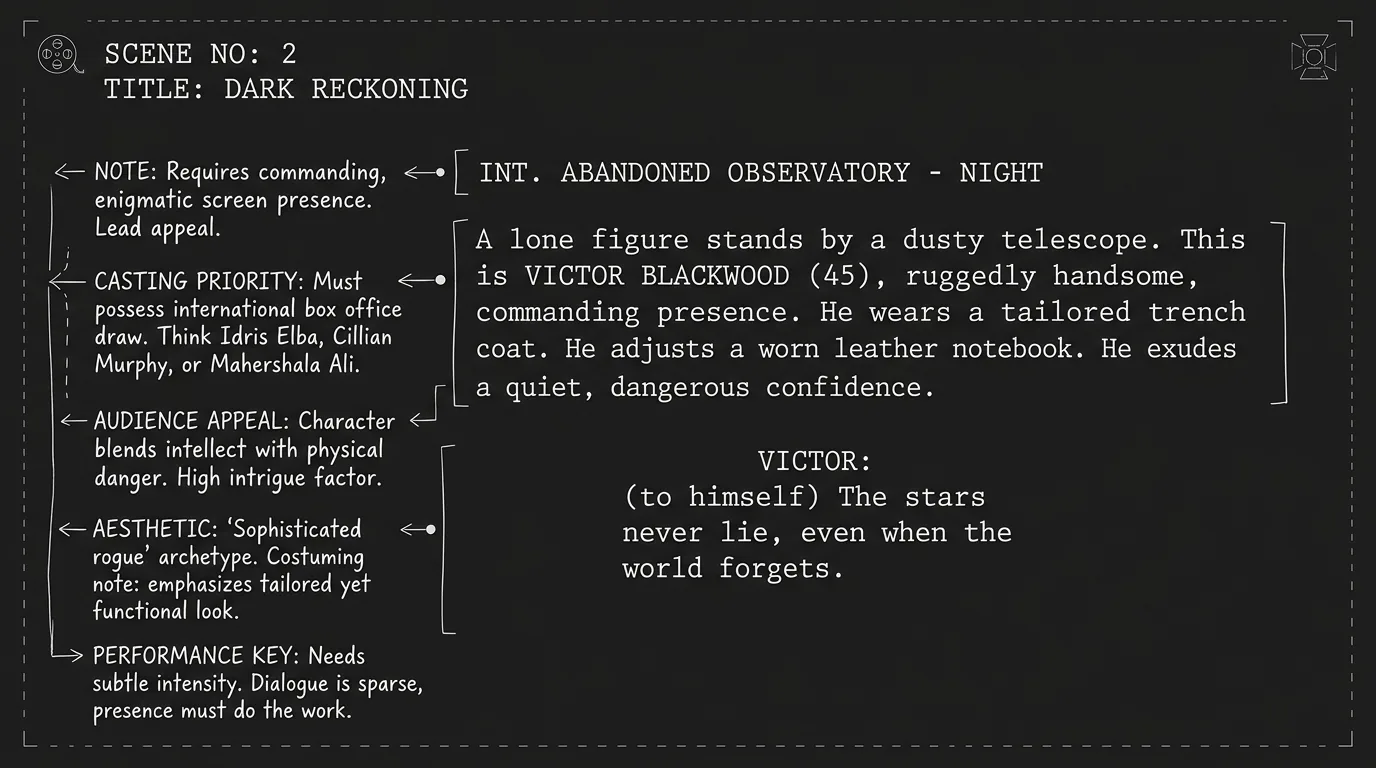
The character introduction is your casting pitch. In sixty words or less, you tell the reader who this person is, not their biography, not their physical measurements, but their essence. The thing that makes an actor say: "I want to play that."
Cinematic workflow frames

These two visuals work as a pair: the first shows Cinematic workflow still, first angle, 35mm film grain, and the second shifts to Cinematic workflow still, second angle, 35mm film grain - compare them briefly, then move on.
Why Character Introductions Matter
The introduction is the reader's first impression. It determines:
Emotional investment. Does the reader care about this person? Are they intrigued, repelled, curious?
Casting vision. Can the reader (producer, director, casting agent) see who might play this role?
Actor interest. Does the actor reading the script see a part worth playing?
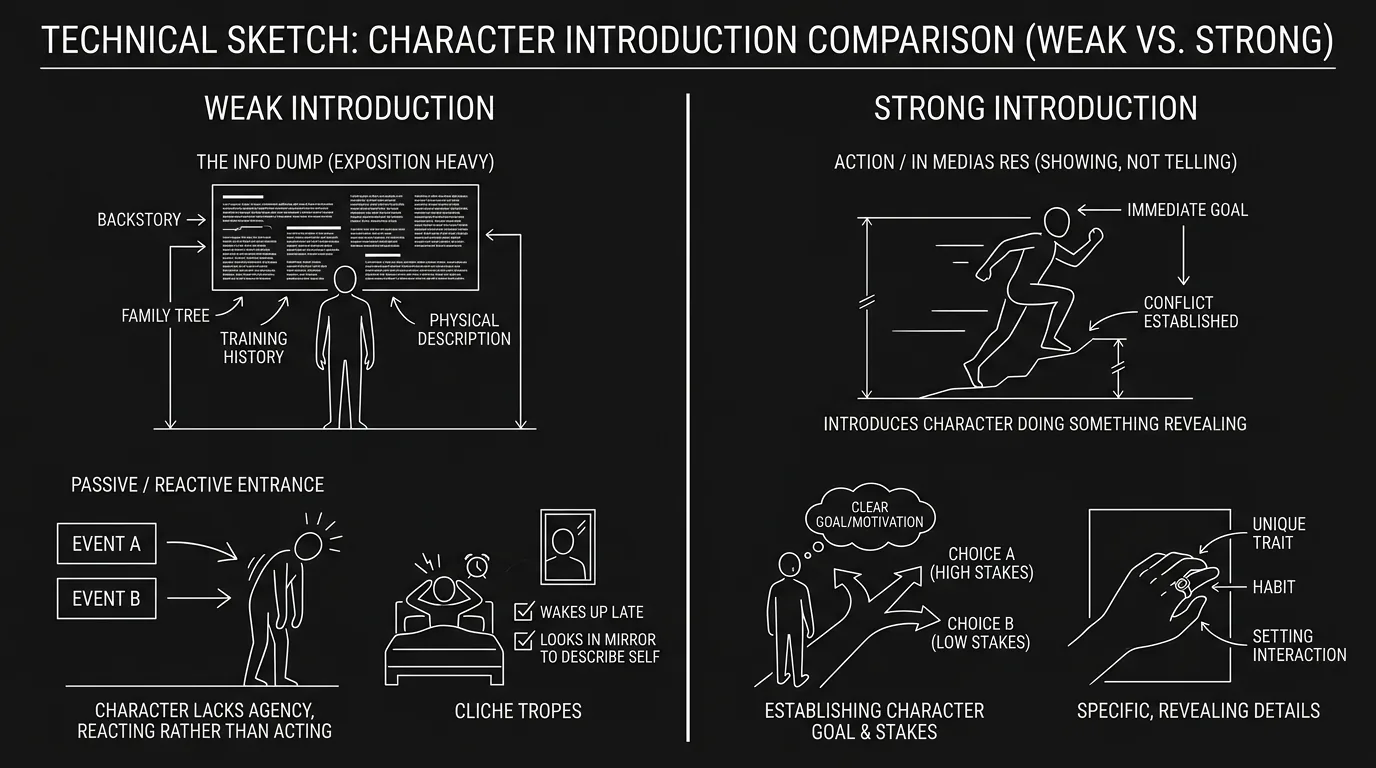
A flat introduction, "JOHN, 40, enters", does none of these things. It conveys basic information (name, age) and nothing else. It's a placeholder, not a portrait.
A great introduction does all three. It creates a person in the reader's mind. It suggests the kind of actor who could embody this role. And it promises the actor that this character has depth worth exploring.
What Attracts A-List Actors
A-list actors choose roles for complex reasons, but patterns emerge:
Complexity. They want characters with contradictions, depth, room for interpretation. Not villains who are simply evil or heroes who are simply good.
Transformation. They want characters who change, who are different at the end than at the beginning. Awards love arcs.
Challenge. They want roles that demand something: physical transformation, emotional range, unfamiliar territory.
Scene-stealing potential. They want moments that showcase their abilities. The monologue. The breakdown. The quiet devastation.
Your character introduction hints at these things. It says: This role has depth. This character will surprise you. This is a performance opportunity.
A Table: Weak vs. Strong Character Introductions
| Weak Introduction | Strong Introduction |
|---|---|
| "JOHN (45) sits at the bar." | "JOHN (45) sits at the bar, nursing a drink like it owes him money. His wedding ring catches the light, he keeps touching it, then stopping himself." |
| "MARIA, 30, beautiful." | "MARIA (30) enters, the kind of beautiful that stops conversations. She's aware of it and exhausted by it." |
| "DETECTIVE COLE is tough." | "DETECTIVE COLE (50s) chews a toothpick like it insulted his mother. Twenty years on the job, and he still hasn't learned to fake a smile." |
| "EMMA is nervous." | "EMMA (25) straightens her collar for the third time. Her confidence is a costume she's still learning to wear." |
The strong versions create instant character. They suggest internal life, contradiction, backstory.
Technique #1: The Defining Contradiction
Great characters contain opposites. The introduction should hint at this:
Example:
MARCUS WEBB (40s) wears a preacher's collar and a convict's scars. When he prays, it sounds like a threat.
Preacher and convict. Prayer and threat. The contradiction invites questions: Who is this person? What happened to them? Actors love roles they can explore.
Example:
DR. LISA CHEN (30s) is the youngest chief of surgery this hospital has seen. She makes decisions that save lives, then cries in the supply closet. No one has ever seen her cry.
Competent yet vulnerable. Public strength, private fragility. The role promises emotional range.
Technique #2: The Behavioral Detail
Rather than abstract qualities ("kind," "intelligent"), show behavior:
Example:
TOM (60s) enters a room and immediately reorganizes the chairs into a circle. He can't help himself, he's been facilitating for thirty years.
We don't say Tom is organized or helpful. We show it through action. The reader infers the qualities from the behavior.
Example:
CLAIRE (28) laughs too loud at her own jokes, and checks to see if anyone else is laughing. They're not.
We understand Claire's insecurity without naming it. The detail is specific, sad, funny.
Technique #3: The Evocative Comparison
Comparisons create instant imagery:
Example:
VICTOR REYES (40s) dresses like a mortician at a wedding, always slightly too formal, always slightly out of place.
The comparison is specific and visual. The reader sees Victor.
Example:
HARRIET (70s) moves through the room like a retired dancer, grace that refuses to fade, even when the body says otherwise.
We understand Harriet's history without a backstory dump. The comparison does the work.
Try it free
Try Screenweaver for free on your script
It is free. Import your existing project, get a clearer view of your outline, and regain control of your story structure in minutes.
Start FreeWhat to Avoid
Avoid over-specific physical description. "Brown hair, 5'7", 145 pounds, green eyes" limits casting and bores readers. Unless physical details matter to the story, leave them open.
Avoid generic adjectives. "Beautiful," "handsome," "smart," "tough" say nothing. Show these qualities instead.
Avoid camera directions. "We see SARAH for the first time" intrudes. Just introduce her.
Avoid backstory dumps. "JOHN, who lost his wife three years ago and now struggles with alcoholism" is telling, not showing. Let backstory emerge through story.
Avoid clichés. "Girl-next-door charm" and "bad-boy edge" are casting speak, not character writing.
The Age Question
Actors are sensitive about age. Specificity can backfire.
Options:
- Exact age: "JAMES (42)" – Use when age matters precisely.
- Decade: "JAMES (40s)" – Common, flexible.
- Life stage: "JAMES, middle-aged" – Vague, allows wider casting.
- Relational: "JAMES, older than his years" – Evocative, open.
In general, use the decade format (30s, 40s, 50s) unless plot demands precision. It's casting-friendly.
The "Trench Warfare" Section: What Goes Wrong
Failure Mode #1: The Empty Introduction
"JACK, 35, enters."
No character. No essence. No reason to care.
How to Fix It: Add at least one detail that reveals personality, history, or behavior.
Failure Mode #2: The Laundry List
"SARAH (28), tall, blonde, athletic, smart, funny, kind, with a troubled past and a fear of commitment."
Too much. Contradictory. Impossible to hold in mind.
How to Fix It: Choose one or two defining elements. Let the rest emerge through story.
Failure Mode #3: The Acting Instruction
"MARCUS (50) should be played with quiet intensity."
This isn't a character introduction; it's a performance note. Intrusive. Unwelcome.
How to Fix It: Describe the character, not the performance. "MARCUS (50) is quiet, but his silence has a weight that fills the room."
Failure Mode #4: The Beauty Trap
"ELENA is the most beautiful woman in the world."
This is unmeetable. No actor is the most beautiful woman in the world. You're setting up failure.
How to Fix It: Be specific about what makes her striking. "ELENA (30) has the kind of face that makes people forget what they were saying."
Failure Mode #5: Gendered Stereotypes
"STRONG but SENSITIVE." "Tough but with a SOFT SIDE." These are gendered clichés masquerading as complexity.
How to Fix It: Write specific contradictions that feel earned. What does "strong" look like in action? What does "sensitive" mean for this person?
Example: Rewriting a Flat Introduction
Before:
DAVID CHEN, 38, a doctor, enters the emergency room.
After:
DAVID CHEN (38) moves through the emergency room like he's done it ten thousand times, because he has. Coffee stain on his scrubs. Wedding ring on a chain around his neck, too dangerous to wear on his hand. He smiles at a dying man and the smile is real.
The rewrite shows competence, routine, backstory (why the ring on a chain?), and humanity. David is a person now.
Case Study: Great Character Introductions
From Juno (Diablo Cody):
"JUNO MACGUFF stands on a suburban front lawn, drinking from a large carton of Sunny Delight. Her outfit is a curious combination of punky and preppy."
Simple but specific. The Sunny Delight. The "punky and preppy" combination. We know Juno immediately.
From The Silence of the Lambs (Ted Tally):
"CLARICE STARLING, mid-20's, her features only conventionally pretty. She is tense, sweaty, grubby, but there's a strength about her, some mark of recent courage."
"Only conventionally pretty" invites casting of a real person, not a movie star type. The "mark of recent courage" promises depth.
From The Social Network (Aaron Sorkin):
"MARK ZUCKERBERG is a sweet-looking 19-year-old who's probably not aware that he can be alternately sweet and sour, or that he has a bad habit of coming across as though he's got 120 things on his mind and his current conversation isn't one of them."
Complex immediately. Sweet-looking but sour. Brilliant but absent. The contradiction is the character.
The Perspective: Writing People, Not Types
Actors don't want to play types. They want to play people, complex, contradictory, surprising people.
Your character introduction is your first chance to say: This is a person worth becoming. Not a villain. Not a love interest. Not a sidekick. A human being with a history, a wound, a want.
When you write a great introduction, you're casting the role yourself, not by specifying "a George Clooney type" but by creating a character so vivid, so intriguing, so clearly worth exploring that any talented actor would want to inhabit them.
That's the goal. Sixty words that create a person. Sixty words that stop the page-flipping and start the imagining.
Write introductions that make actors say: "I need to play this."
[YOUTUBE VIDEO: A casting director discussing what makes them stop and pay attention to a character in a script, with examples of introductions that led to A-list casting.]
Further reading:
- For writing internal states without overwriting, see the unfilmable action line: when to write what can't be seen.
- If you're developing character arcs, see Chekhov's Gun: tracking setups and payoffs.
- The WGA Foundation hosts panels on character writing at wgafoundation.org{:rel="nofollow"}.
Final Step
Build your next script with Screenweaver
Move from ideas to production-ready pages faster with timeline-native writing and AI-assisted story flow.
Try Screenweaver