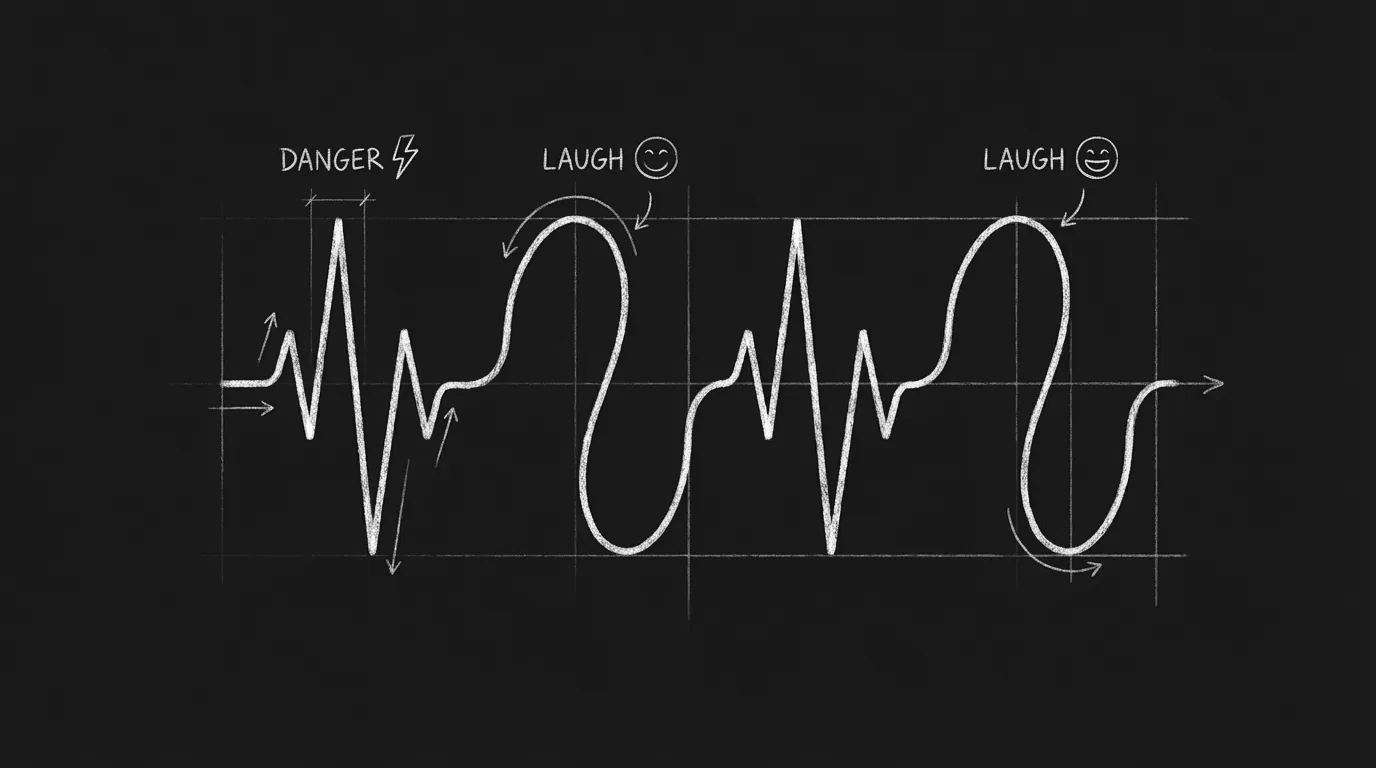
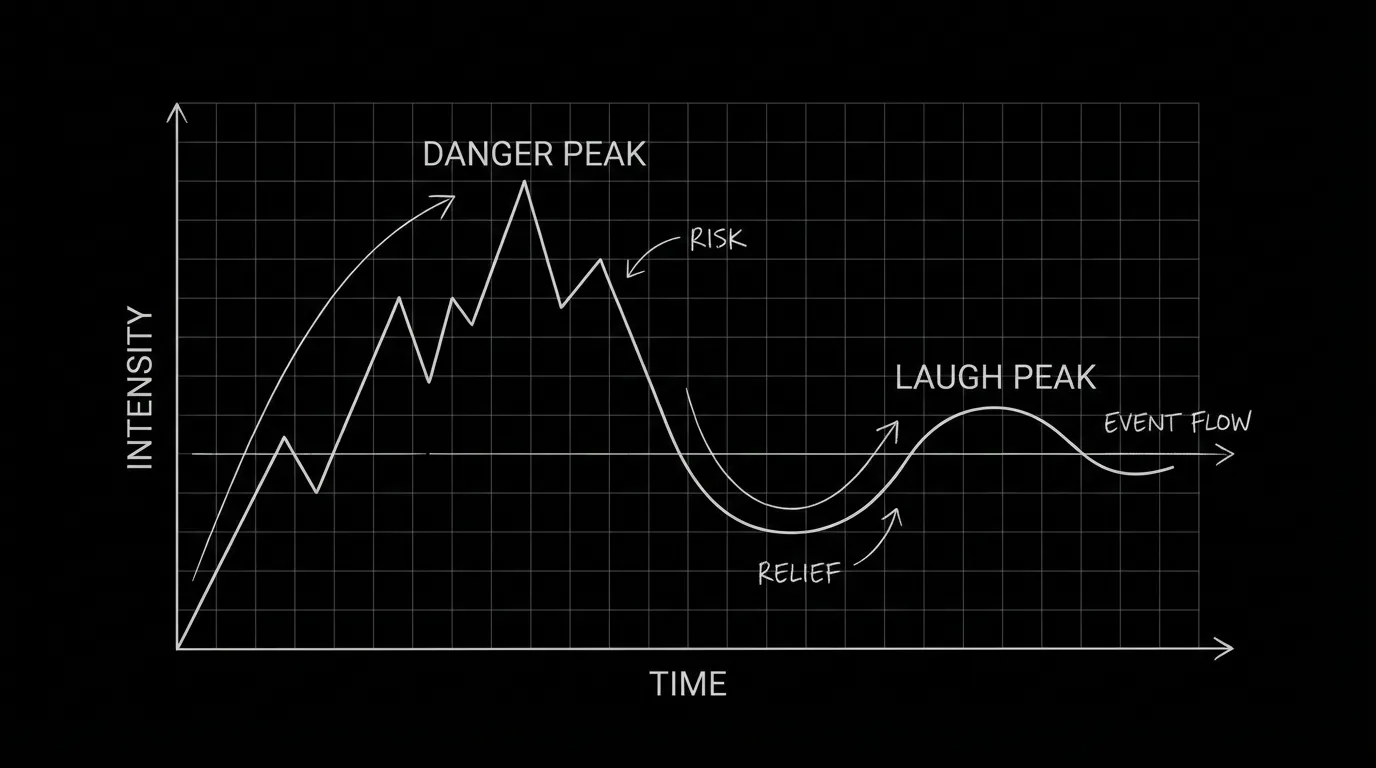
Hero image prompt: Dark mode technical sketch. Solid black background, thin white hand-drawn lines. A single curve that oscillates between two states, one peak labeled “danger,” one peak labeled “laugh”, same line, alternating. No neon. Minimalist, high-contrast.
The car flips. He crawls out. He says the line. The audience laughs, but they’re still holding their breath. Action-comedy lives in that split. If the stakes disappear when the joke lands, the genre goes flat. If the jokes disappear when the stakes rise, you’ve got a straight action movie with a few one-liners. The craft is in the rhythm: when to let the danger breathe, when to cut it with a beat, and when to let someone actually get hurt. Here’s how to keep both sides alive on the page.
The best action-comedy doesn’t undercut the stakes. It lets the stakes sit there, then finds the human response, the panic, the absurdity, the wrong thing to say at the worst moment. The laugh comes from the reality, not from dismissing it.
Think about Lethal Weapon or The Nice Guys. People die. The threat is real. But the protagonists are also funny, because they’re scared, because they’re messes, because they say what we’re thinking at the worst time. The comedy doesn’t erase the action. It runs alongside it. Your job as a writer is to pace the two so they don’t cancel each other out. A joke too soon after a death can feel cruel. A death too soon after a big laugh can feel like a bait-and-switch. The audience has to believe that the danger matters. Then they can laugh when the character finds a way through it, or fails to.
Free tool: use the Beat Sheet Calculator to map these beats to exact page numbers for your script length.
Why the Balance Matters
Action-comedy has two engines: physical stakes and comedic release. If you lean too hard on comedy, the action feels like a cartoon. No one’s really at risk. The punches don’t land. If you lean too hard on action, the comedy feels like a distraction. The audience wants to know if they’ll make it; they don’t want to be pulled out for a gag. The balance is in the timing. You raise the stakes. You let them sit. Then you release with a beat that’s true to the character, a quip, a mistake, a reaction that’s human. The release doesn’t lower the stakes. It lets the audience breathe so you can raise them again.
The other half of the balance is consequence. In the best action-comedy, the danger has cost. Someone gets hurt. Something is lost. The joke might come right after, but the hurt is still there. When the comedy and the stakes are both real, the genre earns its tone. When the comedy is used to avoid consequence, the audience stops caring. So the rule is: the stakes have to be real enough that the joke is a relief, not a replacement for feeling. Our guide on formatting fight scenes applies when you’re writing the action side, clarity on the page keeps the reader in the moment so the comedy can land in the right place.
Pacing the Switch: When to Laugh, When to Hold
Let the danger land first. After a big action beat, a crash, a near-miss, a loss, give the audience a moment to feel it. One beat. Two. Then the character can react. The reaction might be a line. It might be a physical beat (checking they’re in one piece, then the wrong thing comes out). If you cut to the joke too fast, the audience doesn’t register the danger. If you wait too long, the moment passes and the joke feels late. The sweet spot is: we feel the impact, then we get the release. That’s the rhythm.
Use character for the comedy, not set-up/punch. The funniest moments in action-comedy come from who the character is. The coward who says what we’re thinking. The pro who’s annoyed by the amateur. The pair who can’t stop bickering even when they’re running. When the joke is a one-liner that could belong to anyone, it feels pasted on. When the joke is what this person would say in this situation, it feels earned. So the comedy isn’t separate from the action. It’s the character’s response to the action. For more on making dialogue feel distinct, see distinct voices and the blind read test.
Don’t protect everyone. If no one important is ever hurt, the stakes are fake. The audience knows it. So let the action have cost. A supporting character. A wound that lasts. A loss that the protagonist carries. The comedy can sit next to that. It doesn’t have to erase it. Deadpool works because the stakes are real for him and for the people he cares about, the humor is his way of coping, not a way of avoiding the cost.
| Principle | What It Does |
|---|---|
| Let danger land first | One or two beats of consequence before the release; we feel it, then we laugh |
| Comedy from character | The joke is what this person would say here; not generic one-liner |
| Consequence is real | Someone can get hurt; the comedy doesn’t erase the cost |
| Rhythm of raise and release | Stakes go up, we breathe, joke, then stakes can go up again |
Try it free
Try Screenweaver for free on your script
It is free. Import your existing project, get a clearer view of your outline, and regain control of your story structure in minutes.
Start FreeRelatable Scenario: The Script That Jokes Too Soon
You’ve written a chase. The car goes off the road. Cut to: the hero crawling out, dusting off, and dropping a punchline. The reader never felt the crash. So you add a beat. The car stops. Silence. They’re both still. One of them moves. “You okay?” “No.” Then the joke, something that comes from the relief of being alive, or from the character’s inability to be serious. Now the danger landed. The joke is a release. The same joke, different placement, different effect. For more on controlling rhythm on the page, see micro-pacing and white space.
Relatable Scenario: The Script That’s All Stakes, No Release
You’ve written an action sequence. It’s tense. It goes on for six pages. The reader is exhausted. There’s no moment to breathe. So you find one beat where the character can react like a human. Not a joke that undercuts, a reaction that lets us remember we’re with a person. A muttered “oh no.” A wrong move that’s funny because it’s so wrong. A line that’s exactly what someone would say when they’re in over their head. One beat of release. Then you can tighten the screws again. The audience will follow because you gave them a breath.
The Trench Warfare Section: What Beginners Get Wrong
Using comedy to avoid writing the action. The action is vague. “They fight. It’s chaotic.” The jokes do the work. The reader never sees the stakes. Fix: write the action clearly. Who’s where? What’s the threat? Then add the character’s response. The comedy lives in the response, not in place of the action.
Making every line a joke. Page after page of quips. The audience gets tired. Nothing lands. Fix: let some moments sit. Let the character be scared. Let them be quiet. The jokes that stay are the ones that come after we’ve felt something. For more on comedy rhythm, see the rule of three and comedy.
No consequence. The hero is invincible. The sidekick is invincible. We never believe they’re in danger. Fix: let someone get hurt. Let a plan fail. Let the cost of the action be visible. Then the comedy has something to play against.
Tone whiplash. We’re in a full comedy scene, then someone dies with no setup. The audience feels manipulated. Fix: the danger has to be present from the start. The tone can shift, but the possibility of loss should be there so the shift doesn’t feel random.
Step-by-Step: Checking the Balance
After you’ve written an action-comedy sequence, mark every beat that’s “stakes” and every beat that’s “release.” Are they alternating? Is there a long stretch with no release? Add one character beat, a line, a reaction, that lets the audience breathe. Is there a long stretch with no stakes? Add a moment of real danger or cost. The goal is a rhythm: we care, we laugh, we care again. When both engines are running, the genre works. For structure that supports this kind of pacing, see beat boards and outlines, mapping the sequence can help you see where the balance goes off.
One External Resource
For a short overview of the action-comedy genre and its conventions, see Action comedy on Wikipedia. Reference only; not affiliated.
The Perspective
Action-comedy isn’t action with jokes. It’s action and comedy sharing the same space. The stakes have to be real enough that the laugh is a relief. The comedy has to be real enough that we remember we’re with humans. When you get the rhythm right, danger, breath, release, danger again, the audience gets to be scared and laughing at the same time. That’s the contract. Honor both sides.
Final Step
Build your next script with Screenweaver
Move from ideas to production-ready pages faster with timeline-native writing and AI-assisted story flow.
Try Screenweaver