
The call connects.
One voice is trained to stay calm. The other voice is unstable, angry, terrified, and armed. Somewhere behind that second voice, someone is breathing too fast and trying not to make a sound.
This is where many scripts either get brilliant or collapse into cliche.
Hostage negotiation scenes are hard because they look like "just talking." No car chases. No elaborate fight choreography. No spectacle by default. Writers panic and compensate with shouting, countdown threats, and generic lines like "You have ten minutes!" It feels intense for a page, then becomes repetitive.
The truth is the opposite. Negotiation scenes are among the most inherently dramatic forms of action writing because language itself becomes tactical movement. Every line changes risk level. Every pause can save or cost a life. Every misunderstanding can trigger irreversible violence.
That is your opportunity.
If you write it as a conversation, it drags.
If you write it as strategic combat under moral pressure, it sings.
Why Hostage Negotiation Scenes Feel Fake So Often
Weak hostage negotiation scenes usually break in one of four places.
They have no procedural logic. Everyone acts like they are improvising in a genre vacuum.
They flatten psychology. The hostage-taker becomes a screaming archetype, the negotiator becomes a robotic "voice of reason," and hostages become furniture.
They misuse time pressure. Instead of dynamic pressure waves, the scene uses repetitive countdown dialogue.
They skip consequence architecture. Negotiation beats happen, but no meaningful tactical state changes.
Here is why that matters: negotiation is not about saying the right sentence once. It is about maintaining a fragile communication channel while reducing volatility and extracting leverage over time.
That process has rhythm.
A cliche scene does not.
A hostage negotiation scene is not a speech contest. It is a survival algorithm running in human voices.
The Four-Layer Model That Makes the Scene Work
To avoid cliche, write negotiation on four simultaneous layers: tactical, psychological, procedural, and relational.
The tactical layer asks: who controls options right now?
The psychological layer asks: whose emotional state is escalating or stabilizing?
The procedural layer asks: what command decisions and constraints shape available moves?
The relational layer asks: what trust, projection, shame, or need is forming between negotiator and subject?
If you only write one layer, scene depth collapses.
Most beginner drafts overfocus on tactical threats and ignore relational progression. But actual negotiation leverage usually emerges from relational micro-wins: name use, listening markers, validated emotion, controlled choices, face-saving exits.
That does not make scenes soft. It makes them credible and more dangerous, because volatility is now tied to fragile trust.
Scenario One: The Rookie Writer's "Countdown Trap"
Classic beginner setup: the hostage-taker keeps saying "You have five minutes" every page. Negotiator stalls. SWAT waits. No structural movement.
This is the countdown trap. Artificial urgency replaces evolving stakes.
A stronger version uses changing clocks, not one clock. Media clock, tactical breach clock, injured-hostage medical clock, daylight clock, political chain-of-command clock. As these clocks collide, negotiation choices become morally and strategically harder.
Now each exchange matters because time pressure is multi-directional, not repetitive.
Scenario Two: The "Villain Monologue Over Phone"
Another frequent issue: the hostage-taker explains ideology in long speeches while holding everyone at gunpoint. It reads like exposition disguised as tension.
In real pressure environments, people rarely deliver clean doctrine. They loop, fragment, fixate, test, project, and contradict themselves.
Write that instability.
Not chaos for chaos' sake. Patterned instability that the negotiator must read in real time.
When you do this, the scene shifts from "let villain talk" to "decode and survive."
Scenario Three: The "Hero Negotiator Who Solves Everything Alone"
Movies sometimes mythologize one negotiator as omnipotent. On page, this often becomes unrealistic and dramatically narrow.
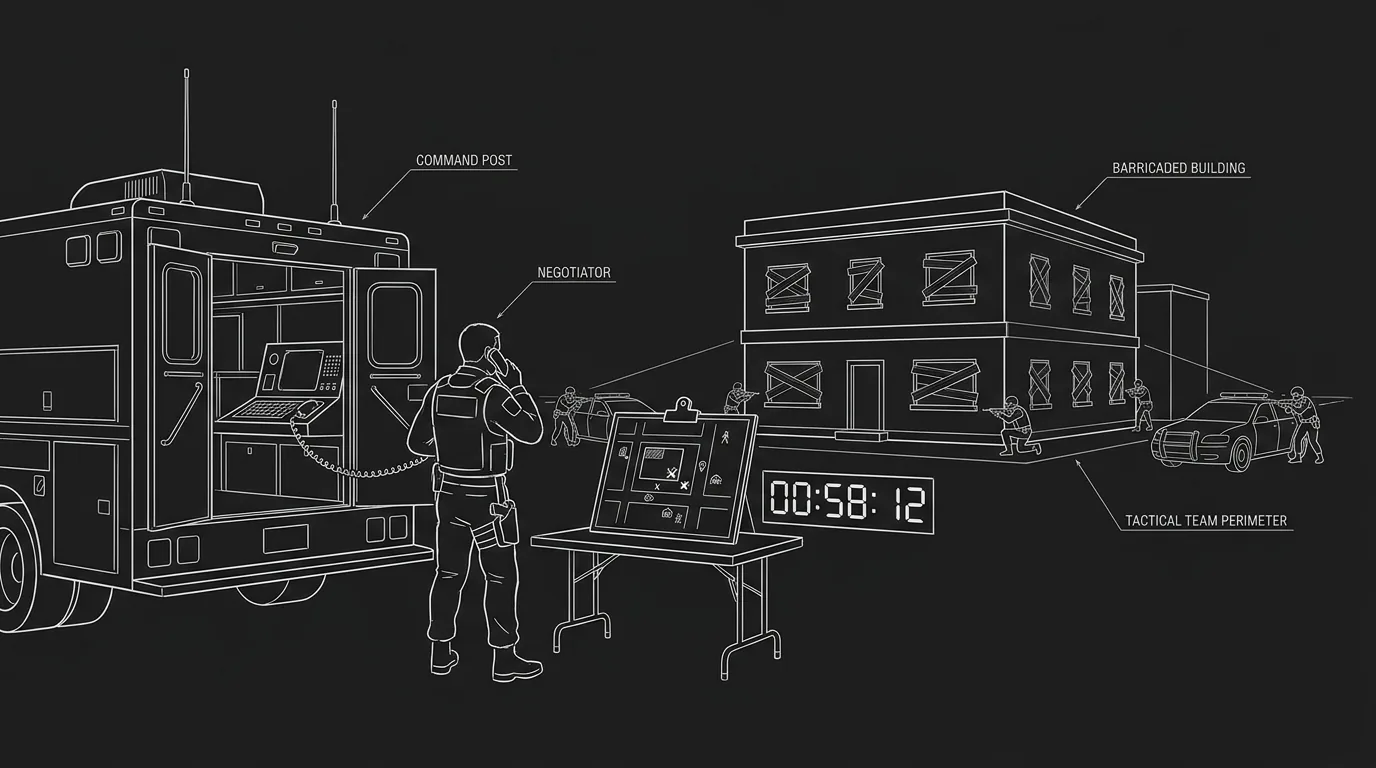
Negotiations are team systems. Intelligence analyst, tactical commander, legal advisor, psychologist, crisis comms, medics, command hierarchy. Your protagonist can still be central, but they should work inside a pressure network.
This gives you richer conflict: the negotiator's best relational move may clash with command's tactical impatience.
Now the scene has internal and external friction.
Step-by-Step Workflow for Writing a High-Pressure Negotiation Scene
Step 1: Define the Non-Negotiables for Both Sides
Before drafting dialogue, write the red lines.
What can the negotiator never promise?
What can the hostage-taker never accept?
What can command never tolerate?
What can the hostage never survive?
Red lines create meaningful decision boundaries. Without them, dialogue feels like improvisation without cost.
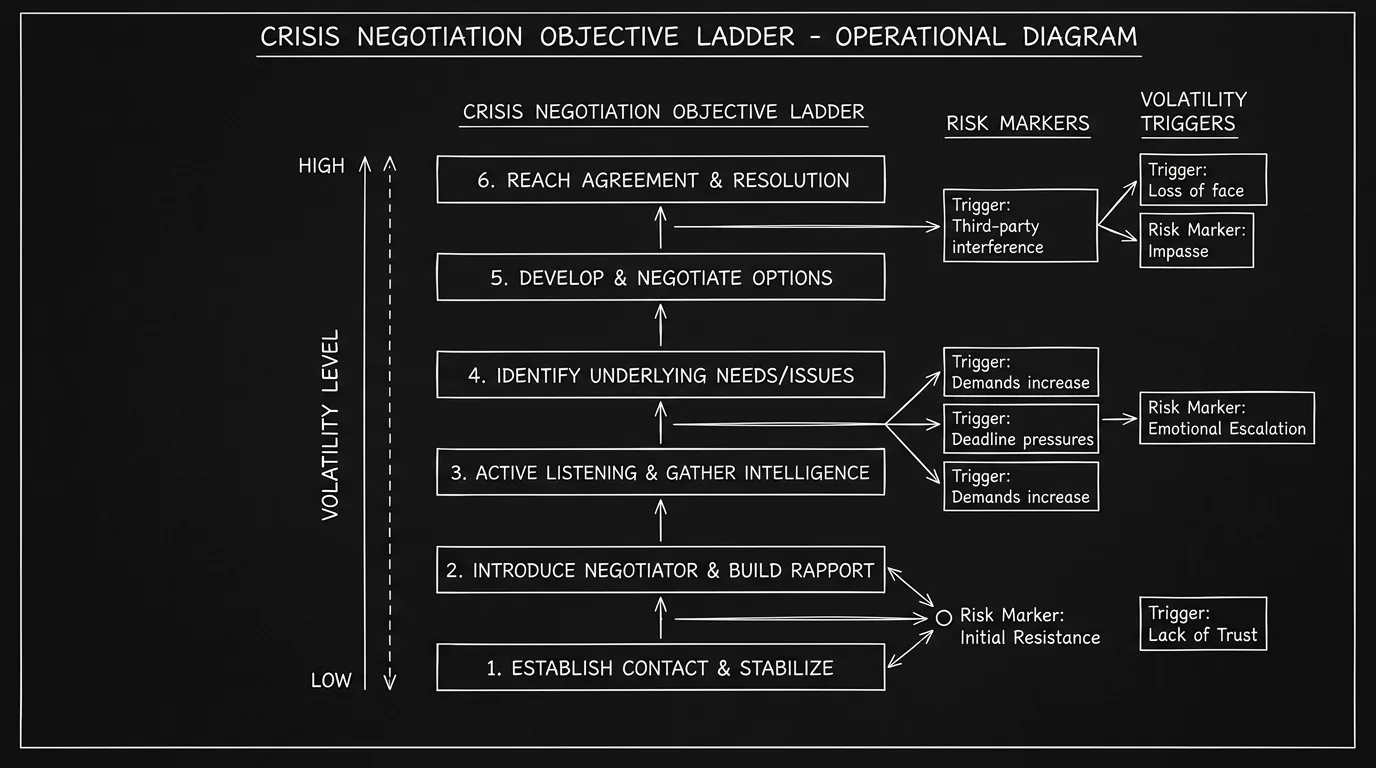
Step 2: Build an Objective Ladder Instead of a Single Goal
A common mistake is one objective: "free all hostages."
Write objective ladders instead.
Phase one objective might be stabilize communication.
Phase two objective might be proof-of-life and hostage count.
Phase three objective might be release vulnerable hostages.
Phase four objective might be controlled surrender.
Each phase should produce new leverage and new risk. This makes the scene progressive.
Step 3: Design Volatility Triggers
List three things that can spike danger abruptly: media leak, mistaken gunshot sound, family member call, power outage, tactical misstep, negotiation phrase interpreted as threat.
Then decide where one trigger hits.
Volatility spikes keep scene alive and test negotiation strategy under stress.
Step 4: Write the Negotiator's Tactic Rotation
Negotiators do not repeat one move forever.
Map tactic rotation:
rapport opening,
active listening,
time expansion,
bounded choice framing,
face-saving offer,
incremental compliance ask.
When one tactic fails, pivot. If your negotiator repeats the same language for two pages, cut and redesign.
Step 5: Give the Subject Internal Logic
Even destabilized subjects act from internal logic. Maybe they fear imprisonment more than death. Maybe they need public validation. Maybe they need one person to hear their grievance. Maybe they feel trapped by irreversible prior action.
Write this logic clearly in your prep notes.
You do not need to justify violence. You do need to understand decision drivers.
Step 6: Stage Hostages as Dynamic Variables
Hostages are often underwritten. Do not do that.
Who is injured?
Who can communicate silently?
Who is mistaken for law enforcement family?
Who becomes emotional catalyst?
Hostage state changes should alter negotiation strategy.
Step 7: End the Scene on Tactical Reconfiguration
Do not end on a loud line.
End on a shift:
one hostage released,
proof-of-life secured,
phone line cut and replaced,
subject moved location,
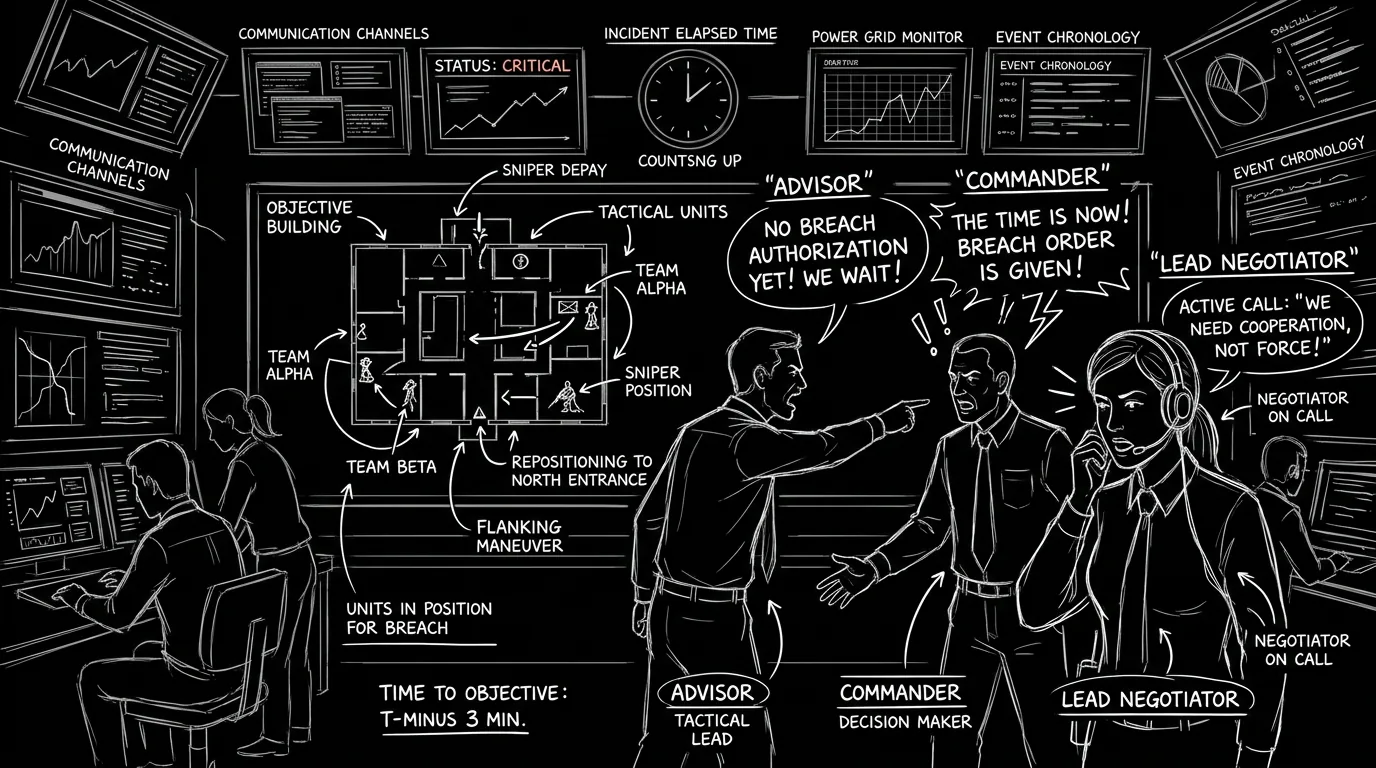
command authorizes contingency breach,
negotiator removed by command.
A reconfiguration beat gives scene forward drive.
Try it free
Try Screenweaver for free on your script
It is free. Import your existing project, get a clearer view of your outline, and regain control of your story structure in minutes.
Start FreeComparison Table: Flat vs High-Functioning Negotiation Writing
| Dimension | Flat Negotiation Scene | High-Functioning Negotiation Scene |
|---|---|---|
| Time pressure | Repetitive countdown dialogue | Multiple interacting clocks |
| Character psychology | One-note rage vs calm | Volatility plus strategic reading |
| Tactical movement | Talking in place | Phase-based leverage shifts |
| Team dynamics | Lone hero negotiator | Conflicting command ecosystem |
| Hostage role | Passive background props | Active risk and leverage variables |
| Scene ending | Shouted threat or cliff line | Concrete tactical reconfiguration |
The Trench Warfare Section: What Beginners Get Wrong (and How to Fix It Fast)
This section is intentionally direct.
First error: writing threat language without escalation logic.
If every line is "I will kill them," threat becomes noise. Fix by tying threats to specific triggers and visible capability shifts.
Second error: no proof-of-life protocol.
Negotiators need verification beats. Fix by adding requests for specific hostage identifiers and behavioral confirmation under controlled prompts.
Third error: magical persuasion.
Negotiator says one empathetic sentence, subject surrenders. Fix by writing trust accumulation over multiple micro-wins.
Fourth error: command room silence.
No one in command challenges negotiator strategy. Fix by introducing internal pressure: legal risk, political oversight, tactical impatience, media escalation.
Fifth error: emotional monotony.
Subject screams nonstop. That is exhausting, not tense. Fix by giving emotional waveform: spikes, fatigue troughs, dissociation moments, paranoid reactivation.
Sixth error: jargon dumping.
Writers overcompensate with procedural jargon that reads like copied manuals. Fix by using only essential terms and embedding them through action context.
Seventh error: no geography.
Readers cannot track where hostages and threat points are. Fix with concise spatial anchors in action lines.
Eighth error: scene ignores sensory pressure.
Negotiations happen in noisy, physically uncomfortable environments. Fix by adding selective sensory constraints: radio chatter bleed, siren rhythm, heat, static, cramped command vehicle.
Ninth error: tactical team as faceless wallpaper.
Breach team exists but has no narrative role. Fix by connecting negotiation beats to tactical readiness and constraints.
Tenth error: unrealistic instant trust.
Subject immediately believes negotiator identity and promises. Fix by including skepticism tests and trust barriers.
Eleventh error: no miscommunication risk.
Everything heard perfectly. In reality, audio and cognition fail under stress. Fix with one ambiguity beat that must be corrected fast.
Twelfth error: no moral ambiguity.
Scene frames one side as pure evil, the other as pure righteousness, flattening tension. Fix by writing ethically complex decisions without equalizing harm.
Thirteenth error: no concession economy.
Subject demands everything, negotiator gives nothing or everything. Fix by writing incremental concession trades tied to measurable compliance.
Fourteenth error: hostages invisible after setup.
Once scene starts, hostages vanish from page. Fix by inserting periodic hostage-state updates that alter tactic choices.
Fifteenth error: ending without consequence.
Scene cuts after emotional peak with no operational shift. Fix by ending on changed conditions.
Sixteenth error: pacing collapse in long calls.
Phone dialogue stretches too long. Fix with intercut beats to command, tactical units, hostages, and external pressure vectors.
Seventeenth error: no face-saving path.
Subject is offered only humiliation or death, increasing resistance. Fix by designing one plausible surrender narrative the subject can accept psychologically.
Eighteenth error: negotiator forgets self-regulation.
Protagonist remains perfectly composed always. Fix by showing controlled stress management: breathing reset, voice recalibration, hand tremor hidden under clipboard.
Nineteenth error: overuse of dramatic interruptions.
Calls keep dropping conveniently. Fix by using communication disruptions sparingly and with consequence.
Twentieth error: no post-scene residue.
Negotiation ends, everyone resets emotionally. Fix by carrying psychological and institutional consequences into following scenes.
The most cinematic negotiation scenes are often the most disciplined scenes: clear objectives, evolving leverage, and humane detail under severe pressure.
Body Image: Negotiation Objective Ladder
Practical 60-Minute Rewrite Drill
Take your current hostage negotiation draft and run this exact pass.
First ten minutes: mark every line that repeats the same threat or same reassurance.
Next ten minutes: convert scene structure into phases with one objective per phase.
Next ten minutes: add one volatility trigger that forces tactic pivot.
Next ten minutes: insert one command-vs-negotiator conflict beat with real stakes.
Next ten minutes: add two hostage-state updates that change operational decisions.
Final ten minutes: rewrite ending to land on tactical reconfiguration, not just dialogue climax.
This pass usually transforms scenes from static argument to dynamic crisis progression.
Credibility Without Turning Your Script Into a Manual
Writers often swing between two bad options: no procedure at all, or overwhelming procedure.
You need calibrated specificity.
Give enough operational detail for credibility, then keep focus on dramatic function. A line about perimeter control matters if it changes decision pressure. A line about communication channels matters if it affects trust or timing. Technical detail should always do story work.
For external craft and script-study references, the Writers Guild Foundation Library is useful and should be treated as a nofollow external resource in your publishing setup.
As discussed in our guide on [how to write a final confrontation scene that feels earned], escalation should feel like cumulative consequence, not random noise.
If your negotiation scene hinges on confession under pressure, the method in [how to write a confession scene in a thriller] helps sequence truth beats without exposition drag.
And when a betrayal detonates during negotiations, our piece on [how to write a betrayal reveal scene] can help you reframe trust collapse in tactical terms.
Body Image: Command Conflict and Tactical Reconfiguration
YouTube Placeholder
Extra Calibration: Dialogue Rhythm Under Extreme Stress
One advanced adjustment can immediately improve realism: sentence-length volatility.
Under extreme stress, people do not speak in perfectly balanced lines. They fragment, over-explain, self-correct, and repeat key words when cognition narrows. Use that rhythm intentionally.
Let the subject's language pattern evolve with state changes. During escalation, lines may become clipped and accusatory. During temporary rapport, lines may lengthen with justification and grievance detail. During fear spikes, language can collapse into imperative fragments.
The negotiator's rhythm should also shift, but with discipline. Early lines might be short and stabilizing to reduce overload. Mid-scene lines may widen to invite narrative disclosure. Crisis spikes may require concise command phrases to prevent misinterpretation.
This is not decorative style work. It is tactical clarity.
Another high-value adjustment is controlled repetition with purpose. Repeating a subject's chosen phrase can validate hearing and build rapport. Repeating your own reassurance line too often can sound automated and destroy trust. Keep a repetition ledger in revision: what phrases recur, why they recur, and what state change they produce.
When you tune rhythm and repetition this way, the scene gains authenticity without drowning in jargon. Readers feel physiological pressure through language shape, not just through plot description.
Ending Perspective: Write Negotiation as Action, Not Talk
If your hostage negotiation scene feels cliche, you do not need louder lines.
You need better movement.
Movement of trust.
Movement of leverage.
Movement of risk.
Movement of options narrowing and opening in real time.
Hostage negotiation is one of the purest forms of dramatic writing because the battlefield is language and the consequences are immediate. Treat every line as an action with cost. Treat every pause as a decision. Treat every concession as currency.
Do that, and your scene stops reading like genre imitation.
It starts reading like survival under intelligence.
And that is exactly what audiences remember: not the shouting, not the countdown, but the feeling that one wrong word could end everything, and one right move bought life by inches.
Final Step
Build your next script with Screenweaver
Move from ideas to production-ready pages faster with timeline-native writing and AI-assisted story flow.
Try Screenweaver