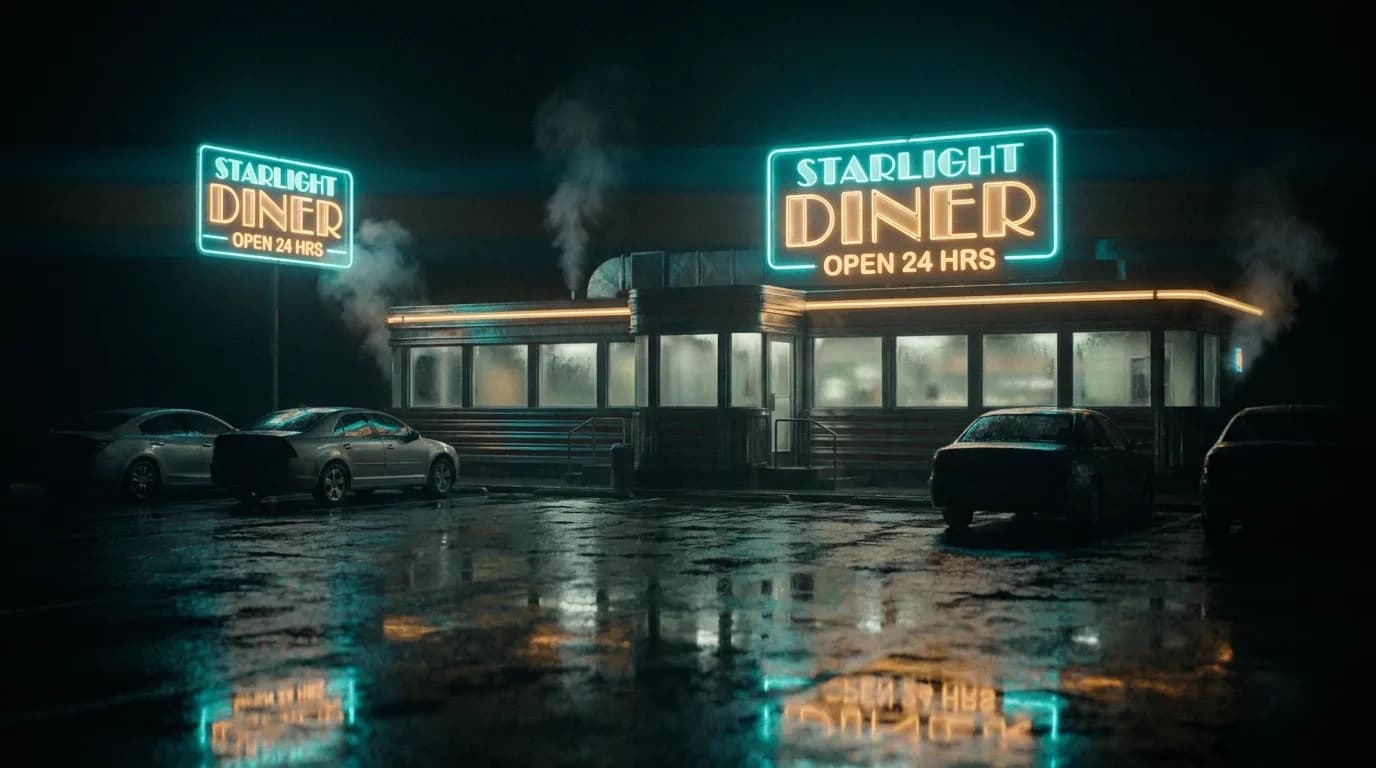

He's had four drinks. Maybe five. The scene requires him to be drunk, not sloppy, not cartoonish, but genuinely impaired. Somewhere between buzzed and blackout. And you, the writer, have to indicate this on the page.
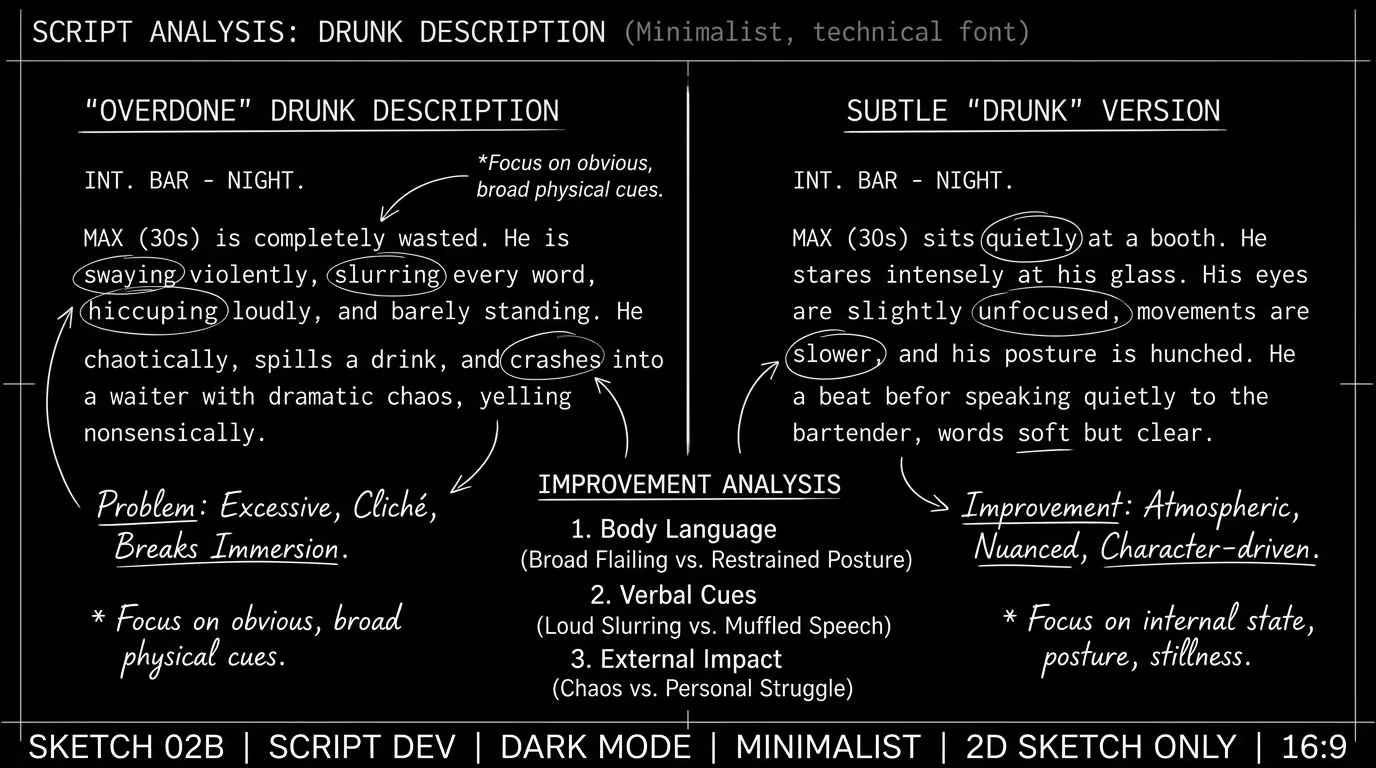
The challenge: "He's drunk" isn't enough. It tells the actor nothing about how to play it. And overwriting, "He sways, slurs every word, nearly falls", turns the character into a caricature. Real intoxication is subtle, specific, and often more sad than funny.
This guide covers how to write drunk characters with precision: using stage directions that guide performance without dictating it.
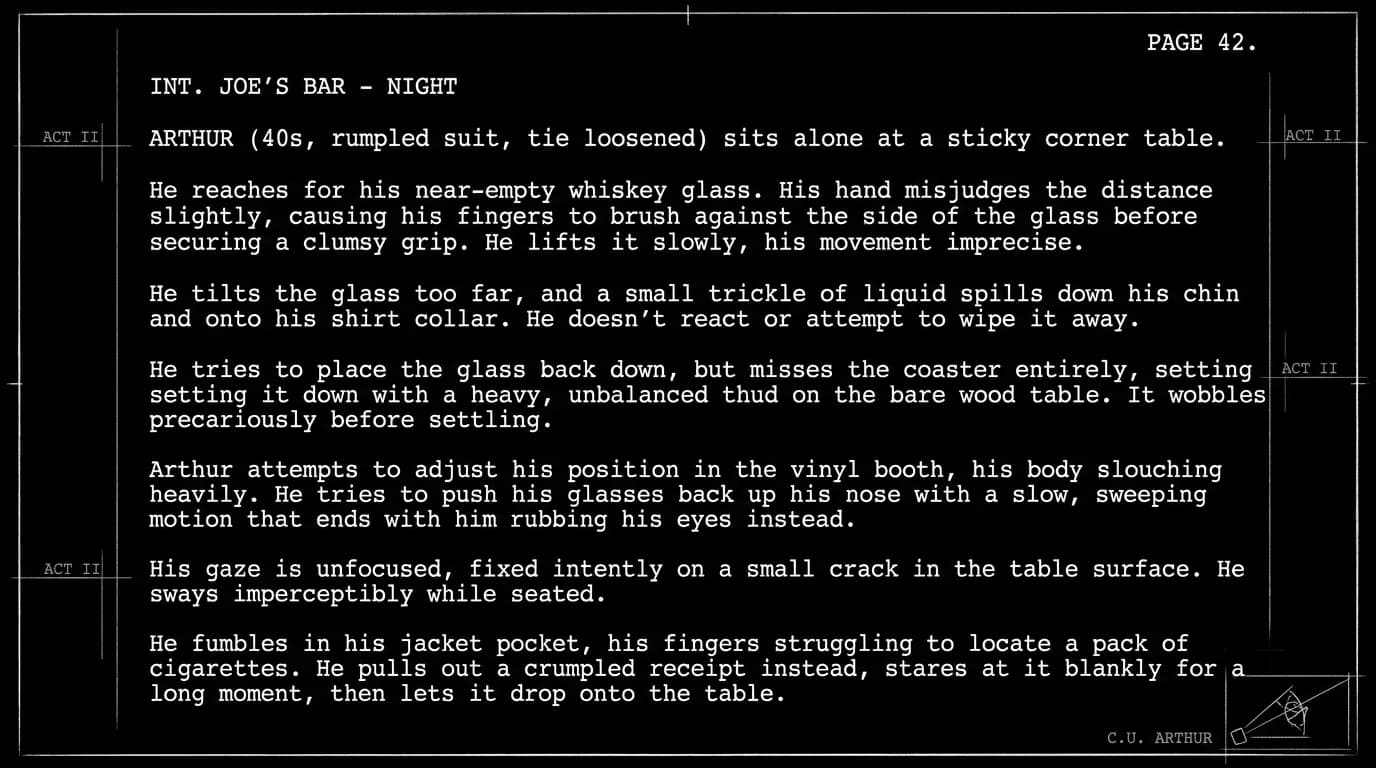
Cinematic workflow frames
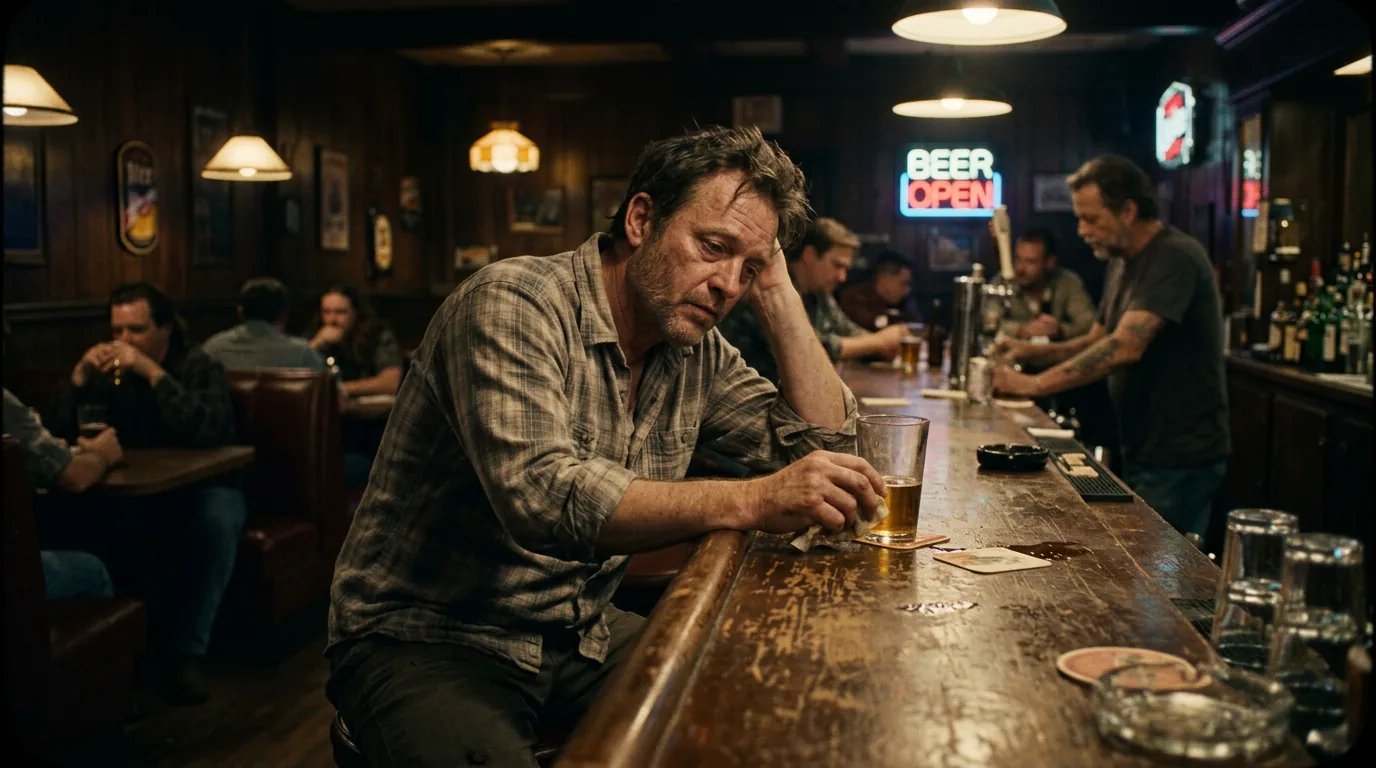
These two visuals work as a pair: the first shows Cinematic workflow still, first angle, 35mm film grain, and the second shifts to Cinematic workflow still, second angle, 35mm film grain - compare them briefly, then move on.
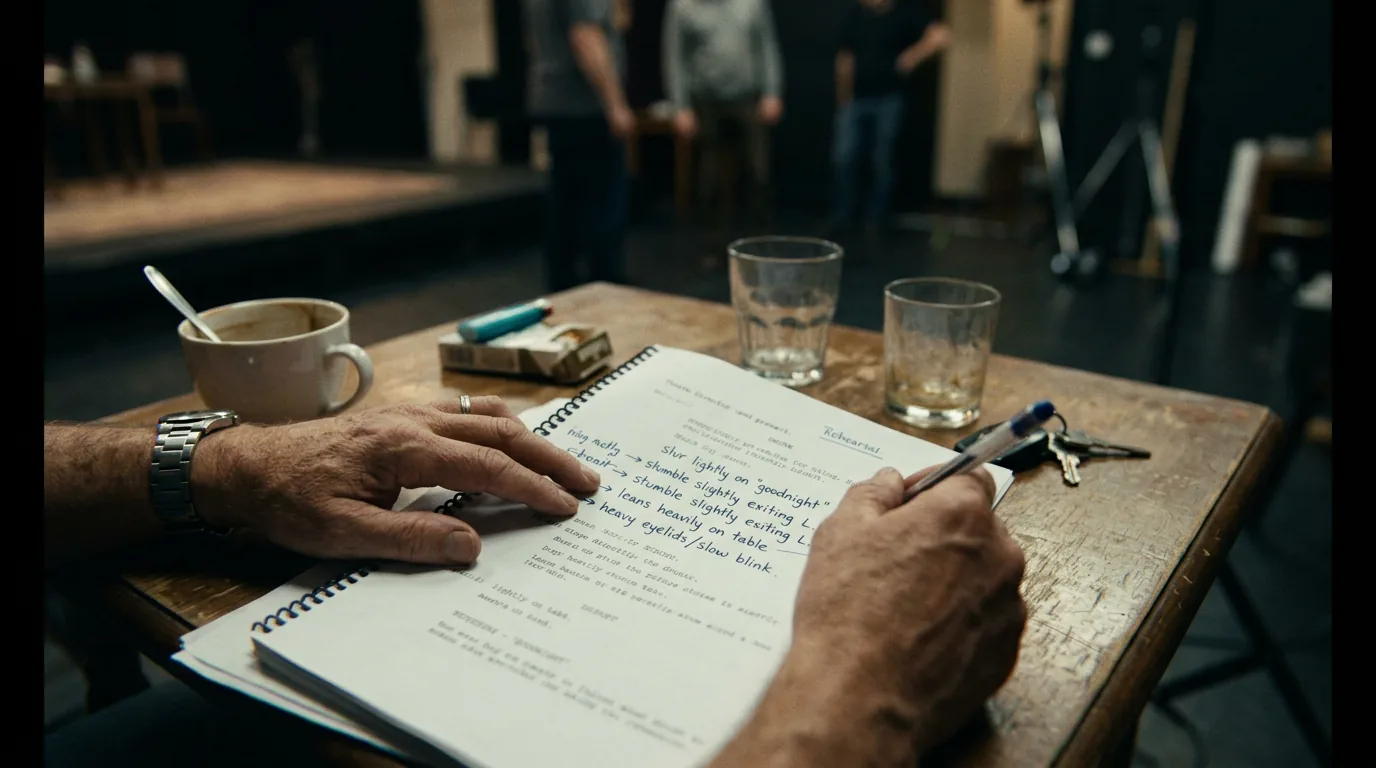
The Problem with "He's Drunk"
If you write:
Michael enters. He's drunk.
The actor and director make all the choices. What kind of drunk? Happy? Angry? Sloppy? Functional? The reader has no idea what the scene should look like.
If you overwrite:
Michael enters. He's clearly drunk, stumbling, slurring, eyes unfocused, steadying himself on furniture, hiccupping, and nearly tripping over the rug.
Now you've micromanaged the performance. The actor feels constrained. The scene becomes comedy whether you intended that or not.
The goal is somewhere between: guidance without dictatorship.
Principle #1: Choose the Type of Drunk
Intoxication presents differently depending on the person, the substance, and the situation. Choose which type your scene requires:
The Functional Drunk. Seems almost sober until you notice the small things: over-careful diction, extra-deliberate movements, a slight delay in responses.
The Happy Drunk. Loose, warm, affectionate. Laughs too easily. Says things they normally wouldn't.
The Sad Drunk. Maudlin. Emotional dam breaks. Years of repressed feeling surface.
The Angry Drunk. Short fuse. Reads offense in everything. Violence simmers.
The Sloppy Drunk. Loss of motor control. Stumbling. Slurring. The stereotypical "drunk" but real for some people.
The Blackout Drunk. Functioning on autopilot. May not remember this conversation tomorrow.
Your stage directions should suggest which category without naming it explicitly.
A Table: Types of Drunk and Their Tells
| Type | Physical Tells | Speech Tells | Emotional Tells |
|---|---|---|---|
| Functional | Deliberate movements, over-careful | Precise but slow, occasional wrong word | Controlled, slightly off |
| Happy | Loose limbs, wide gestures | Louder, faster, more tangents | Affectionate, uninhibited |
| Sad | Slumped posture, unfocused gaze | Quieter, trails off, confessional | Vulnerable, tearful |
| Angry | Tense body, invading space | Cutting, repetitive, accusatory | Volatile, reactive |
| Sloppy | Swaying, gripping surfaces | Slurred, incomplete sentences | Variable, unpredictable |
| Blackout | Mechanical, robotic | Repetitive, disoriented | Vacant, disconnected |
Technique #1: The Specific Physical Detail
Rather than "drunk," give one or two specific physical tells:
Example:
Michael enters. He closes the door with extra care, the precision of someone trying hard not to make noise.
This implies intoxication without naming it. The actor understands: functional drunk.
Example:
Sarah sits at the bar. Her laugh is too loud, and when she reaches for her glass, she knocks over the cocktail napkin. She doesn't notice.
Small, specific. Happy drunk, losing fine motor control.
Example:
Tom stands at the window. His posture is slack. He speaks to his reflection more than to her.
Sad drunk. Turned inward. Not performing for the room.
Technique #2: The Speech Pattern
Intoxication affects speech. You can indicate this in action description or through dialogue formatting:
Slurred speech:
MICHAEL (words slightly loose) I told him. I told him everything.
The parenthetical suggests slurring without phonetic spelling ("I tol' him"). Phonetic spelling can feel insulting; let the actor interpret.
Over-precise speech:
SARAH (enunciating carefully) I am perfectly. Capable. Of driving myself home.
The periods indicate deliberate pacing. The character is working hard to sound sober.
Trailing off:
TOM It doesn't matter anymore. It never... (loses the thought) What was I saying?
The unfinished sentence and action description show mental fog.
Technique #3: The Behavioral Moment
One key action can convey intoxication better than multiple tells:
Example:
Michael reaches for his keys. Misses. Tries again.
Simple. Concrete. Drunk.
Example:
Sarah hugs him, longer than she normally would. She doesn't want to let go.
Emotional inhibition lowered. She's not sloppy; she's exposed.
Example:
Tom laughs at nothing. Then stops. His face goes dark.
Volatile. The emotional weather is shifting.
Try it free
Try Screenweaver for free on your script
It is free. Import your existing project, get a clearer view of your outline, and regain control of your story structure in minutes.
Start FreeThe "Trench Warfare" Section: What Goes Wrong
Failure Mode #1: Caricature
The drunk character is a sitcom joke: hiccupping, lampshade-on-head, can't walk straight.
How to Fix It: Ground the intoxication in reality. Watch documentaries or interviews with intoxicated people. Notice the subtlety. Even very drunk people often think they're behaving normally.
Failure Mode #2: Only Physical, No Emotional
The script shows motor impairment but ignores how alcohol affects emotion and judgment.
How to Fix It: Drunkenness isn't just physical; it's psychological. What inhibitions drop? What feelings surface? Write the emotional shift, not just the stumble.
Failure Mode #3: Phonetic Spelling
Dialogue written as: "I shwear, I didn' do nuthin'."
How to Fix It: Avoid phonetic spelling. It's hard to read and can feel condescending. Use parentheticals or action description to indicate slurred speech; let the actor perform it.
Failure Mode #4: Inconsistent Intoxication
The character is sloppy drunk in one line and perfectly articulate in the next.
How to Fix It: Track the intoxication throughout the scene. If they're impaired, they stay impaired. Moments of clarity are possible, but they should feel like effort.
Failure Mode #5: Drunk Without Reason
The character is drunk because the plot requires it, but the drinking isn't shown or motivated.
How to Fix It: Establish the drinking earlier, either on-screen or through reference. Why are they drunk? What drove them to it? Intoxication is a symptom; the cause matters.
Example Scene: Functional Drunk
INT. LIVING ROOM – NIGHT
Michael sits on the couch. A glass of whiskey, mostly empty, is on the table. Another glass is already drained.
Sarah enters, sets down her bag.
SARAH How long have you been home?
MICHAEL (too even) A while.
He reaches for the glass. His hand is steady, but the movement is deliberate, the control of someone working not to wobble.
SARAH You've been drinking.
MICHAEL I had a drink.
He smiles. The smile is just slightly off, too wide, too long.
SARAH Michael.
MICHAEL (the facade cracking) I'm fine. I'm always fine.
This scene conveys intoxication through: the visual setup (glasses), physical control (deliberate movement), speech (too even), and behavior (the cracking smile). No phonetic spelling, no slapstick.
Writing Drunk Dialogue
Drunk people don't always slur. They might:
- Repeat themselves
- Lose their train of thought
- Say things they'd never say sober
- Become fixated on one idea
- Confess
- Contradict themselves in the same sentence
Example:
TOM I never loved her. I loved her so much. You know what I mean? You know.
The contradiction is drunken logic. It makes emotional sense even when it makes no literal sense.
The Perspective: Writing the Unseen
Intoxication is an internal state with external symptoms. Your job is to write the symptoms, the tells, in a way that suggests the internal reality.
This is true for many states: fear, grief, love, exhaustion. You can't film the feeling; you can only film the behavior. But the behavior must be chosen carefully, or it rings false.
For drunk scenes, the key is specificity. Not "drunk" but "reaching for keys and missing." Not "slurred" but "enunciating carefully, like each word is a test." Not "emotional" but "laughs at nothing, then stops, face going dark."
These details guide the actor without trapping them. They give the reader a movie to see. And they keep the scene grounded, human, not cartoon.
Write the drunk you've seen. Write the drunk you've been. Write the specifics. That's how it rings true.
[YOUTUBE VIDEO: An acting coach discussing techniques for playing intoxicated characters, with examples of subtle vs. over-the-top performances and what the script can do to guide actors.]
Further reading:
- For internal states in action lines, see the unfilmable action line: writing what can't be seen on screen.
- If you're writing emotional transformations, see the before/after scene: showing character status change without dialogue.
- StudioBinder has resources on directing actors through physical states at studiobinder.com{:rel="nofollow"}.
Final Step
Build your next script with Screenweaver
Move from ideas to production-ready pages faster with timeline-native writing and AI-assisted story flow.
Try Screenweaver