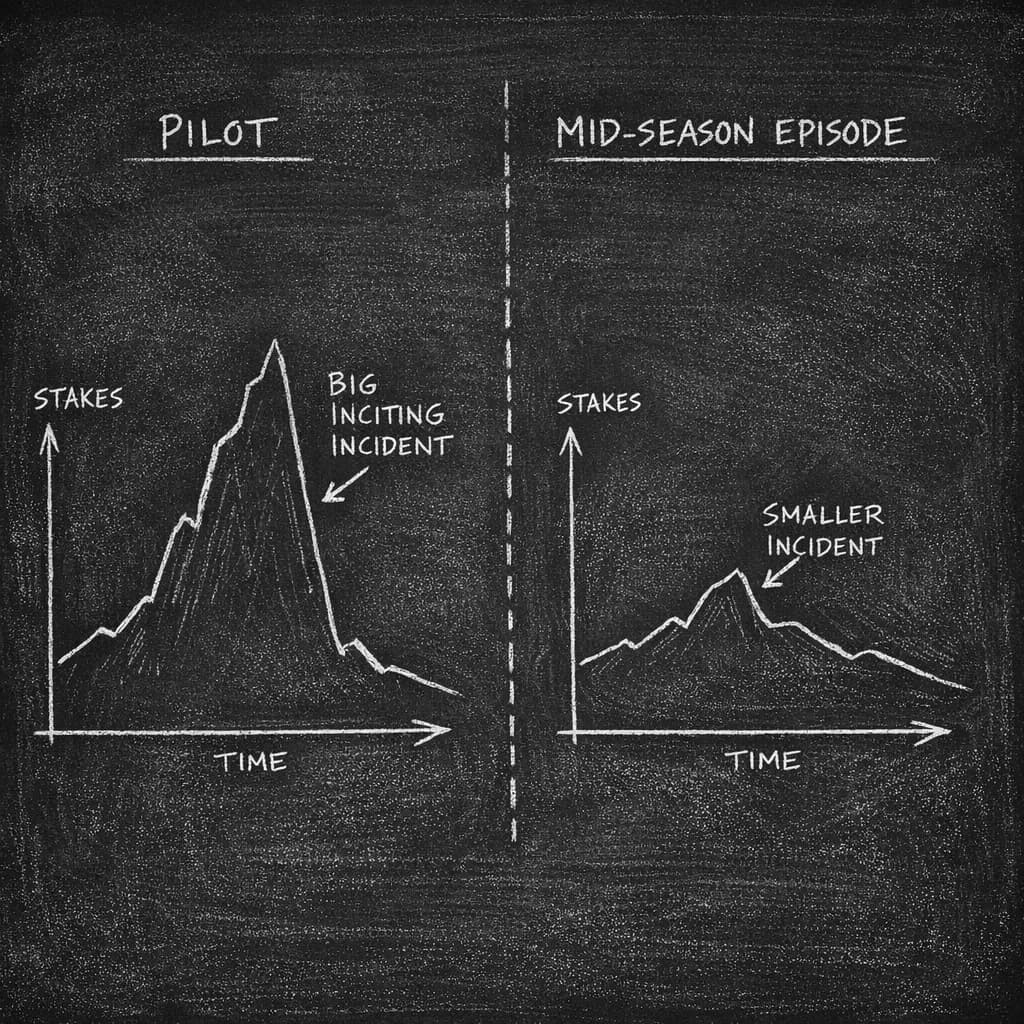

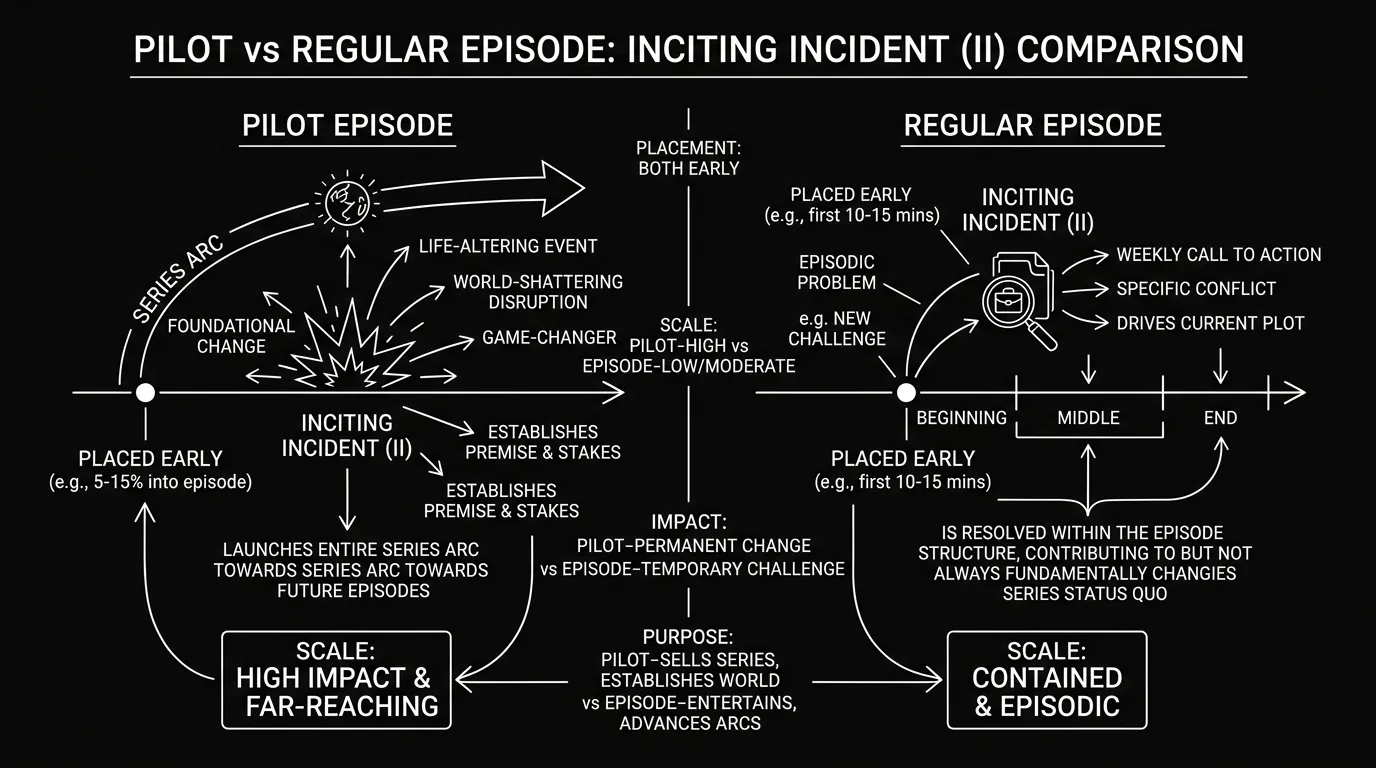
The inciting incident is the moment that tilts the world of the story. In a feature, it usually lands in the first act. In episodic TV, it depends which episode you’re writing. The pilot has to launch the whole series,so its inciting incident is often the one that creates the premise. “This is the world. This is the thing that changes everything.” By episode 5, the series is already running. The inciting incident of that episode is smaller. It’s the thing that kicks off this week’s story. Same term. Different scale. Different job. If you treat them the same, you’ll either overload the pilot or underpower the episode. So the craft is knowing which inciting incident you’re writing,and where it goes.
The pilot’s inciting incident starts the series. The episode’s inciting incident starts the episode. They’re not the same beat.
Think about it. In the pilot of Breaking Bad, Walter White gets the cancer diagnosis and then sees the drug deal. That’s the inciting incident (or the combination of incidents) that creates the series. We’re in. By episode 5, we’re already in that world. The inciting incident of episode 5 might be: a new problem, a new client, a new threat. It doesn’t have to redefine the show. It has to kick off the A-plot (and maybe the B-plot) for that hour. So when you’re outlining a pilot, you’re asking: what’s the one thing that makes this series happen? When you’re outlining episode 5, you’re asking: what’s the one thing that makes this episode happen? The structure is similar. The scale is different. Our guide on the inciting incident in features covers the beat in general; here we focus on how it shifts in TV,pilot vs. mid-season.
Pilot: The Inciting Incident That Launches the Series
In the pilot, the inciting incident (or the sequence of incidents) does two jobs. First, it establishes the world and the protagonist. Second, it creates the central situation or question that the series will explore. So the pilot’s inciting incident is big. It might be the moment the character enters a new world (the job, the place, the relationship). It might be the moment something is taken away (the loss that forces the character to act). It might be the moment the character makes a choice that defines the series (Walter decides to cook; the detective takes the case). The pilot doesn’t have to resolve that. It has to launch it. So the inciting incident in the pilot is the one that makes the audience ask: what happens next? And the answer is: the rest of the series. That’s why pilots are hard. You’re not just writing one story. You’re writing the first chapter of a long one. The inciting incident has to bear that weight. It has to be the thing that makes the series possible. As with outlining a 60-minute pilot, the spine of the pilot includes this beat: something has to happen that makes the series go.
Episode 5 (or Any Mid-Season Episode): The Inciting Incident That Launches the Episode
In episode 5 (or any episode after the pilot), the audience already knows the world. They know the characters. So the inciting incident of this episode doesn’t have to create the series. It has to create the episode. Something happens that kicks off the A-plot. The case comes in. The character gets a phone call. The character makes a decision that drives the hour. The inciting incident can be smaller. It can be more contained. It might tie into the season arc,or it might be a standalone problem. The point is: by the first act break (or early in the episode), something has happened that gives the episode its engine. “This week, the story is about X.” X was triggered by the inciting incident. So in the pilot, the inciting incident is “why does this series exist?” In episode 5, the inciting incident is “why does this episode exist?” Same structural beat. Different scope.
| Context | Inciting incident job | Scale |
|---|---|---|
| Pilot | Launch the series; create the central situation | Large; defines the show |
| Episode 5 (or mid-season) | Launch the episode; create the A-plot (and maybe B-plot) | Contained; defines the hour |
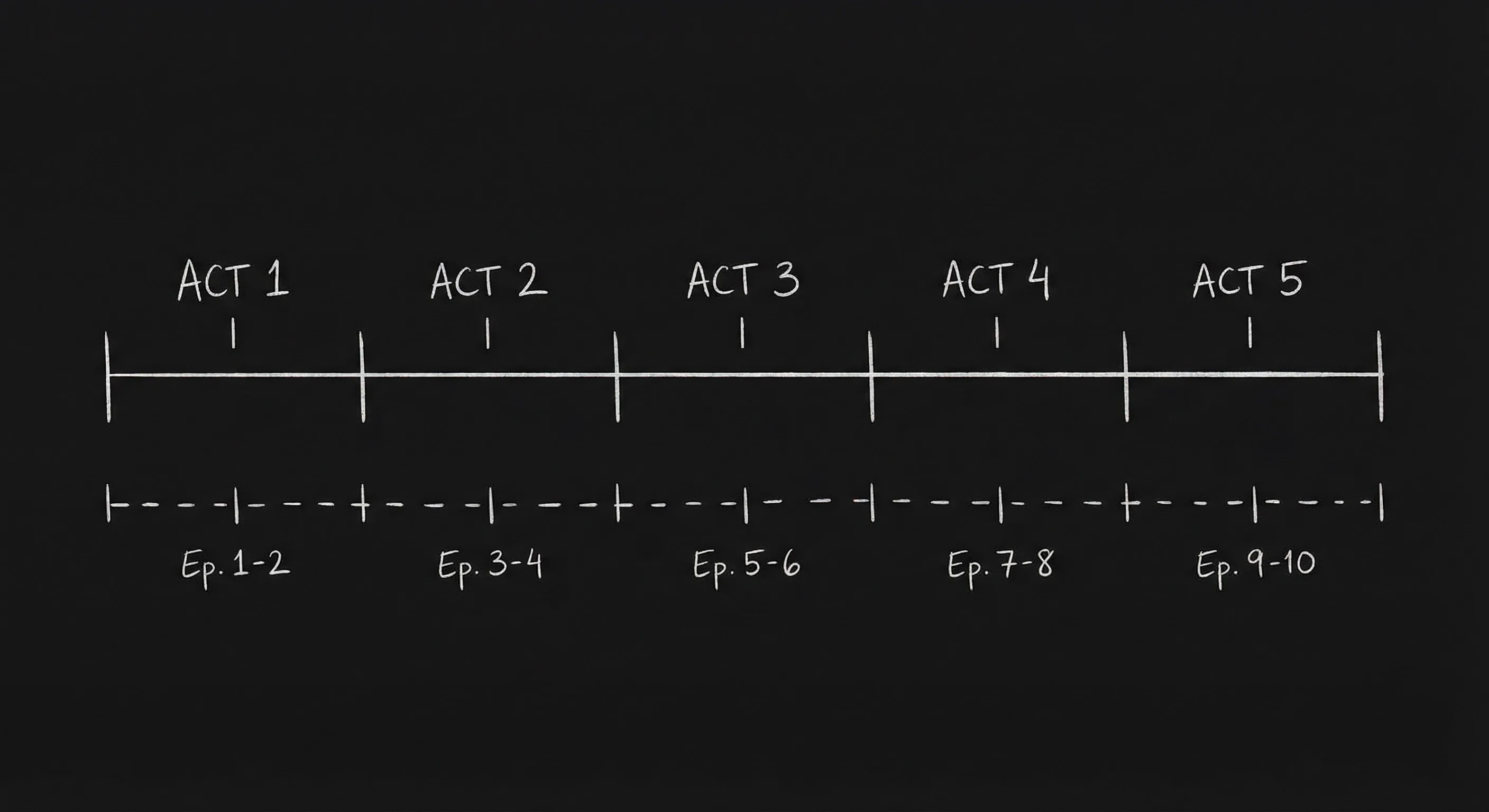
When you’re in the writers’ room, you’re often breaking the episode: what’s the inciting incident this week? It might be the cold open. It might be the first scene after the titles. It has to happen early enough that the episode has somewhere to go. And it has to be clear enough that the audience knows what “this week’s story” is. Our guide on the 5-act structure for limited series applies to how the season is shaped; the inciting incident of each episode is how you get into that episode’s chunk of the season.
Relatable Scenario: The Procedural Pilot
The pilot has to establish: the detective, the world, the kind of cases we’ll see. The inciting incident might be: the detective gets the case that will define the series (the one that’s personal, or the one that introduces the recurring villain). Or it might be: the detective is assigned to the unit, or the partner, or the city. Something happens that makes the series possible. By episode 5, we’re in the rhythm. The inciting incident might be: the body is found, the client walks in, the call comes. Smaller. Contained. The series is already launched. The episode just needs its own launch.
Try it free
Try Screenweaver for free on your script
It is free. Import your existing project, get a clearer view of your outline, and regain control of your story structure in minutes.
Start FreeRelatable Scenario: The Serialized Drama
The pilot’s inciting incident might be: the event that changes everything (the disappearance, the death, the revelation). That event drives the whole season. By episode 5, we’re deep in the aftermath. The inciting incident of episode 5 might be: new information, a new character, a decision that pushes the season arc forward. It’s still connected to the big picture. But it’s the thing that makes this episode move. So the pilot’s inciting incident is “the big thing.” Episode 5’s inciting incident is “the next thing.” Both matter. They’re just different sizes.
The Trench Warfare Section: What Beginners Get Wrong
Using the same scale for pilot and episode. You write episode 5 as if it’s a mini-pilot. The inciting incident is huge,it tries to redefine the series. The episode feels overloaded. Or you write the pilot as if it’s episode 5. The inciting incident is small,a case, a phone call. The pilot doesn’t launch. Fix: Match the scale. Pilot = inciting incident that launches the series. Episode = inciting incident that launches the episode. Different jobs. Different sizes.
Delaying the inciting incident in an episode. You have 45 minutes. You spend 15 on setup. The audience is bored. Fix: In episodic TV, the inciting incident usually lands early,cold open or first act. Get the episode’s engine running fast. The pilot can take a bit longer to set the world; the episode doesn’t have that luxury. We know the world. Give us the problem.
Pilot inciting incident that’s vague. “Something changes.” What? The audience doesn’t know what the series is. Fix: The pilot’s inciting incident has to be concrete. We see it. We feel it. We know what the series is about because of it. Make it specific. Make it early enough that the pilot has time to explore the consequences.
Episode inciting incident that’s unrelated to the series. The episode could be any show. There’s no connection to the characters or the season. Fix: Even in a procedural, the episode’s inciting incident should feel like this show. The case, the client, the problem,something should tie to the series’ tone or theme. In a serialized show, the episode’s inciting incident should push the season arc. It’s not a standalone. It’s the next beat.
Step-by-Step: Breaking the Inciting Incident for Pilot vs. Episode
Pilot: What’s the one event or decision that makes this series exist? Write it. Make it concrete. Place it in the first act,early enough that the pilot can explore the aftermath. Read the pilot. Does the audience know what the series is? If not, the inciting incident might be too late or too vague. Episode (e.g., 5): What’s the one event or decision that kicks off this episode’s A-plot? Write it. Place it early,cold open or first act. Read the episode. Does the audience know what “this week’s story” is? If not, sharpen or move the inciting incident. The principle is the same. The scale is different. Get the scale right. Our guide on cold opens is relevant: sometimes the inciting incident is the cold open. Sometimes it’s the first beat after the titles. Either way, it has to land early so the episode has an engine.
The Perspective
The inciting incident is the tilt. In a pilot, it tilts the whole series into motion. In episode 5, it tilts the episode into motion. Same beat. Different size. When you’re writing the pilot, give that beat the weight it needs,it’s launching everything. When you’re writing the episode, give it the weight it needs,it’s launching the hour. Don’t confuse them. The pilot’s inciting incident is the one that makes the audience come back next week. The episode’s inciting incident is the one that makes them stay this week. Both matter. Size them right.
In a vertical short drama the inciting incident lands inside episode 1, already in motion, because the viewer decides in five seconds. The short drama script format article shows what that looks like on a one-page episode.
Final Step
Build your next script with Screenweaver
Move from ideas to production-ready pages faster with timeline-native writing and AI-assisted story flow.
Try Screenweaver