
You have a script. You have a dream buyer. Netflix, a studio, a production company. What you might not have is a clear picture of how pitches actually land in 2026. The market is crowded. Execs see hundreds of projects a year. The script is the proof of craft,but it is rarely the first thing they see. The first thing is the pitch. The deck. The logline. The meeting. If those fail, the script never gets read. So the real skill is not only writing something great. It is packaging it so that the right person wants to open the document. Here is the reality of the market and how to meet it.
Pitching in 2026 is not the same as pitching a decade ago. Streamers have shifted from buying everything to being selective. Studios are blending theatrical and streaming in ways that change what they want. The bar for “we want to meet” is higher. That does not mean the door is closed. It means you need a sharper package: a script that is ready, a pitch that is clear, and a deck that shows the vision without requiring the exec to imagine it from scratch. The pitch deck has become the standard bridge between “I have a script” and “read my script.” Get the deck right and you increase the chance that someone will say yes to the read.
The Reality of the Market
Executives and development teams are overwhelmed. They receive thousands of submissions through agents, managers, contests, and sometimes cold queries. They cannot read every script. So they triage. The logline and the pitch deck are the first filter. If the logline does not hook, the script does not get requested. If the deck does not convey tone, world, and stakes in a few pages, the meeting does not get scheduled. That sounds harsh. It is simply how the system works. Your job is to make it easy for them to say yes. Give them a reason to open the script. Give them a reason to take the meeting. The script does the rest,but only if it gets the chance.
Who you pitch to matters as much as what you pitch. Netflix, major studios, and indie producers all have different appetites. Some want elevated genre. Some want broad comedy. Some want limited series, some want features. Research the slate. Look at what they have bought or produced recently. Your pitch should feel like it could sit alongside their existing titles,not as a copy, but as a fit. A pitch that feels random for their brand will get a polite pass no matter how good the script is. For more on how to make sure your script does not get tossed before the read, our guide on mistakes that get scripts tossed applies to both the script and the materials that surround it,sloppy formatting or a vague logline can kill interest before page one.
The logline and the pitch deck are the first filter. If the logline does not hook, the script does not get requested. Your job is to make it easy for them to say yes.
The Pitch Deck
A pitch deck is a short visual document that sells the project. It is not the script. It is not a treatment. It is a curated set of pages that answer: what is this, what does it look like, and why should we care? A typical deck might run ten to twenty pages. It often includes a title page, a logline, a synopsis or premise, character breakdowns, tone and comps (e.g. “X meets Y”), a few key art or concept images, and sometimes a section on the team or the path to production. The goal is to create desire. By the end of the deck, the reader should want to read the script or take the meeting.
The best decks are specific. Vague language (“a thrilling journey”) does nothing. Concrete stakes, clear characters, and a distinct tone do. Every page should earn its place. If a page does not add information or mood, cut it. Execs will flip through quickly. They should be able to grasp the premise in under a minute and feel the tone in the visuals and the voice. That is where images help. A few strong concept images or key-frame moments can communicate “this is what it looks like” faster than paragraphs. But those images have to match the script. They have to feel like the same project. If the deck promises a dark, grounded thriller and the images look like a cartoon, the disconnect will kill trust. As we cover in our piece on using generative storyboards responsibly, the right approach is to lock the script first, then build visuals that illustrate it,so the deck and the script are one vision.
BODY IMAGE 1 PROMPT: Dark mode technical sketch. Solid black background. A single “deck” rectangle divided into horizontal bands: from top to bottom, thin labels “Logline,” “Premise,” “Characters,” “Tone,” “Key images.” Clean thin white lines. Minimalist, high-contrast. Suggests the structure of a pitch deck.
From Script to Deck: The Visual Pitch Deck
Building a pitch deck used to mean writing a separate document and then hunting for or commissioning images. You had a script in one place and a deck in another. Keeping them in sync was manual. That created friction,and the risk that the deck would drift from the script or that you would delay making the deck because the process was cumbersome. A better approach is to generate the deck from the same place the script lives. When the script is the source of truth, the deck can be an export. You choose the key moments, the tone, and the structure; the tool turns that into a presentable deck. No copy-paste between apps. No “which version of the script is this deck based on?” One project, one export.
ScreenWeaver supports this workflow. You develop your script and structure in the same environment,the Living Story Map and the script are one object. When the script is ready for the market, you can export a Visual Pitch Deck directly from the tool. The deck is built from your script: key beats, key moments, and the option to include generated storyboard frames that illustrate tone and key scenes. Because the deck is derived from the script, it stays aligned. You do not maintain two documents. You write the script, you mark what matters for the pitch, and you export. That reduces the gap between “I have a script” and “I have a package to send.” For a fuller picture of how the same environment handles structure and script from outline to export, our guide on what ScreenWeaver is walks through the path from development to pitch and production.
When the script is the source of truth, the deck can be an export. One project, one export. You write the script, you mark what matters for the pitch, and you export.
| Approach | Risk | Better practice |
|---|---|---|
| Deck built separately from script | Deck and script drift; two sources of truth; extra manual work | Export deck from the same project as the script |
| Images chosen before script is locked | Visuals don’t match latest draft; misleading pitch | Lock script, then generate or select images for key moments |
| Pitch without a deck | Exec has to imagine everything; harder to get a read or meeting | Send a clear deck (logline, premise, tone, a few visuals) with the script or before it |
The Logline and the Meeting
The logline is one or two sentences that answer: who is the protagonist, what do they want, what stands in their way, and what are the stakes? It should be specific enough to distinguish your project from every other “thriller” or “comedy.” It should be clear enough that an exec can repeat it in a room. Writing a good logline is its own discipline. Avoid abstraction. “A woman must confront her past” could be anything. “A disgraced journalist has 72 hours to prove a senator’s confession was coerced,or the story that ruined her career will ruin her again” is a movie. Spend time on it. The logline is often the only thing that gets read before the decision to request the script or take the meeting.
The meeting is the next step. You have gotten a read. They liked it. Now they want to hear you pitch. That pitch is verbal. You might use the deck as a leave-behind or as something to reference on a screen, but in the room you are telling the story. Know the spine. Know the tone. Know the comps. Be ready to answer “what happens next?” or “how would this work as a series?” or “who do you see in this?” You are not reading the script. You are selling the vision. Confidence and clarity matter more than performance. They already have the script. The meeting is about whether they want to work with you and whether the project fits their slate.
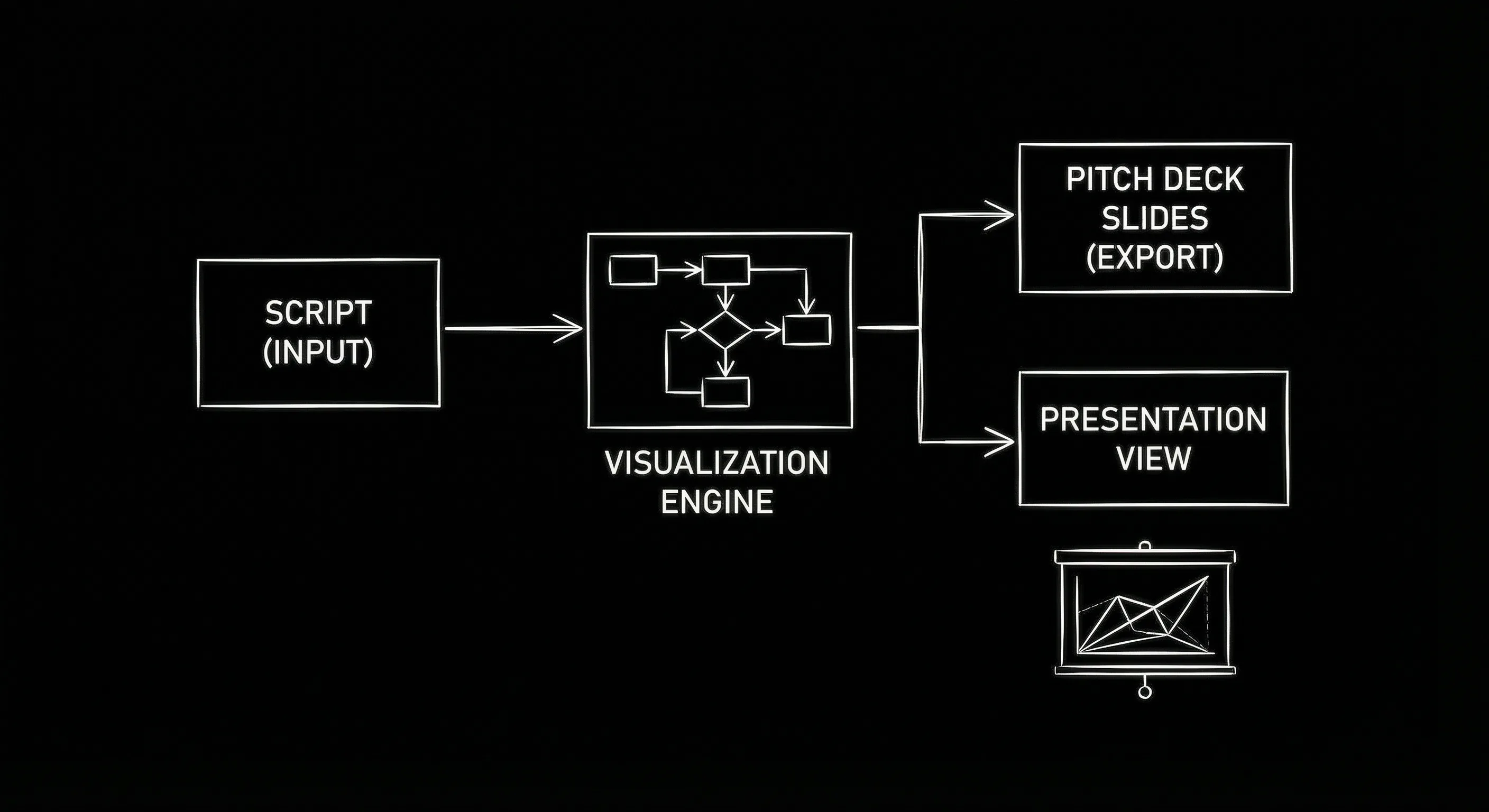
BODY IMAGE 2 PROMPT: Dark mode technical sketch. Solid black background. Left: script icon or “Script” label. Right: pitch deck (rectangle with a few panels or frames). A single arrow from script to deck, with a small “export” or “Visual Pitch Deck” label. Thin white hand-drawn lines. Minimalist, high-contrast. Suggests one-click or direct export from script to deck.
The Takeaway
Pitching in 2026 is about clarity and packaging. The script is the proof. The logline and the pitch deck are the keys that open the door. Know the market. Know who you are pitching to. Build a deck that derives from your script so it never drifts,and so you are not maintaining two separate deliverables. Export the Visual Pitch Deck when the script is ready, and send a package that makes it easy for an exec to say yes. The rest is persistence, revision, and the slow work of getting the right script in front of the right person. Give them a reason to open the document. Then let the pages do the rest.
Final Step
Build your next script with Screenweaver
Move from ideas to production-ready pages faster with timeline-native writing and AI-assisted story flow.
Try Screenweaver