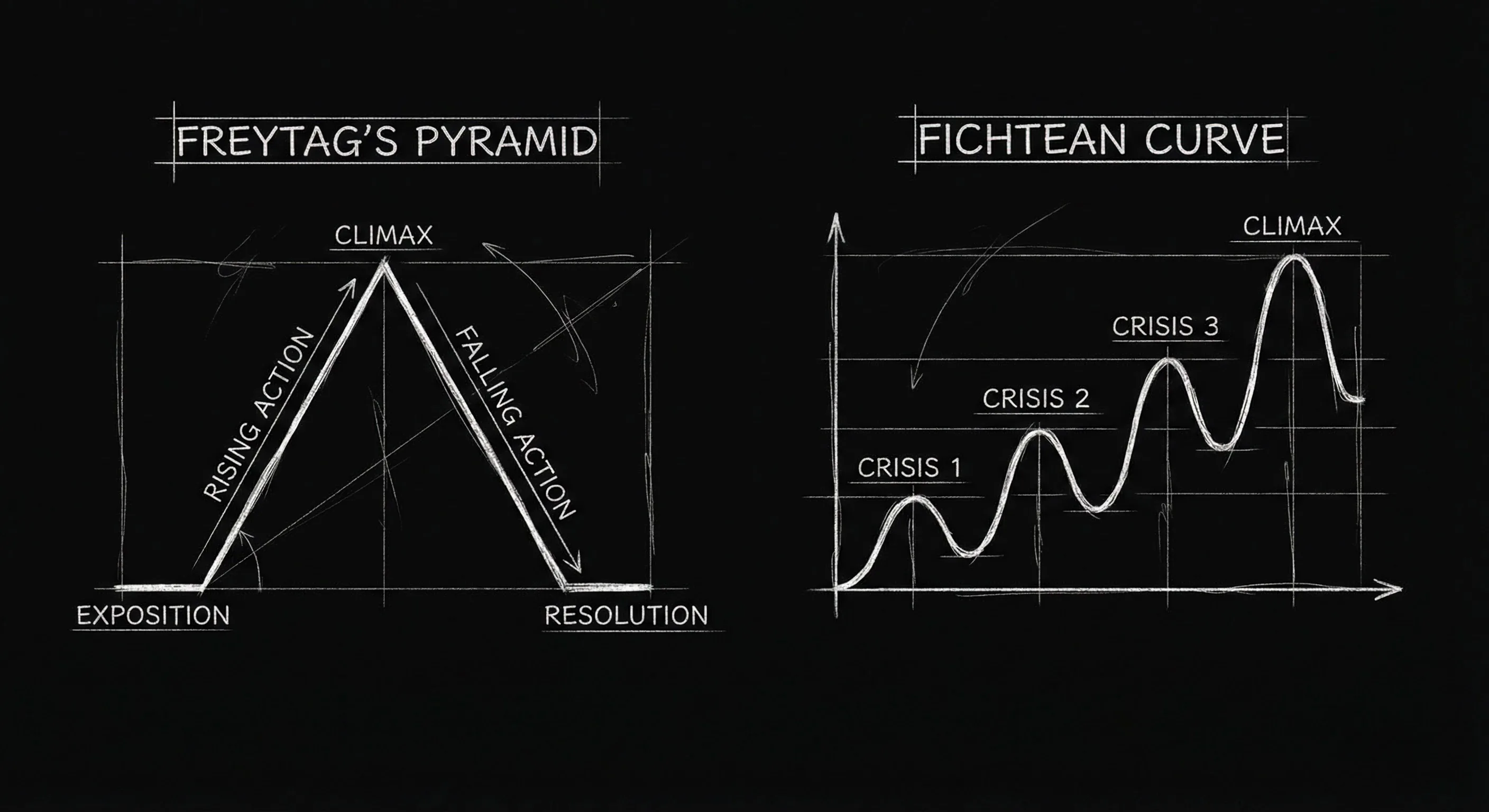

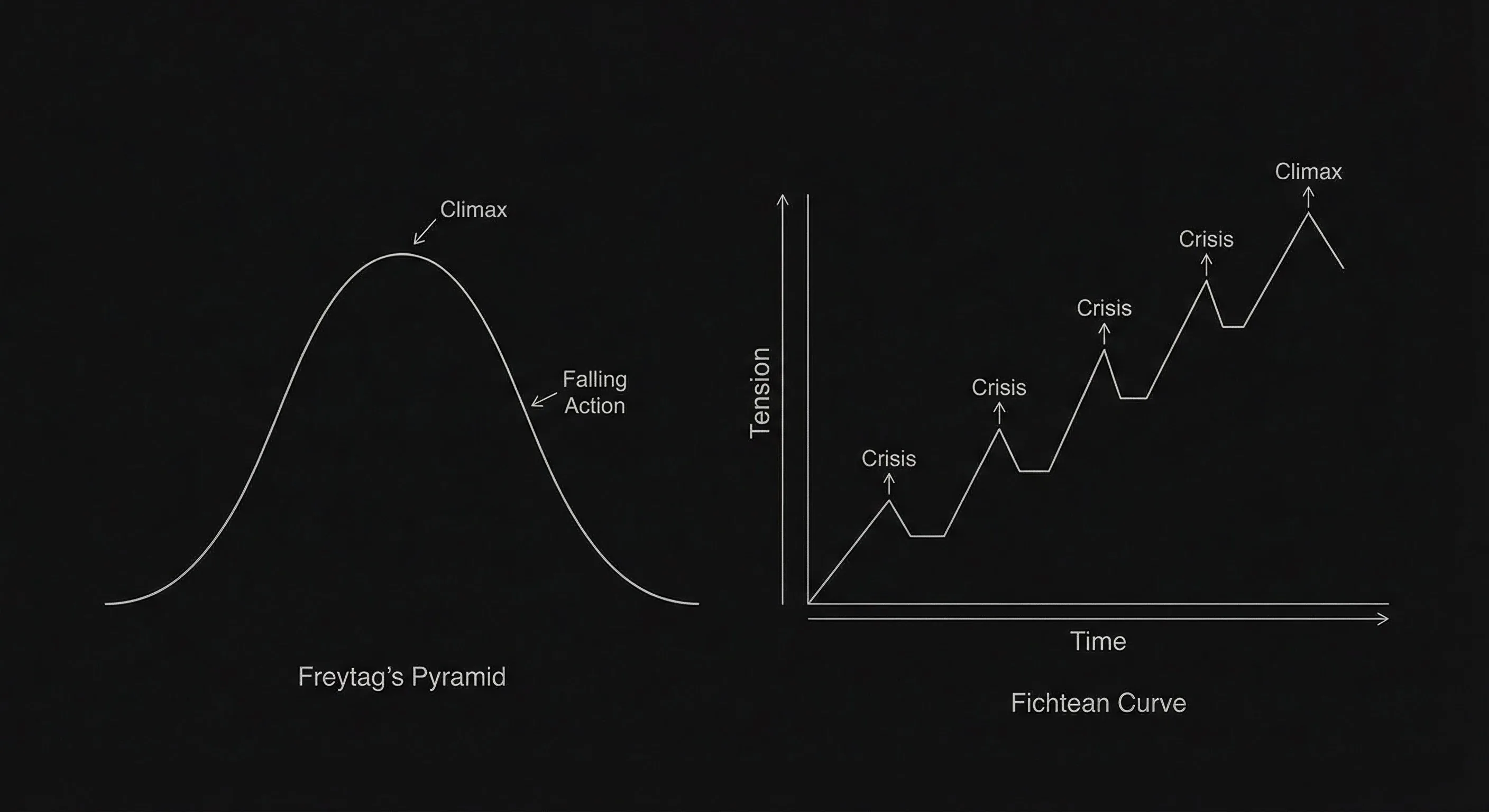
Your thriller has a great premise. The first act works. Then someone says the middle feels slow,too much setup, not enough pressure. You thought you were following "rising action." You were. But in a thriller, "rising action" can feel like a long ramp. The audience wants to feel crisis after crisis, not one long climb to a single peak. That's the difference between Freytag's pyramid and the Fichtean curve. Freytag gives you one big rise, one climax, one fall. The Fichtean curve gives you repeated crises,each one a mini-climax,that stack like steps. For suspense and thrillers, the Fichtean curve often fits better. The protagonist is never safe for long. Every time they think they've caught a breath, the next crisis hits. Tension doesn't plateau. It ratchets.
This isn't academic. It's practical. When you sit down to outline a thriller, the choice of curve shapes how you plan the middle. Do you build toward one central climax (Freytag), or do you design a series of escalating crises with no real "rest" (Fichtean)? Get it wrong and the script feels either too flat in the middle or too scattered. Get it right and the reader can't put the script down.
Freytag's Pyramid: The Classic Shape
Gustav Freytag was analyzing five-act drama in the nineteenth century. His pyramid has five phases: exposition (setup), rising action (complications build), climax (the turning point), falling action (consequences play out), and denouement (resolution). The shape is a triangle: we climb, we peak, we come down. Most mainstream films still use a version of this. There's one central climax. Everything before builds to it. Everything after deals with it. The audience expects a peak and then a release. For a drama or a romance, that often works. The emotional peak is the confession, the battle, the revelation. One big moment.
The problem for thrillers: the rising action is one long slope. In a 120-page script, that might mean 50 pages of "things get worse" before we hit the climax. If "worse" is gradual,a little more pressure here, a little more there,the middle can feel like a slog. The audience knows the climax is coming. They're waiting. The slope isn't steep enough. So they drift. Freytag works when the genre can sustain a long build (e.g. a mystery where the audience is piecing clues) or when the climax is so big that the build earns it. It fails when the audience needs to feel repeated danger, not one long approach to danger.
The Fichtean Curve: Crises Instead of a Single Rise
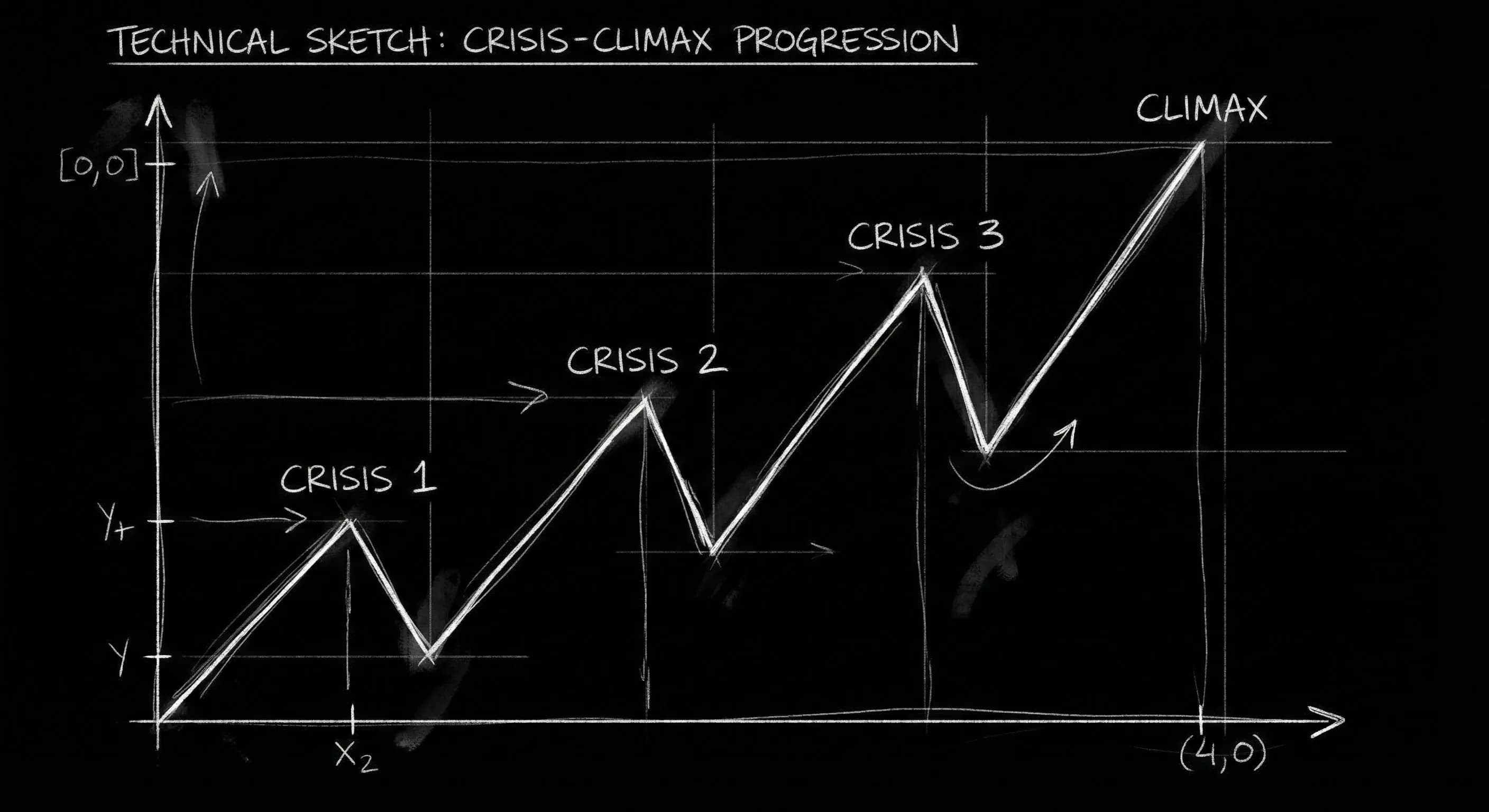
The Fichtean curve (named for Johann Fichte, though the narrative application is often attributed to John Gardner and others) doesn't rely on one long rising action. It relies on crises. The story opens with a crisis or a hook. Then another crisis. Then another. Each crisis is a mini-climax. The protagonist resolves (or survives) one,and the next one hits. There's no long plateau. The curve looks like a set of steps going up: spike, partial drop, spike, partial drop, spike again, until the final climax. The "falling action" between crises is short. Just enough to let the audience breathe before the next hit. That's why it fits thrillers. The character is constantly tested. The stakes keep rising because each crisis raises the cost of the next. There's no safe middle. Compare that to Freytag: in the middle, we're still "rising." In the Fichtean model, we're already in the fire.
In a Freytag thriller, the protagonist climbs toward the confrontation. In a Fichtean thriller, they're already in the confrontation,and it keeps getting worse.
Side-by-Side: When to Use Which
| Aspect | Freytag's Pyramid | Fichtean Curve |
|---|---|---|
| Middle act feel | One long build; single climax | Repeated crises; multiple mini-climaxes |
| Protagonist | Working toward the big confrontation | Constantly in confrontation; no rest |
| Best for | Drama, mystery, romance, epic | Thriller, horror, survival, chase |
| Reader experience | "When will it peak?" | "What next?" |
| Risk | Middle can sag if rise is too gradual | Can feel exhausting if crises aren't varied |
Use Freytag when the story has a central confrontation that everything builds toward,a trial, a battle, a confession. Use the Fichtean curve when the story is relentless,the protagonist is hunted, trapped, or under constant pressure and each scene can turn into a new crisis.
Relatable Scenario: The Home-Invasion Script
You're writing a home-invasion thriller. Family. Night. Intruders. If you use Freytag, you might have: Act 1, they realize someone's outside; Act 2, they hide, they try to call for help, tension builds; Act 3, the final confrontation. The middle is "they hide and things get scarier." That can work. But it can also feel like one long wait. With the Fichtean curve, you design crises. Crisis 1: they realize the phone is dead and the car is disabled. Crisis 2: the intruders enter; the family is in the closet, one of them almost coughs. Crisis 3: the kid runs; they're found. Crisis 4: the father fights back, gains a weapon, but the intruders have the mother. Each crisis has a mini-resolution (they survive, they get a step closer to escape) and then the next crisis hits. The middle isn't "rising action." It's a series of peaks. The audience never settles. That's the Fichtean advantage.
Try it free
Try Screenweaver for free on your script
It is free. Import your existing project, get a clearer view of your outline, and regain control of your story structure in minutes.
Start FreeRelatable Scenario: The Political Thriller
Your protagonist is a journalist digging into a conspiracy. Freytag version: they find a source, then another, then another; the climax is the big expose or the moment they're caught. The middle is "following the trail." It can feel procedural,interesting but not pulse-pounding. Fichtean version: each source or clue leads to a crisis. Source one is murdered. The protagonist is warned. They dig anyway. Source two is compromised; the protagonist is followed. They shake the tail but their apartment is searched. Each beat is a crisis,a threat, a loss, a close call. The story isn't "building to the climax." It's "one crisis after another until the final one." The midpoint shift still matters: around the middle, the protagonist might stop reacting and start acting,but the engine of the middle is repeated crisis, not one long slope.
The Trench Warfare Section: What Beginners Get Wrong
Using Freytag for a thriller and wondering why the middle drags. If your genre is suspense or thriller, try mapping the middle as 3–5 distinct crises instead of "rising action." Give each crisis a clear trigger and a clear outcome (even if the outcome is "they survive, but now X is worse"). You'll feel the difference on the page.
Using the Fichtean curve but making every crisis the same. "Someone attacks. They escape. Someone attacks again." The audience needs variety. Different kinds of crises: physical danger, emotional betrayal, a deadline, a moral choice. Different scales: some small (a close call), some large (a major loss). If every beat is "then another fight," it becomes monotonous. Vary the type and the stakes.
No breathing room. The Fichtean curve doesn't mean zero downtime. It means the downtime is short. A moment of relief, then the next crisis. If you never let the audience or the character breathe, the crises blur together and nothing lands. Give a beat of silence or safety,then take it away.
Forgetting the climax. In the rush to pile on crises, some writers forget to land the final one. The last crisis should be the biggest and should resolve the central question. The Fichtean curve isn't "no climax",it's "many mini-climaxes plus one final climax." The end still needs to feel like an end.
Mixing the two without intention. You can combine them. For example: Fichtean crises in the middle, then a Freytag-style climax and falling action. But do it on purpose. If you're not sure whether a beat is "rising action" or "crisis," name it. "This is crisis 3: they lose the evidence." Clarity in your own outline will show up in the read.
Step-by-Step: Building a Fichtean Middle
List the major crises your protagonist will face. Not "things get worse",specific events. "The ally is killed." "The escape route is blocked." "The villain reveals they have the protagonist's family." Order them by escalation. The first crisis should be serious; the last should be the most dire. Now give each crisis a before (how we get there) and an after (what changes). The after might be: they survive but are wounded, they gain a clue but lose trust, they escape but the villain is closer. Then write the middle as a sequence of these crisis beats. Short breathers between them. No long stretches where "they plan" or "they travel" without a crisis interrupting. For more on keeping the protagonist active through these beats, see our guide on the midpoint shift: the turn from reactive to active often lands right in the middle of the Fichtean stack.
How This Connects to the "All Is Lost" Beat
In a Fichtean thriller, one of those crises is often the lowest point,the "all is lost" moment. The protagonist has lost the thing they needed, or the ally is gone, or they're captured. That beat fits into the Fichtean curve as the biggest crisis before the rally. So you're not choosing between "Fichtean" and "all is lost." You're using the all-is-lost as one of the crises,usually the one that forces the protagonist to change or commit before the final push. Our article on writing the "All Is Lost" moment goes into how to make that beat land emotionally. In structural terms, it's the crisis that hurts the most,and the one that makes the final crisis possible.
The Perspective
Freytag's pyramid is the default in a lot of writing education. One rise, one fall. For thrillers and suspense, the Fichtean curve is often the better fit. It keeps the middle sharp. It gives the audience repeated reasons to stay. Choose the curve that matches the experience you want: one big peak, or a series of peaks that never let go. Then build your outline to that shape. The reader will feel the difference,and so will you when the middle stops sagging.
Final Step
Build your next script with Screenweaver
Move from ideas to production-ready pages faster with timeline-native writing and AI-assisted story flow.
Try Screenweaver