KI-Video-Modellwahl
Ein interaktiver Modellvergleich, gefiltert nach den Anforderungen Ihrer Einstellung
Dieses Vergleichswerkzeug sagt Filmschaffenden, welches KI-Videomodell zu einer bestimmten Einstellung passt, gemessen an dem, was wirklich zählt: Cliplänge, Auflösung, nativer Ton, Bild-zu-Video und Budget. Schalten Sie die Anforderungen Ihres Projekts ein, und die passenden Modelle steigen nach oben, während die durchgefallenen darunter stehen, mit genannter Ursache.
Es gibt keinen besten KI-Videogenerator, nur das richtige Modell für eine bestimmte Einstellung. Eine Dialogszene braucht nativen Ton, was den halben Markt ausschließt. Ein senkrechter 9:16-Schnitt hat andere Anforderungen als eine 4K-Schlüsseleinstellung. Vergleichsartikel krönen einen Sieger und veralten in einem Monat; ein filterbares Datenblatt beantwortet die Frage, die Sie tatsächlich haben, Einstellung für Einstellung.
Alles läuft in Ihrem Browser. Es werden keine Daten an einen Server gesendet. Daten und Preise im September 2026 gegen Anbieterdokumentation und öffentliche API-Seiten geprüft; dieser Markt verschiebt sich monatlich, prüfen Sie die Versionshinweise, bevor Sie ein großes Budget binden.
Jeder Schalter ist eine harte Anforderung. Modelle, die eine davon verfehlen, rutschen darunter, mit genannter Ursache.
Budgetstufe12 passende Modelle
Preise im September 2026 geprüft (Datensatz 2026-09).
The open-source escape hatch: unlimited retries for the price of a GPU.
Free to self-host under an open license; the real cost is GPU time (roughly $0.50 to $1.00/hour for a rented 24GB+ card). Hosted API versions exist at budget rates.
Best price-to-quality ratio for character motion, with optional native audio.
fal.ai rate of $0.07/sec with audio off; enabling native audio doubles it to $0.14/sec ($0.70 per 5s clip).
Best prompt adherence and physics at the top of the market, with 4K output.
Gemini API standard tier, $0.40/sec at 1080p with audio. 4K and multi-reference inputs lock the clip to 8 seconds.
Longest coherent single takes of any closed model, up to 25 seconds.
API rate of $0.30/sec at 720p up to $0.50/sec at 1024p+. 25-second clips require the Pro app plan's storyboard mode.
Multi-shot generation inside one clip, unusual at this price point.
Volcano Engine / BytePlus API, about $0.07/sec at 1080p ($0.03/sec at 720p). Newer Seedance versions price higher.
Standout stylized and anime motion; strong value on dynamic action.
MiniMax API bills per clip: $0.49 for a 6s 1080p clip (normalized here to 5s). 10-second clips are 768p only.
Strong scene logic and dialogue audio; the app ecosystem is where it shines.
API rate of $0.10/sec at 720p. 15-second clips are an in-app limit; the API caps single generations at 12 seconds. OpenAI has announced an API sunset for late September 2026, so treat API access as transitional.
Veo quality with audio at a price you can afford to iterate on.
Gemini API fast tier, $0.12/sec at 1080p with audio. Same model family, lower fidelity, roughly a third of the standard price.
Only model shipping true HDR output, with a reasoning pass on the prompt.
Luma API, about $0.24/sec for 1080p SDR. HDR output roughly doubles the price; draft mode is far cheaper for look development.
Fast, playful iteration and effects templates aimed at social formats.
Credit-based estimate: 40 credits per 5s 1080p clip on the $28/mo, 700-credit Standard plan ($0.04/credit). 480p drafts cost about a third of that.
Cheapest way into the Runway ecosystem for previz and animatics.
Runway developer API, $0.05/sec (5 credits/sec in-app). The workhorse tier for previz volume.
Precise motion control and the most mature editing toolchain around the model.
Runway developer API, $0.12/sec (12 credits/sec in-app). Output is 720p native; upscaling is a separate pass.
Vollständige Datentabelle
| Modell | Max. Clip | Max. Auflösung | Bilder/s | Ton | I2V | Pro 5-s-Clip |
|---|---|---|---|---|---|---|
| Veo 3.1 | 8s | 4K | 24 | ja | ja | $2.00 |
| Veo 3.1 Fast | 8s | 1080p | 24 | ja | ja | $0.60 |
| Sora 2 | 15s | 720p | 30 | ja | ja | $0.50 |
| Sora 2 Pro | 25s | 1080p | 30 | ja | ja | $2.50 |
| Kling 2.6 Pro | 10s | 1080p | 30 | ja | ja | $0.35 |
| Runway Gen-4.5 | 10s | 720p | 24 | nein | ja | $0.60 |
| Runway Gen-4 Turbo | 10s | 720p | 24 | nein | ja | $0.25 |
| Seedance 1.0 Pro | 10s | 1080p | 24 | nein | ja | $0.35 |
| Luma Ray 3 | 10s | 1080p | 24 | nein | ja | $1.20 |
| Pika 2.2 | 10s | 1080p | 24 | nein | ja | $1.60* |
| Hailuo 2.3 | 10s | 1080p | 24 | nein | ja | $0.41 |
| Wan 2.5 | 10s | 1080p | 24 | ja | ja | kostenlos (selbst gehostet) |
Preise in Dollar pro 5-Sekunden-Clip nach öffentlichen API-Preisen. Das Sternchen kennzeichnet eine Schätzung aus einem mittleren Guthabentarif.
So funktioniert es
Jeder Schalter ist ein harter Filter über einen von Hand geprüften Datensatz der wichtigsten Modelle: Veo 3.1, Sora 2, Kling 2.6, Runway Gen-4.5, Seedance, Luma Ray 3, Pika, Hailuo und das quelloffene Wan. Passende Modelle werden nach einem Fähigkeitswert geordnet (Auflösung, nativer Ton, Bild zu Video, Cliplänge), bei Gleichstand stehen günstigere vorn. Modelle, die einen Filter verfehlen, werden nicht versteckt: Sie rutschen nach unten, mit ausgeschriebener Ursache, denn zu wissen, warum ein Modell für diese Einstellung falsch ist, ist die halbe Entscheidung.
Welches KI-Videomodell soll ich nehmen?
Gehen Sie von der Einstellung aus, nicht von der Rangliste. Für Dialogszenen zählen nur Modelle mit Ton: Veo 3.1, Sora 2, Kling 2.6 und das quelloffene Wan erzeugen synchrone Sprache im selben Durchgang, während Runway, Luma, Pika, Seedance und Hailuo stummes Video liefern, das Ton in der Postproduktion braucht. Bei der Wahl zwischen Kling, Veo und Sora für eine Sprechszene entscheiden meist Preis und Aufnahmelänge: Kling ist die günstige Wahl, Veo die für Bildqualität, Sora 2 Pro die für lange Aufnahmen.
Länge und Auflösung teilen das Feld genauso klar. Die längste Einzelgenerierung eines geschlossenen Modells sind die 25 Sekunden von Sora 2 Pro; der Großteil des Marktes endet bei 10, Veo 3.1 bei 8, mit einer Verlängerungsfunktion darüber hinaus. Wenn Sie natives 4K brauchen, steht Veo 3.1 im September 2026 allein da. Ein Vergleich zwischen Veo 3 und Sora 2 oder zwischen Runway und Kling, der diese harten Grenzen ignoriert, vergleicht Marketingseiten, keine Werkzeuge.
Deshalb schlägt eine interaktive Auswahl einen Artikel über den besten KI-Videogenerator 2026: Die Daten verschieben sich monatlich. Kling hat mit 2.6 nativen Ton bekommen, Veo mit 3.1 4K, und die Preise beider haben sich binnen eines Quartals bewegt. Der Datensatz hinter dieser Seite trägt ein sichtbares Datum und auf einen 5-Sekunden-Clip normalisierte Preise: Wenn sich der Markt wieder bewegt, sehen Sie genau, wie aktuell der Vergleich ist, statt einem undatierten Artikel zu vertrauen.
Für wen das gedacht ist
- KI-Filmschaffende: ordnen Sie jeder Einstellung Ihrer Liste das passende Modell zu, statt ein einziges Modell zu allem zu zwingen.
- Agenturen und Content-Teams: begründen Sie eine Modellwahl gegenüber Kundschaft mit benannten Daten und einem datierten Preis statt mit einer Artikelrangliste.
- Kreative mit knappem Budget: finden Sie das günstigste Modell, das Ihre echten Anforderungen noch erfüllt, einschließlich der kostenlosen selbst gehosteten Spur.
Vom Drehbuch aus.Zum Storyboard.
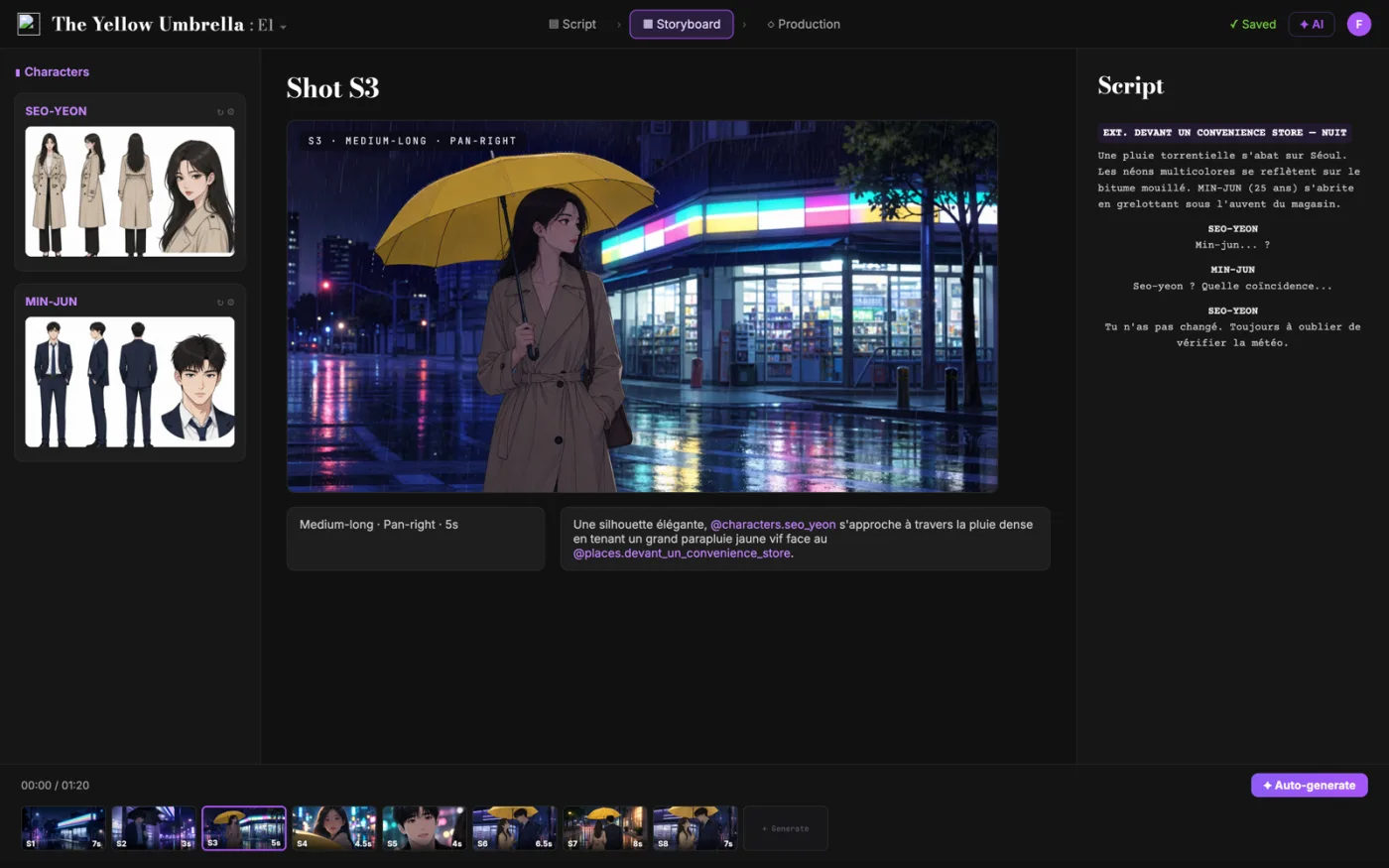
ScreenWeaver zerlegt dein Drehbuch in Einstellungen und erstellt daraus das Storyboard. Bildausschnitt, Winkel, Bewegung und Dauer bestimmst du. Figuren bleiben von Einstellung zu Einstellung gleich.
- 0 $, ohne Ablaufdatum
- Export als PDF und Final Draft
- Mac, Windows, Linux, iPad
Modellauswahl für KI-Video: der komplette Leitfaden
Es filtert einen datierten, von Hand geprüften Datensatz der großen KI-Videomodelle (Veo, Sora, Kling, Runway, Seedance, Luma, Pika, Hailuo, Wan) nach Ton, Cliplänge, Auflösung, Bild-zu-Video, vertikaler Ausgabe und Budgetstufe.
Bei dieser Arbeit liegt das Kernproblem offen: Vergleichsartikel veralten in Wochen und küren einen Sieger, obwohl das richtige Modell in Wahrheit von Einstellung zu Einstellung wechselt. Bleibt es ungelöst, erzeugt es Reibung weiter unten in der Kette und langsamere Entscheidungen. Das praktische Ziel ist eine engere Auswahl von Modellen, die die harten Anforderungen der Einstellung erfüllen, mit genannten Ausschlüssen und dem jeweiligen Grund.
Grenze, die Sie im Kopf behalten sollten: Es vergleicht veröffentlichte Spezifikationen und Preise, nicht die subjektive Qualität bei Ihrem konkreten Prompt; eine engere Auswahl verdient vor größeren Ausgaben trotzdem je eine Testgenerierung.
Fortgeschrittener Einsatz: Erfahrene Teams lassen die Auswahl einmal je Einstellungskategorie der Shotlist laufen (Dialog, Action, Insert, Social-Schnitt) und legen eine Modellzuordnung je Kategorie fest, statt eines Hausmodells für alles.
Schritt für Schritt
- Aktivieren Sie nur die Anforderungen, die die Einstellung wirklich hat; jeder Filter ist eine harte Bedingung, keine Vorliebe.
- Lesen Sie bei den Treffern die Stärkenzeile und die Preisnotiz, nicht nur die Preisspalte.
- Sehen Sie sich die Ausschlussliste an: ein Modell, das nur am Ton scheiterte, kann trotzdem gewinnen, wenn Sie den Ton in der Post machen.
- Kopieren Sie den Vergleichstext samt Datumsstempel September 2026 in Ihre Produktionsnotizen.
Anwendungsfälle nach Rolle
- KI-Filmemacher: die einzigen Modelle finden, die eine 10-Sekunden-Dialogaufnahme halten, bevor das Storyboard darauf gebaut wird.
- Content-Team: das günstigste Modell wählen, das 9:16 vertikal und 1080p schafft, für eine Social-Kampagne.
- Produktion: die Modellwahl mit datierten Spezifikationen dokumentieren, damit die Entscheidung eine Kundenrunde überlebt.
Häufige Fehler
- Ein Modell für einen ganzen Film wählen, statt Modelle den Einstellungstypen zuzuordnen.
- Eine undatierte Rangliste für aktuell halten, obwohl sich Spezifikationen monatlich verschieben.
- Nach nativem Ton filtern, obwohl die Einstellung ohnehin in der Post vertont wird.
Bewährte Praxis im Beruf
- Halten Sie eine Pipeline mit zwei Modellen: ein günstiges für Auflösung und Iteration, ein Premium für Schlüsselbilder.
- Für Dialog zuerst Modelle mit nativem Ton in die Auswahl nehmen; nachträgliche Lippensynchronität hält selten stand.
- Nutzen Sie die kostenlose selbstgehostete Stufe als Hebel: wer Wans Kostenuntergrenze kennt, entscheidet bei bezahlten Modellen schärfer.
Behandeln Sie die Ausgabe dieses Werkzeugs als Entscheidungshilfe, nicht als Ersatz für das Schreiben. Ein starkes Drehbuch bleibt wegen seiner konkreten Entscheidungen, seiner emotionalen Genauigkeit und der Klarheit seiner dramatischen Bewegung im Gedächtnis. Werkzeuge nehmen das Rauschen weg, damit Ihre Energie dorthin geht, wo sie zählt: Figur, Konflikt, Steigerung, Auszahlung. Wenn Sie nach jedem Durchgang die Ergebnisse prüfen und die angenommenen Änderungen protokollieren, wird Ihre Arbeitsweise von Fassung zu Fassung schneller und berechenbarer. Genau das schätzen professionelle Partner: weniger Überraschungen, klarere Begründungen und ein Buch, das sich mit Absicht weiterentwickelt.
Ausführliche Fragen
Welches KI-Videomodell eignet sich am besten für Dialogszenen?
Nehmen Sie zuerst die Modelle mit nativem Ton: Veo 3.1 für die Bildgüte, Sora 2 Pro für Aufnahmen bis 25 Sekunden, Kling 2.6 Pro als günstige Option mit Ton-Schalter, und Wan 2.5 beim Selbsthosten. Stumme Modelle erzwingen Lippensynchronität in der Post, die eine Großaufnahme selten übersteht.
Wie stehen Runway und Kling 2026 zueinander?
Runway Gen-4.5 bietet präzise Bewegungssteuerung und eine ausgereifte Werkzeugkette, nativ in 720p ohne Ton, für etwa 0,60 $ je 5-Sekunden-Clip. Kling 2.6 Pro liefert 1080p, starke Figurenbewegung und optional nativen Ton ab 0,35 $. Kling gewinnt meist auf dem Datenblatt, Runway im Arbeitsablauf.
Gibt es einen kostenlosen KI-Videogenerator, der fürs Filmemachen taugt?
Wan 2.5 ist die ernsthafte kostenlose Option: quelloffen, 1080p, Clips bis 10 Sekunden, nativer Ton und Bild-zu-Video. Es kostet GPU-Zeit statt Clipgebühren, passt also zu wiederholungslastigen Abläufen und Teams, die eigene Inferenz betreiben.
Welche Spezifikationen sollte ich vergleichen?
Sechs harte Werte entscheiden die meisten Einstellungen: maximale Länge einer Generierung, maximale Auflösung, Bildrate, nativer Ton, Bild-zu-Video und Preis je Clip. Alles andere (Stil, Prompttreue, Bewegungsqualität) beurteilt man an einer Testgenerierung, nicht am Datenblatt.
Welche Modelle liefern 9:16 vertikal?
Stand September 2026 erzeugen alle großen Modelle dieses Datensatzes 9:16 nativ, darunter Veo 3.1, Sora 2, Kling 2.6 und Runway Gen-4.5. Für vertikale Social-Arbeit entscheiden Preis je Clip und Auflösung, nicht die Unterstützung des Seitenverhältnisses.
Was unterscheidet Veo 3.1 und Sora 2 in der Praxis?
Veo 3.1 führt bei Bildgüte, Physik und nativem 4K, mit 8-Sekunden-Generierungen. Sora 2 setzt auf längere zusammenhängende Aufnahmen (15 Sekunden, 25 bei Pro) und sein App-Ökosystem. Für eine einzelne Schlüsseleinstellung gewinnt meist Veo, für lange durchgehende Bewegung Sora 2 Pro.
Häufige Fragen
Stand September 2026: Google Veo 3.1 (beide Stufen), OpenAI Sora 2 und Sora 2 Pro, Kling 2.6 Pro (als Option, die den Preis etwa verdoppelt) und das quelloffene Wan 2.5. Runway Gen-4.5, Luma Ray 3, Pika, Seedance und Hailuo erzeugen stummes Video.
Sora 2 Pro führt mit Einzelaufnahmen von 25 Sekunden über seinen Storyboard-Modus. Sora 2 erreicht 15 Sekunden in der App, die meisten anderen Modelle (Kling, Runway, Seedance, Luma, Pika, Hailuo, Wan) enden bei 10 Sekunden und Veo 3.1 bei 8, wobei dessen Verlängerungsfunktion eine Einstellung weit über zwei Minuten hinaus verketten kann.
Sie lösen unterschiedliche Probleme. Kling 2.6 Pro liefert starke Figurenbewegung für etwa 0,35 bis 0,70 Dollar pro Fünf-Sekunden-Clip, was zu Abläufen mit vielen Wiederholungen passt. Veo 3.1 kostet im Standardtarif rund 2,00 Dollar pro Fünf-Sekunden-Clip, führt aber bei Prompttreue, Physik und 4K. Viele entwerfen auf Kling und drehen Schlüsseleinstellungen auf Veo nach.
Weil die Ursache eine Information ist. Zu sehen, dass Runway Gen-4.5 am nativen Ton scheiterte und nicht an der Qualität, sagt Ihnen, dass es weiterhin infrage kommt, wenn Sie den Ton in der Postproduktion machen. Ausgeschlossene Modelle zu verstecken macht aus einer Datenentscheidung eine Blackbox.
Jede Angabe und jeder Preis wurde im September 2026 gegen Anbieterdokumentation und öffentliche API-Preise geprüft, und der Datensatz trägt dieses Datum sichtbar. KI-Videodaten verschieben sich monatlich, und genau deshalb ist dies ein datierter, filterbarer Datensatz statt eines statischen Rankings.
Related tools
Kostenrechner für KI-Video
Einen KI-Film pro fertiger Minute budgetieren, Wiederholungen eingerechnet.
Szenen-zu-Clip-Planer
Eine Szene in KI-Videoclips zerlegen, die zur Längenbegrenzung Ihres Modells passen.
KI-Video-Prompt-Generator
Filmische Prompts für Veo, Sora, Runway und Kling bauen.
Prompts für Kamerabewegungen
Animierte Sammlung der Kamerabewegungen, mit Prompts zum Kopieren.
You can also browse the full library on /tools.
Core blog guides
- Idea → first draft (process hub)
- Screenplay format guide 2026
- Hidden costs of “free” software
- Affordable software & TCO
- Revision passes (structure → dialogue)
Filmtechniken
Filmtechniken zum Entdecken
Jede mit einem kurzen Clip, einem Drehbuchauszug und der Zeile für die Shotlist.