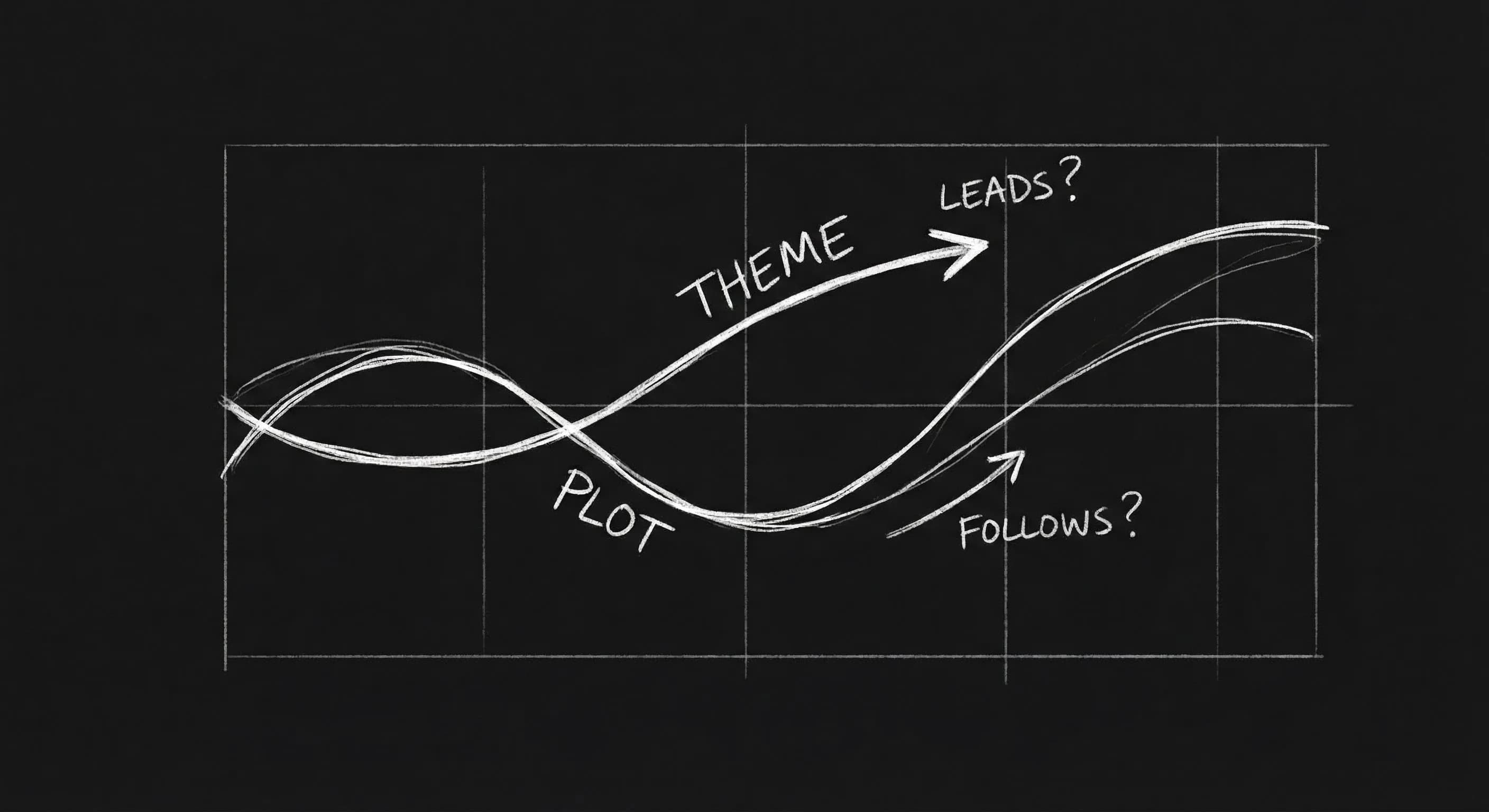

You have an idea. Is it a situation (plot) or a question (theme)? Theme is what the story is about,the idea, the argument, the feeling. Plot is what happens,the events, the choices, the mechanics. They’re not the same. And writers disagree about which to build first. Some start with theme: “I want to write about the cost of loyalty.” Then they find a plot that explores it. Some start with plot: “A detective has 24 hours to solve the case.” Then they find the theme in the telling. There’s no single right answer. But there is a useful question: what do you have first? And how do you use it to find the other? When you know that, you’re less likely to end up with a plot that goes nowhere or a theme that never becomes a story.
Plot is what happens. Theme is what it means. You need both. The order you find them in is up to you.
Think about it. If you start with theme,“I want to explore whether people can change”,you still need a plot. A situation. Characters. Events. The theme doesn’t write the script. It gives you a compass. You ask: what story would put that question on screen? Maybe a character who’s done something terrible and is trying to make amends. Maybe a character who doesn’t believe in change and is proved wrong. The plot is the vehicle. The theme is the destination. If you start with plot,“A woman discovers her husband is a serial killer”,you still need a theme. What is this story about? Betrayal? Complicity? The face we show vs. the face we hide? The plot is the vehicle. The theme is what the audience takes home. So the debate isn’t “theme or plot.” It’s “which do I have first, and how do I build the other from it?” Our guide on the B-plot and thematic resonance is relevant: once you have a theme, the B-plot can echo it. And our guide on circular narratives shows how theme can shape the ending,the return to the opening image. So theme and plot aren’t enemies. They’re partners. The question is how you get to both.
Starting With Theme
When you start with theme, you have an idea or a question. “What does it cost to tell the truth?” “Can you love someone and still betray them?” “Is redemption possible?” You don’t have the story yet. You have the territory. So you go looking for a plot that puts that question in play. You ask: what situation would force a character to face this? What choice would embody this? What world would make this question urgent? The risk of starting with theme is that you end up with an essay,characters who represent ideas, plot that feels like illustration. The fix is to let the plot have its own logic. The theme is the compass. The plot is the journey. The journey has to be specific. It has to have events that could happen in more than one way. The theme emerges from the choices the character makes, not from the writer announcing it. So when you start with theme, you’re not writing a sermon. You’re writing a story that tests the theme. The character might prove it. They might disprove it. They might complicate it. The plot is the test. Make the test hard. Make the outcome uncertain. Then the theme will land.
Starting With Plot
When you start with plot, you have a situation. “A heist goes wrong.” “A couple is trapped in a cabin.” “A lawyer discovers their client is guilty.” You have events. You might not yet have the theme. So you ask: what is this story really about? What question does this situation raise? The heist might be about trust. The cabin might be about the past catching up. The lawyer might be about complicity. You find the theme by asking what the plot means. The risk of starting with plot is that you end up with a sequence of events that don’t add up to anything. The fix is to identify the theme and then make sure the plot serves it. Cut the events that don’t. Add the beats that deepen the question. The plot is the vehicle. The theme is what the audience takes home. So when you start with plot, you’re not just moving pieces. You’re making the pieces mean something. Find the meaning. Then sharpen the plot so the meaning lands. Our guide on character arcs fits here: the character’s change often embodies the theme. So when you have a plot, ask how the character changes,and that change will point you to the theme. Then you can reinforce it in structure, B-plot, and ending.
A Practical Comparison
| Start with theme | Start with plot |
|---|---|
| You have a question or idea | You have a situation or premise |
| You look for a plot that tests it | You look for the meaning in the plot |
| Risk: preachy or abstract | Risk: empty or mechanical |
| Fix: give the plot its own logic, make the test hard | Fix: name the theme, cut what doesn’t serve it |
Both paths can work. The key is to end up with both. A plot that moves and a theme that lands. If you have only plot, the script might feel hollow. If you have only theme, the script might feel like a lecture. So no matter where you start, you have to find the other. Theme-first writers need to build a plot that’s specific and surprising. Plot-first writers need to find the theme and make the plot serve it. The debate is about process. The goal is the same: a story that happens and means something.
Relatable Scenario: The Writer With a Message
You want to write about injustice. You have the theme. You don’t have the story. So you ask: what situation would put injustice on screen in a way that’s specific? Maybe a character who benefits from the system and has to choose whether to speak up. Maybe a character who is harmed and has to choose how to respond. You build a plot around that. The plot has to have events,choices, consequences, turns. It can’t just be “injustice is bad.” It has to be “this person, this choice, this cost.” The theme is the compass. The plot is the map. You draw the map so the compass points somewhere. When you’re done, the audience should feel the theme without you stating it. They should feel it because they lived the plot.
Try it free
Try Screenweaver for free on your script
It is free. Import your existing project, get a clearer view of your outline, and regain control of your story structure in minutes.
Start FreeRelatable Scenario: The Writer With a Cool Premise
You have a premise: “A man wakes up with no memory and has to find out who he is.” Cool. But what is it about? Identity? The past we can’t escape? The self as story? You look at the premise and ask what question it raises. Maybe: “Are we our memories?” Then you shape the plot so that question is tested. The character’s choices, the reveals, the ending,all of them should engage the theme. If the plot is just a puzzle (find the memory, find the villain), it might be clever but empty. If the plot is a way to ask “who are we without our past?” then the premise has a theme. The plot serves it. The audience takes something home. That’s the plot-first path: you have the engine. You find the soul.
The Trench Warfare Section: What Beginners Get Wrong
Theme as message. You know what you want to say. So the characters say it. The plot illustrates it. The audience feels lectured. Fix: Let the theme be tested, not stated. The character might be wrong. The situation might complicate the theme. The ending might be ambiguous. Theme is a question, not a billboard. Let the plot ask the question. Don’t have the characters answer it in dialogue.
Plot with no theme. Things happen. The script has events. But when it’s over, the audience doesn’t know what it was about. Fix: Ask what the story is about. What question does this situation raise? Name it. Then look at your plot. What can you cut that doesn’t serve that? What can you add that deepens it? The theme doesn’t have to be heavy. It has to be there. Even “survival” or “family” is a theme. Find it. Serve it.
Starting with theme and never finding a plot. You have a beautiful idea. You can’t turn it into a story. Fix: Theme is not a story. You need a character, a situation, a choice. Ask: what would put this theme under pressure? What would make it hard for the character? Build a plot from that. One situation. One character. One choice. The theme will run through it. But the plot has to exist. Events. Scenes. Stakes.
Starting with plot and never finding the theme. You have a cool premise. You write the script. It feels empty. Fix: After the first draft (or in outline), ask: what is this about? What do I want the audience to feel or think? Name it. Then revise so the plot serves that. Cut the scenes that don’t. Add the beats that do. The plot is the body. The theme is the heart. You need both.
Thinking you have to choose. “Do I develop theme or plot?” You don’t choose one. You develop both. You might start with one. But you end with both. Fix: Use whichever you have first to find the other. Theme leads to plot (what story tests this?). Plot leads to theme (what does this story mean?). Keep going until both are strong. That’s the goal.
Step-by-Step: Finding Theme From Plot (or Plot From Theme)
If you have theme: Write the theme in one sentence. “This story is about the cost of loyalty.” Now ask: what situation would put that to the test? What character would be forced to choose? What would they stand to lose? Build a plot from that. One character, one situation, one choice. Make the choice hard. Make the outcome uncertain. Then write. The plot should feel specific. The theme should emerge without being stated. If you have plot: Write the plot in one sentence. “A detective has to solve the case before the killer strikes again.” Now ask: what is this story really about? Truth? Obsession? The past? Name the theme. Then look at your outline or draft. Does every major beat serve that theme? Cut what doesn’t. Add what does. When you’re done, the audience should know what the story was about,not because you said it, but because they felt it. Our guide on elemental structure can help when the theme is more mood or force than message; the same principle holds. The story has to mean something. Plot is how it happens. Theme is what it means. Get both. The order is up to you.
The Perspective
Theme and plot aren’t rivals. They’re partners. You might find the theme first and go looking for a plot. You might find the plot first and go looking for the theme. Either way, you need both. A plot that moves and a theme that lands. So don’t get stuck in the debate. Get stuck in the work. What do you have? Use it to find what you don’t have. When both are strong, the script is done. That’s the only rule that matters.
Final Step
Build your next script with Screenweaver
Move from ideas to production-ready pages faster with timeline-native writing and AI-assisted story flow.
Try Screenweaver