Short Drama Episode Planner
A vertical drama season, episode by episode, cliffhanger by cliffhanger
Enter how many episodes your vertical drama has and how long each one runs. This short drama episode planner lays out the season as five movements, gives every episode a cliffhanger shape and a timestamp skeleton, pins the paywall episode, the midpoint and the all-is-lost episode, and writes a Fountain skeleton for episode 1 you can paste into any screenwriting app.
Micro dramas on ReelShort, DramaBox and their peers run 60 to 100 episodes of one to three minutes. Every episode opens on a hook in the first five seconds, turns once, and ends on a cliffhanger, and the episode before the paywall has to carry the strongest one. Writers who plan a season like a feature run out of reversals by episode 20; the planner spreads them across the whole run.
Everything runs in your browser. Titles and names you type never leave it and nothing is stored.
Apps unlock the first episodes free and gate the rest. Turn off for TikTok, Shorts or Reels.
Used only in the Fountain skeleton for episode 1.
Season plan
Five movements
- HookE1 to E3
Conflict in the first image, the premise fully legible by the end of episode 1, the lead committed by the end of this block.
- Setup to paywallE4 to E10
Every episode raises the price of the premise. The last episode of this block ends on the biggest reveal of the first act.
- EscalationE11 to E35
The secret gets harder to keep, the rival gets closer, the stakes go public. Ends on the midpoint reversal.
- CollapseE36 to E56
Everything the lead built comes apart. The block ends on the all-is-lost episode, where the clock runs out.
- PayoffE57 to E70
The confrontation, the reveal the audience waited for, and a final button that opens season 2.
Episode grid
Every episode: hook at 0:00, turn by 0:54, cliffhanger from 1:25. Highlighted rows are pinned milestones.
| Ep | Movement | Cliffhanger shape | Milestone |
|---|---|---|---|
| E1 | Hook | Revelation · someone learns what they cannot unlearn | Cold open: conflict in the first image, inciting incident inside episode 1 |
| E2 | Hook | Reversal · the power or the relationship flips | The lead chooses. No more reacting |
| E3 | Hook | Deadline · a clock starts or runs out | |
| E4 | Setup to paywall | Intrusion · someone or something arrives | |
| E5 | Setup to paywall | Revelation · someone learns what they cannot unlearn | |
| E6 | Setup to paywall | Reversal · the power or the relationship flips | |
| E7 | Setup to paywall | Deadline · a clock starts or runs out | |
| E8 | Setup to paywall | Intrusion · someone or something arrives | |
| E9 | Setup to paywall | Revelation · someone learns what they cannot unlearn | |
| E10 | Setup to paywall | Revelation · someone learns what they cannot unlearn | Paywall cliffhanger: strongest reveal of act one |
| E11 | Escalation | Deadline · a clock starts or runs out | |
| E12 | Escalation | Intrusion · someone or something arrives | |
| E13 | Escalation | Revelation · someone learns what they cannot unlearn | |
| E14 | Escalation | Reversal · the power or the relationship flips | |
| E15 | Escalation | Deadline · a clock starts or runs out | |
| E16 | Escalation | Intrusion · someone or something arrives | |
| E17 | Escalation | Revelation · someone learns what they cannot unlearn | |
| E18 | Escalation | Reversal · the power or the relationship flips | |
| E19 | Escalation | Deadline · a clock starts or runs out | |
| E20 | Escalation | Intrusion · someone or something arrives | |
| E21 | Escalation | Revelation · someone learns what they cannot unlearn | |
| E22 | Escalation | Reversal · the power or the relationship flips | |
| E23 | Escalation | Deadline · a clock starts or runs out | |
| E24 | Escalation | Intrusion · someone or something arrives | |
| E25 | Escalation | Revelation · someone learns what they cannot unlearn | |
| E26 | Escalation | Reversal · the power or the relationship flips | |
| E27 | Escalation | Deadline · a clock starts or runs out | |
| E28 | Escalation | Intrusion · someone or something arrives | |
| E29 | Escalation | Revelation · someone learns what they cannot unlearn | |
| E30 | Escalation | Reversal · the power or the relationship flips | |
| E31 | Escalation | Deadline · a clock starts or runs out | |
| E32 | Escalation | Intrusion · someone or something arrives | |
| E33 | Escalation | Revelation · someone learns what they cannot unlearn | |
| E34 | Escalation | Reversal · the power or the relationship flips | |
| E35 | Escalation | Reversal · the power or the relationship flips | Midpoint reversal: the secret goes public or the power flips |
| E36 | Collapse | Intrusion · someone or something arrives | |
| E37 | Collapse | Revelation · someone learns what they cannot unlearn | |
| E38 | Collapse | Reversal · the power or the relationship flips | |
| E39 | Collapse | Deadline · a clock starts or runs out | |
| E40 | Collapse | Intrusion · someone or something arrives | |
| E41 | Collapse | Revelation · someone learns what they cannot unlearn | |
| E42 | Collapse | Reversal · the power or the relationship flips | |
| E43 | Collapse | Deadline · a clock starts or runs out | |
| E44 | Collapse | Intrusion · someone or something arrives | |
| E45 | Collapse | Revelation · someone learns what they cannot unlearn | |
| E46 | Collapse | Reversal · the power or the relationship flips | |
| E47 | Collapse | Deadline · a clock starts or runs out | |
| E48 | Collapse | Intrusion · someone or something arrives | |
| E49 | Collapse | Revelation · someone learns what they cannot unlearn | |
| E50 | Collapse | Reversal · the power or the relationship flips | |
| E51 | Collapse | Deadline · a clock starts or runs out | |
| E52 | Collapse | Intrusion · someone or something arrives | |
| E53 | Collapse | Revelation · someone learns what they cannot unlearn | |
| E54 | Collapse | Reversal · the power or the relationship flips | |
| E55 | Collapse | Deadline · a clock starts or runs out | |
| E56 | Collapse | Deadline · a clock starts or runs out | All is lost: the deadline hits |
| E57 | Payoff | Revelation · someone learns what they cannot unlearn | |
| E58 | Payoff | Reversal · the power or the relationship flips | |
| E59 | Payoff | Deadline · a clock starts or runs out | |
| E60 | Payoff | Intrusion · someone or something arrives | |
| E61 | Payoff | Revelation · someone learns what they cannot unlearn | |
| E62 | Payoff | Reversal · the power or the relationship flips | |
| E63 | Payoff | Deadline · a clock starts or runs out | |
| E64 | Payoff | Intrusion · someone or something arrives | |
| E65 | Payoff | Revelation · someone learns what they cannot unlearn | |
| E66 | Payoff | Reversal · the power or the relationship flips | |
| E67 | Payoff | Deadline · a clock starts or runs out | |
| E68 | Payoff | Intrusion · someone or something arrives | |
| E69 | Payoff | Intrusion · someone or something arrives | Final confrontation |
| E70 | Payoff | Revelation · someone learns what they cannot unlearn | Payoff, then the button for season 2 |
Episode 1 skeleton (Fountain)
Paste into ScreenWeaver, Final Draft or any Fountain-aware app. The bracketed notes are the timing rules; replace them with scenes.
Title: UNTITLED VERTICAL
Credit: Written by
Author: Your Name
Notes: Vertical drama, 9:16. Episode 1 of 70. Target 90 seconds.

EPISODE 1

INT. LOCATION - NIGHT

[[0:00 HOOK. First image is the conflict: HERO caught in the act, or RIVAL arriving. No establishing shot.]]

HERO
(the line that starts the fight)

RIVAL
(the line that raises the price)

[[0:54 TURN. The one change this episode exists for. A choice, not a reaction.]]

INT. SAME - CONTINUOUS

[[1:25 CLIFFHANGER. Revelation: someone learns something they cannot unlearn. Cut before the reaction.]]

EPISODE 2

[[0:00 HOOK. Open on the reaction the last episode withheld.]]
How the planner builds the season
The season is split into five movements: a three episode hook block, a setup block that ends on the paywall episode (or at fifteen percent of the run when there is no paywall), an escalation block to the midpoint, a collapse block to eighty percent, and the payoff. Each episode gets one of four cliffhanger shapes in rotation, so no two consecutive episodes end the same way, and the milestone episodes are pinned to the shape that suits them: the paywall and finale end on a revelation, the midpoint on a reversal, the all-is-lost episode on a deadline. Inside every episode the turn is placed at sixty percent of the runtime and the cliffhanger in the last five seconds. Page math uses one page per sixty seconds of vertical screen time.
Why a vertical drama needs a season grid, not a three act outline
A feature has three or four reversals. A 70 episode micro drama needs 70, one per episode, plus a handful that are bigger than the rest. Three act structure gives you the big ones and nothing for the 60 episodes in between, which is why so many vertical scripts sag after the paywall: the writer spent the reveals early.
The grid solves that by making the cliffhanger a property of the episode slot, not of the story. Episode 23 ends on a deadline whether or not you have thought of one yet, and knowing that in advance is what makes 70 reversals writable. The milestones give the season its spine: the paywall reveal, the midpoint flip, the all-is-lost deadline and the finale are the four episodes a platform reads first.
The same grid works for an AI-produced season. Each episode's hook, turn and cliffhanger timestamps become the three frames the storyboard cannot skip, and the Fountain skeleton opens in ScreenWeaver as a script with one episode per outline node.
For the craft behind the grid, read short drama episode structure and the four cliffhanger shapes it rotates.
Who uses the short drama episode planner
- Vertical drama writers. Size a 60 to 100 episode pitch and know which episodes a platform will read first.
- AI micro drama creators. Plan a paywall-free social season and feed each episode's three timestamps into the storyboard.
- Small studios. Compare season shapes for runtime, page count and reversal load before committing a budget.
Short Drama Episode Planner: la guía completa
It converts episode count, episode length and paywall position into five movements with episode ranges, a per-episode cliffhanger rotation (revelation, reversal, deadline, intrusion), the runtime and page math at one page per sixty seconds, and a Fountain skeleton for episode 1 with hook, turn and cliffhanger timestamps.
En este trabajo el problema central está claro: a vertical drama season is 40 to 100 episodes that each need a hook, one turn and a cliffhanger, and writers who plan it like a feature or a pilot run out of reversals by episode 20. Si no se resuelve, genera fricción más adelante y decisiones más lentas. El objetivo concreto es a season grid where every episode has a movement, a cliffhanger shape and a timestamp skeleton, with the paywall episode, midpoint and all-is-lost pinned before a line of dialogue is written.
Límite que conviene tener presente: The grid is a planning scaffold, not a story: it tells you where a reversal must land and what shape the cliffhanger should take, and you still have to invent the reversal. Page math assumes dialogue-led vertical pages at roughly sixty seconds each; action-heavy episodes run shorter on the page.
Uso avanzado: Advanced writers export the grid, paste it as the outline of a ScreenWeaver project with one episode per outline node, then write each episode against its pinned cliffhanger shape and check the running total against the season runtime after every ten episodes.
El método paso a paso
- Enter the episode count and pick the episode length; 70 episodes at 90 seconds is the common app pitch, 40 at 60 seconds a realistic social season.
- Keep the paywall on for app distribution and set the free episode count the platform uses (around 8 to 12); turn it off for TikTok, Shorts or Reels.
- Read the five movements and the pinned milestones (paywall, midpoint, all is lost, confrontation, finale), and write one sentence of story for each before touching the grid.
- Copy the grid into your outline, copy the Fountain skeleton into a new script, and write episode 1 against its 0:00 hook, turn and last-five-seconds cliffhanger.
Casos de uso por perfil
- Vertical writer: size a 70 episode pitch for an app and know which episode carries the paywall cliffhanger before writing the sample episodes.
- AI micro drama creator: plan a 40 episode social season with no paywall, then feed each episode's hook, turn and cliffhanger into the storyboard.
- Small studio: compare a 60 x 90 second season against 80 x 60 seconds for runtime, page count and how many reversals each demands.
Errores frecuentes que evitar
- Ending consecutive episodes on the same cliffhanger shape, which is why the tool rotates four shapes and pins the milestones.
- Putting the season's biggest reveal after the paywall episode instead of on it, so free viewers never have a reason to pay.
- Planning the season as three acts, which leaves 30 episodes of middle with nothing pinned; five movements with a hard midpoint fix that.
Buenas prácticas del oficio
- Write the paywall episode and the finale first; if those two cliffhangers are not the strongest in the season, the plan is wrong.
- Use the turn timestamp as a hard rule in the room: if nothing changes by that second, the episode is a scene, not an episode.
- Keep episode 1 under the target length by ten seconds; the hook has to survive an autoplay preview with no sound.
Trata lo que sale de esta herramienta como apoyo a la decisión, no como sustituto de la escritura. Un buen guion se recuerda por sus decisiones concretas, su precisión emocional y la claridad de su movimiento dramático. Las herramientas sirven para quitar ruido, de modo que tu energía vaya donde importa: personaje, conflicto, escalada y pago. Si revisas los resultados después de cada pasada y llevas un registro de los cambios que aceptas, tu método se vuelve más rápido y más previsible de una versión a otra. Eso es justo lo que valoran los colaboradores profesionales: menos sorpresas, razones más claras y un guion que evoluciona con intención.
Preguntas ampliadas
How many episodes should a short drama season have?
App platforms commission 60 to 100 episodes of one to three minutes; the planner defaults to 70 episodes at 90 seconds, which is about 105 minutes of finished runtime. Social seasons published on TikTok, Shorts or Reels work at 20 to 40 episodes because there is no paywall to feed.
Where should the paywall episode go in a vertical drama?
Most apps unlock the first 8 to 12 episodes free and gate the rest. The episode right before the gate must end on the strongest cliffhanger of the first act, usually a revelation the viewer has to pay to see answered. The planner pins that episode and ends the setup movement on it.
How long is a short drama script page?
Vertical scripts are dialogue-led and shot in close-up, so a page runs close to sixty seconds on screen rather than the feature film minute with wide action. A 90 second episode is about a page and a half; a 70 episode season is around 105 pages.
What are the four cliffhanger types the planner rotates?
Revelation (someone learns something they cannot unlearn), reversal (the power or the relationship flips), deadline (a clock starts or runs out) and intrusion (someone or something arrives). Rotating them stops the season from ending every episode on the same beat, and milestone episodes are pinned to the shape that fits them.
Can I use the plan for an AI-generated micro drama?
Yes. The per-episode hook, turn and cliffhanger timestamps map directly onto a storyboard, and the Fountain skeleton opens in ScreenWeaver, where each episode becomes an outline node and the storyboard is generated per shot in 9:16.
Short drama episode planner FAQ
A tool that turns an episode count and episode length into a season plan for a vertical micro drama: five movements with episode ranges, a cliffhanger shape for every episode, pinned milestone episodes (paywall, midpoint, all is lost, finale), runtime and page math, and a Fountain skeleton for episode 1.
Sixty to one hundred episodes of one to three minutes is the range those platforms commission. Seventy episodes at ninety seconds is a common pitch shape and comes to about 105 minutes of finished runtime.
The last free episode, which on most apps is between episode 8 and episode 12. It must end on the strongest reveal of the first act, because that is the moment the viewer decides whether to pay. The planner ends the setup movement on it and pins a revelation-type cliffhanger there.
No. It tells you where each reversal must land and what shape the cliffhanger should take, then you invent the reversal. The Fountain skeleton for episode 1 carries the timing rules as bracketed notes for you to replace with scenes.
Yes. ScreenWeaver has an Episode level in its outline, a 9:16 project setting for vertical, and a storyboard that generates frames per shot. Copy the skeleton, paste it as a new script, and the episodes become outline nodes you can storyboard one by one.
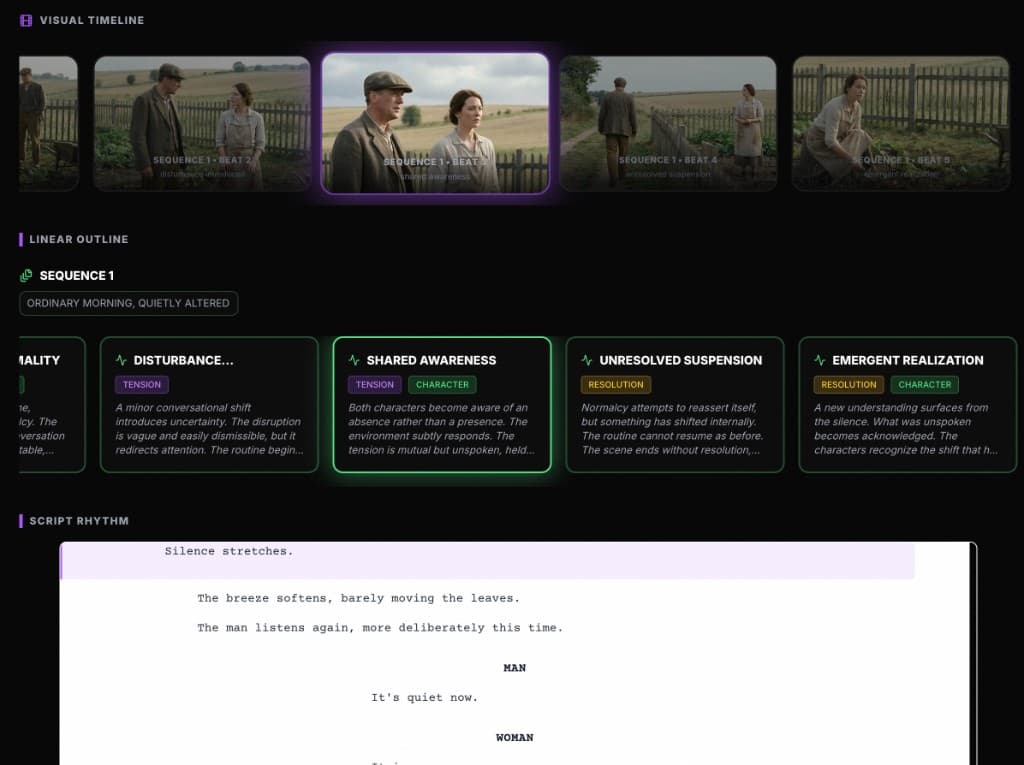
Write the whole season in one workspace
Outline by episode, write in screenplay format, generate 9:16 storyboards per shot and plan production, without leaving the script.
Start free